While the evidence points to SYP undertaking such a coordinated effort, there is an essential point to recognise: it was legally entitled to do so and to present its ‘best case’ to the Taylor Inquiry. There was no legal duty for the force, or individual officers, to obtain or put forward to the Taylor Inquiry any information which might present a different version of events to their preferred narrative. As long as officers did not put forward evidence that was false, misleading or inaccurate, they were not breaching the professional standards of the time.
In the aftermath of the disaster, SYP was, rightly, under intense scrutiny. Its reputation was under threat, damaging public confidence in the force. It faced the prospect of officers being prosecuted and the force having to pay large sums in compensation to those affected. As a publicly funded body, the force had a right to defend itself and to seek to fairly apportion blame, if it believed other individuals and organisations were to some degree responsible.
This appears particularly applicable to SYP’s persistent argument that officers were not responsible for safety on the terraces, and that this was the role of SWFC stewards, as the Green Guide would indicate.
In such circumstances, a police force is—like any other party—allowed to defend itself against allegations and put forward its best case. However, this did not give SYP total freedom to consistently and intentionally:
present unbalanced and unsubstantiated evidence, placing a disproportionate emphasis on supporter behaviour even where it could not prove certain allegations (for example, that large numbers of supporters attended without tickets and/or arrived late, deliberately)
alter the underlying evidence of officers before it was submitted, by amending accounts to fit the narrative it wished to present
minimise the evidence that was given in relation to previous police actions to close the tunnel and monitor capacity in the pens, and in relation to the extent to which the police had previously managed the arrival of supporters at the Leppings Lane end
While such actions may have been legally permissible in relation to the Taylor Inquiry, where there was no duty of candour, they were very clearly not in keeping with the Inquiry’s aim to gain a full understanding of the disaster and prevent such an incident from happening again.
There has been speculation that one reason SYP adopted this unusual approach to collecting evidence was because of its experiences in the aftermath of events at Orgreave coking plant, during the 1984/85 miners’ strike.
On 18 June 1984, Orgreave was the scene of violent confrontations between police officers and striking miners. The plant was in the SYP area, near Sheffield, so a substantial proportion of these officers were from SYP; however, officers were also drawn from other forces around the country. Following the events, 55 protesters were charged with riot. All charges were eventually withdrawn, amid questions over the validity of some of the arresting officers’ statements. It transpired that, among other issues with the statements, when officers from other forces were making statements, SYP officers gave them a standard introduction to use, which set out key locations that the visiting officers would not have known.
Between 2012 and 2015, the IPCC received two voluntary referrals from SYP in relation to allegations of police misconduct relating to Orgreave. In 2015, having reviewed the available information, the IPCC announced its decision not to investigate these allegations nor to reopen complaints about police conduct relating to Orgreave.
After this decision was announced, the IOPC Hillsborough investigation team requested access to the material that had been considered in making it. This was because of the possibility that there could be parallels between SYP’s approach to evidence gathering in both cases.
The Hillsborough investigation team appointed independent counsel to conduct a comprehensive review of the Orgreave material, to assess its relevance to the Hillsborough investigation. The review found there was no material related to Orgreave that was relevant to the Hillsborough criminal investigations or the complaint and conduct investigations being undertaken by the IOPC and Operation Resolve.
While the examples listed here appear to demonstrate a wide-ranging and consistent attempt to deflect the blame away from the police, not all of SYP’s actions in the aftermath of the disaster—or those of its officers—form part of this pattern.
For example, chapters 12 and 13 of this report summarise the IOPC’s investigation into the allegations that blood alcohol testing and PNC checks were carried out on those who died to besmirch their reputations: the IOPC has not found evidence that this was the intent. Nor is there evidence that SYP was behind, or even involved in, the disappearance of two video tapes from the SWFC control room.
There is no doubt that Ch Supt Duckenfield’s lie that the disaster was caused when supporters broke through a gate has had a lasting impact. Similarly, the media coverage after the disaster that focused on the behaviour of supporters led to an enduring public perception that they had somehow been to blame, even though the Taylor Interim Report wholly rejected that view. The HIP Report again called this perception into question and the Goldring Inquests reaffirmed that the actions of supporters in no way caused or contributed to the disaster.
Yet despite the immense damage and hurt that the lie and the media coverage caused, it is not clear that either was the result of a coordinated corporate attempt to deflect blame from the police. The lie was told so quickly, there was no chance for SYP to organise it, and CC Wright corrected it on the night of the disaster. Aside from CC Wright, the central figures quoted in the media reporting did not act or speak on behalf of SYP. The IOPC has not found evidence to indicate that the ensuing coverage was a result of any organised effort by SYP or its legal team.
Though large numbers of SYP officers have provided accounts or statements, and given oral evidence, in which they have highlighted the behaviour of supporters, it is not clear that these accounts were made purely or primarily in an attempt to deflect or minimise blame. Many were responding to a request to provide recollections of what they did and saw, “including crowd behaviour” and to comment on issues such as the mood of the supporters and their own “fears, feelings and observations.”
While the result is that officers described personal experiences that, when viewed collectively, may have supported an attempt to deflect the blame, the IOPC has not found evidence that they wrote their accounts to fit an ‘agreed’ storyline, on the instruction or under direction from senior officers.
Officers made these accounts in an unusual format (see paragraph 9.80). This offered SYP an opportunity to control and amend the evidence its officers gave. However, it cannot be determined that this was SYP’s intention from the outset. Some senior officers have provided plausible alternative explanations for the approach. Further, the evidence indicates there was no forcewide instruction to officers that they should not write pocket notebook entries as normal. Therefore, the IOPC does not view the fact that accounts were made in an unusual format, or the fact that some officers have stated they were not to use their pocket notebooks, as part of the coordinated attempt to deflect blame.
Despite these findings, SYP continued to advance a similar case in the period from the publication of the Taylor Interim Report up to the end of the Popper Inquests.
SYP arranged two events where MPs were shown a video about the disaster, compiled by Ch Insp Bettison and colleagues. At the first of these, attended by a single MP, individual officers were encouraged to share their experiences and recollections, so that the MP present could later “speak up” for the police (see paragraphs 8.21–8.32). Most of the officers at this first meeting then gave graphic accounts of supporters being under the influence of alcohol; in several cases, these included details that had not been in their original written accounts. The second meeting involved Ch Insp Bettison presenting the same video to an audience of MPs at Parliament; the MPs who recall it have all agreed it was an unpersuasive attempt to position SYP’s side of the story.
On the advice of legal representatives, the SYP action team invited some officers to “review” aspects of the evidence that they had given to the Taylor Inquiry, which contradicted or undermined SYP’s preferred account of events. In particular, this request focused on evidence given about police responsibility for monitoring the pens and past actions to close the tunnel (see paragraphs 11.37–11.42).
In preparation for the Popper Inquests, SYP sought to identify witnesses whose accounts discussed supporters’ alcohol consumption, so that it could ask, via its legal team, for them to be called to give evidence (see paragraphs 11.55–11.62).
On legal advice from Mr Metcalf, SYP adopted a “strategy” for the Popper Inquests which sought “to bring out the issue of drink-related hooliganism” (see paragraph 11.63).
Senior officers also repeatedly made clear to their legal team that at the contribution hearings they wished to challenge the Taylor Inquiry finding that SYP had accepted “de facto” responsibility for monitoring the safety of supporters in the pens. While this was consistent with the case they had sought to put to the Taylor Inquiry, doing so was against the advice of SYP’s appointed barrister (see paragraphs 11.17–11.23 and 11.45–11.46). This therefore undermines the argument, made by several of these senior officers at different times, that they were simply following legal advice.
Further, in interactions with the media right up to his retirement, CC Wright continued to indicate that he believed alcohol was a factor in the disaster and that more evidence would still emerge.
The IOPC investigation has not identified any single act, or found a document, that unequivocally demonstrates a clear intention to this effect. However, it has found evidence of patterns of behaviour by senior officers within SYP, over a substantial period of time, which together indicate a deliberate and sustained attempt to deflect or minimise blame.
Broadly, this evidence relates to the way that a group of senior officers within SYP, with the assistance of the legal team appointed by the force’s insurers (rather than the force’s in-house solicitors), sought to show that the disaster was not caused by failings on the part of SYP corporately, or on the part of individual officers. Instead, they advanced a case that the disaster was a result of unprecedented and unforeseeable events—meaning that SYP could not be blamed for failing to foresee, or prepare for, what happened.
The following examples of this can be identified from the initial period up to the publication of the Taylor Interim Report.
The core team of officers and legal representatives took steps to control the content of the accounts that were submitted to WMP and the Taylor Inquiry, in many cases leading to substantive amendments being made to officers’ accounts, as detailed in paragraphs 9.129–9.147. Notable amendments included removal of many comments that criticised the inaction of senior officers and of all comments related to previous actions to close the tunnel to the centre pens. When WMP alerted CC Wright to concerns raised by junior SYP officers about this review and amendment process, CC Wright did not seek to stop it (see paragraphs 9.125–9.128).
SYP actively sought evidence that purported to demonstrate supporters’ alcohol consumption, including through videos and photos that showed litter which potentially could have been left by supporters (see paragraphs 9.11–9.27), and by asking officers to include in their accounts comment on the mood of supporters (see paragraphs 9.85–9.88).
Senior officers, including the match commanders, were invited to meet and agree suitable answers to potential criticisms of them, and of the police operation in general, before they gave evidence to the Taylor Inquiry (see paragraphs 10.94–10.104). In some cases, the answers they then gave could not have been based on their personal experience.
In SYP’s written submissions and the oral evidence of officers, it was repeatedly asserted that there was very little difference between the police operation at the 1989 FA Cup Semi-Final and the police operation at the 1988 Semi-Final (see paragraphs 3.9–3.10), and evidence to the contrary was minimised (see paragraph 10.39).
SYP maintained that previous police actions to close the tunnel to the centre pens were solely the result of junior officers acting on their own initiative and that SYP was not responsible for monitoring capacity on the Leppings Lane terraces. In line with the way that all references to past actions to close the tunnel were removed from SYP officers’ initial accounts (see paragraphs 9.145–9.146), several senior officers who had been on duty argued in their evidence to the Taylor Inquiry that SWFC stewards were responsible for monitoring capacity and safety in the pens. However, their accounts contradicted the evidence other SYP officers had given in the 1985 court case of Harris v Sheffield Utd (see paragraphs 9.151–9.153), as well as comments some of the same officers had made in meetings following the disaster (see paragraphs 9.148–9.150).
The IOPC has identified a range of evidence that appears to undermine the denials made by Ch Supt Duckenfield, Ch Supt Mole, Supt Greenwood, Supt Marshall and Supt Murray at the Taylor Inquiry and Popper Inquests of their prior knowledge of police tactics such as tunnel closure (see paragraphs 10.70–10.82).
These denials mirrored the approach taken in SYP’s written submissions to the Taylor Inquiry, where evidence that may have indicated police responsibility for monitoring the capacity of the pens and controlling access to them, via closing the tunnel, was removed from the final versions, despite having been in earlier drafts.
Further, SYP actively sought to gather and submit additional written evidence to the Taylor Inquiry to refute oral evidence, given by non-police witnesses, that SYP was responsible for monitoring the pens (see paragraphs 10.106–10.109).
As a whole, these actions meant that SYP’s evidence to the Taylor Inquiry painted a largely consistent picture of its officers being overcome by unforeseeable circumstances, including unprecedented levels of drunkenness among the supporters. Lord Justice Taylor summarised this evidence in his interim report as follows: “the police case was to blame the fans for being late and drunk, and to blame the Club for failing to monitor the pens.”
Given the considerable differences between this narrative and the evidence of other parties—notably the evidence provided by supporters—Lord Justice Taylor described the SYP case as an “unrealistic approach” and concluded that the main cause of the disaster was a failure of police control.
Whether there is evidence to suggest that there may have been a general attempt by officers within SYP and/or WMP to deflect or minimise blame for the disaster from the police service, including by focusing on the behaviour or alleged behaviour of supporters.
What was found
• SYP did attempt to deflect blame for the disaster away from the police. Senior officers, working with the legal team, sought to advance a case that the disaster was caused by unprecedented and unforeseeable events, including the failings and actions of others, rather than as a result of any failings on the part of SYP corporately or of individual officers.
• The IOPC has reached this view based on the consistent patterns in SYP’s actions following the disaster and in response to the various investigations into it—such as presenting a case that SYP had never been responsible for monitoring safety in the pens and then removing any references to that from officers’ accounts.
• SYP consistently tried to find and/or promote evidence of drunken behaviour by supporters. Even though this was largely dismissed by the Taylor Inquiry, SYP continued to promote such evidence in meetings with MPs and during the Popper Inquests.
• This was an ongoing process, starting with the evidence presented to the Taylor Inquiry and continuing through the civil litigation and Popper Inquests. At different times, different senior officers were aware that at least some of these actions were taking place.
• SYP was legally entitled to present the force’s best case to the Taylor Inquiry. Because they did not give evidence under oath, and police officers did not have a duty of candour at the time, as long as they did not put forward evidence that was false, misleading or inaccurate, they were not breaching professional standards.
• However, as detailed throughout this report, SYP consistently and intentionally presented unsubstantiated evidence. It also altered the evidence of officers before it was submitted, by amending their accounts. Even if such actions were legally permissible in relation to the Taylor Inquiry, they were not in keeping with the Inquiry’s aim to gain a full understanding of the disaster and to prevent such an incident from happening again.
• There is no evidence that the attempt to deflect blame was related to Freemasonry, or that officers’ actions were undertaken to protect a fellow Freemason.
• The IOPC has not found evidence that WMP was instructed, or deliberately attempted, to deflect blame for the disaster away from the police in general and SYP in particular. However, WMP’s approach to its work for the Taylor Inquiry made it easier for SYP to present the case it wanted. Further, there is evidence to suggest that the officers leading WMP’s flawed and narrow criminal investigation had a fixed view of the evidence before they started.
Significant new evidence
The majority of the evidence the IOPC considered in addressing this term of reference was reviewed or gathered and analysed in relation to the other terms of reference for the investigation. This is shown by the number of cross-references in this chapter to evidence set out earlier.
However, the IOPC did gather new evidence about membership of the Freemasons among SYP officers, including from official records held by the United Grand Lodge of England (UGLE). This enabled investigators to assess the influence of Freemasonry within SYP at the time.
The IOPC investigation focused on a range of allegations about the police response to the disaster, as examined over preceding chapters. However, looking at each of these allegations in isolation only tells part of the story. It has long been claimed that these individual aspects were part of something bigger: an orchestrated attempt by the police to shift the blame for the disaster from them on to supporters.
The first suggestion that there was some form of police ‘cover-up’ was reported in the media in the days after the disaster. Over the years, similar comments have been made by a wide range of people: not only by the families of those who died and Liverpool supporters, but also by some journalists, public figures and campaigners as well as other football supporters. In short, many believe that there was a cover-up, and the IOPC received several complaints to that effect.
These complaints related to the actions of different officers over a long period of time. A range of police actions has been identified as allegedly forming part of this cover-up, and there have also been suggestions of involvement from the wider ‘establishment’.
This issue was therefore included in the IOPC’s terms of reference. In response, the IOPC sought to assess whether there was evidence, from across the whole of its investigation, of an organised or consistent attempt to minimise potential blame against police officers, and of organised or consistent attempts to draw attention to the behaviour of supporters.
The evidence, already set out across the chapters of this report, strongly indicates that SYP did deliberately and consistently try to deflect the blame for the disaster away from the police.
The IOPC also investigated some wider allegations that Norman Bettison told fellow students on an MBA course that SYP was trying to concoct a story and blame Liverpool supporters for the disaster. This was further explored at the Goldring Inquests, with two former students giving evidence about what he had said (separately) to them.
While there are strong consistencies between the accounts of these two individuals, there were also some differences, including around the date it occurred. The IOPC also spoke to several other students from the same group. Though all remembered Norman Bettison taking time off from the course to assist with SYP’s response to the disaster, they did not recall him suggesting anything improper.
In short, the balance of evidence did not support the allegation.
In 2007, Norman Bettison was appointed Chief Constable of WYP and was still in this role when the HIP Report was published on 12 September 2012. His name appeared repeatedly in the HIP Report and there were some implied criticisms of what he did in the aftermath of the disaster.
On the day after the HIP Report was published, he issued a press statement through WYP's press office. He acknowledged the HIP Report had named him but said he had “absolutely nothing to hide.” He then summarised his “personal actions in respect of the Hillsborough tragedy”. Also within the statement was a comment that “Fans' behaviour, to the extent that it was relevant at all, made the job of the police, in the crush outside Leppings Lane turnstiles, harder than it needed to be.”
His statement was widely criticised, in particular for the comment on the behaviour of supporters. On 14 September 2012, he then issued a second statement, in which he apologised for the upset caused by the first statement and sought to clarify his comments.
On 24 October 2012, he resigned as Chief Constable of WYP with immediate effect. He stated he was resigning “not because of any allegations about the past, but because I share the view that this has become a distraction to policing in West Yorkshire now and in the future.”
The IOPC examined the accuracy of the two statements he made against the evidence it had gathered about his role in the aftermath of the disaster. It found several inaccuracies in these two statements, notably related to a comment he made that his involvement ended after the Taylor Inquiry and that he had no involvement with the Popper Inquests and later proceedings.
The statements were the subject of a conduct investigation, commenced by the IOPC. Having reviewed the evidence in the conduct report, the IOPC was of the view that a misconduct panel could conclude that Norman Bettison’s actions in issuing these statements were a deliberate attempt to mislead the public. On this basis, he would have had a case to answer for gross misconduct, if he had still been serving.
The third instance the IOPC referred to was during a telephone conversation between Norman Bettison and the head of HMIC, David O’Dowd. This took place after the appointment was challenged; Mr O’Dowd was asked by the MPA to provide a press release about it, to reassure people that the process had been robust, and the appointment had been made properly. In it, Mr O’Dowd wrote: “Comments have been made about Mr Bettison ‘playing a key role in the post Hillsborough events’. This is factually incorrect and his role was peripheral.”
In a statement to the IOPC in October 2016, Mr O’Dowd said that before he wrote the press release, he spoke to Norman Bettison who “assured me that his role in the enquiry had been peripheral.”
On 28 June 2017, Norman Bettison was charged with four offences of misconduct in public office. One of these offences was related to “untruthfully describing his role in the response of the South Yorkshire Police Force to the Hillsborough Stadium Disaster to Sir David O'Dowd as ‘peripheral’.”
Following this announcement, Mr O’Dowd contacted the CPS to express his concern about the charge as he was not certain that Norman Bettison had used the word peripheral. He then gave a further statement to the IOPC, in which he explained: “My use of the word ‘peripheral’ has caused me concern, as I am not sure where it actually came from. It is not a word I would normally use. I can only assume that the word was used by either Dan Crompton when he briefed me about Mr Bettison, or Mr Bettison himself when I spoke to him on 23/10/98 on the telephone.”
There are no records of exactly what was said in the call on 23 October 1998, but in his statement to the MPA on 2 November, Norman Bettison described his association with the Hillsborough disaster as “a peripheral link more than a decade ago”.
In his first prepared statement to the IOPC, Norman Bettison commented that his link to the disaster was peripheral. However, he added: “I do not say, in any contemporaneous account, and have no recollection of ever saying, that my role in the aftermath was a peripheral one.”
The distinction between his peripheral role in the disaster itself, and his non-peripheral role in the aftermath, may not have been clear to all members of the MPA.
Nonetheless, Mr O’Dowd was clear that whether the exact word “peripheral” was used or not, he did not feel he had been misled.
On 21 August 2018, the CPS announced that, following a review of evidence, the prosecution would be discontinued. This decision was challenged under the Victims’ Right to Review Scheme. The evidence was reviewed by a different prosecutor, who upheld the decision to discontinue.
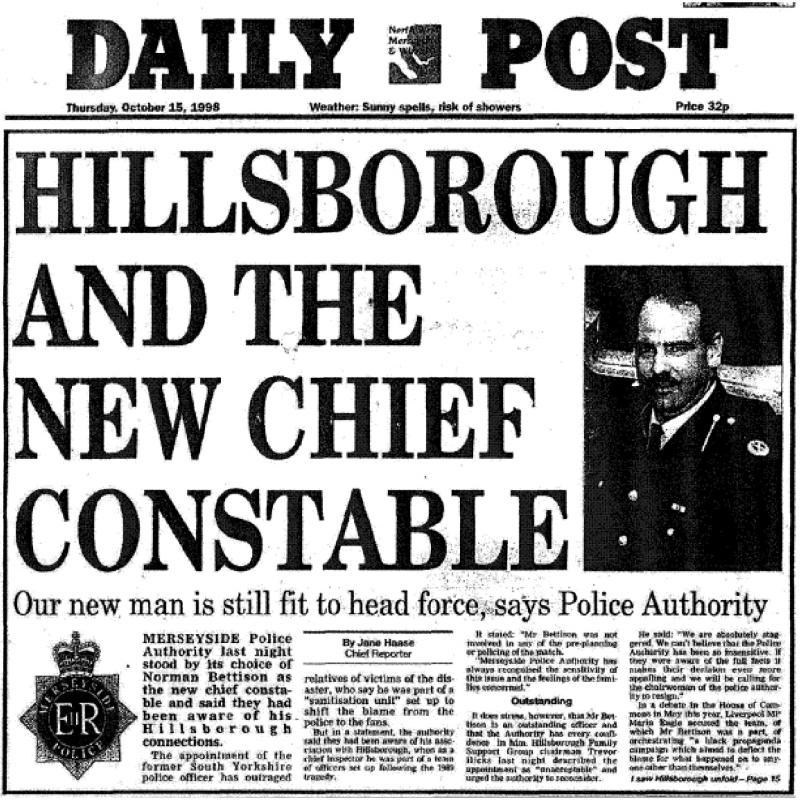
This announcement was almost immediately met with protests from some members of the families of those who died, which were covered extensively in Liverpool’s regional newspapers. These resulted in a series of press releases and statements from the MPA Appointments Committee and other parties, including HMIC, explaining the decision and the process that had been followed.
Image
Figure 20A: Copy of front page of the Daily Post on 15 October 1998 (Source: Trinity Mirror Group)
Norman Bettison also issued a statement via the WYP press office in relation to his involvement in the disaster. In this, he briefly covered his actions on the day itself and then described his involvement in the aftermath. He said he was assigned to a unit “tasked with looking at what had happened on the day of the disaster, making recommendations about the policing of the remaining football matches at Hillsborough before the end of the season and reviewing policing arrangements for football at Hillsborough and other grounds in South Yorkshire the following season”. He also said that later on he “was given a specific role to monitor the public inquiry and the inquest and brief the Chief Constable on progress.”
On 19 October, the Appointments Committee met to discuss the appointment and the response to it. Part of this meeting was open to the media and members of the public. Meeting notes show that two members of the Appointments Committee—the two who stated they had not seen the HMIC assessment—questioned whether Norman Bettison had deliberately concealed information about his role in the disaster during the appointment process. Mr Crompton was at the meeting and responded that Norman Bettison had also recently applied for the post of Chief Constable with a different force, and that his application had been very similar and similarly focused on his senior command experience.
A further meeting was arranged for the whole of the MPA (not just the Appointments Committee) on 2 November. Norman Bettison attended; he read out an account he had prepared of his involvement in the disaster and then answered questions from MPA members. One of the Appointments Committee asked him why he had not raised the issue of his involvement in the disaster at any point. He replied that he had simply been responding to the questions asked and had not sought to set the agenda. He stated: “I did not go away from the interview thinking ‘Phew! Hillsborough wasn’t raised’.”
Having compared the statement he made and responses he gave in the meeting with the evidence set out throughout this report, the IOPC has identified that Norman Bettison did not at any point provide a full account of his involvement in SYP’s response.
While it could be reasonably claimed that covering every aspect of his involvement was not necessary for the purpose, and that it was possible that, ten years after the events, he had simply not recalled some of the tasks he did, the accounts he gave did not include some aspects of his role that could be deemed significant. For instance, he did not mention going to Parliament on behalf of the SYP Chief Constable to show MPs a video relating to the disaster (see paragraphs 8.45–8.52) or his role in SYP’s preparation for the Popper Inquests (see paragraphs 11.29–11.60). He also did not mention his attendance at almost every day of the Taylor Inquiry hearings, or the tasks he carried out as a result of this, such as taking statements from Supt Chapman and a retired SYP officer to refute evidence given by Mr Lock (see paragraphs 10.106–10.109).
Following the meeting, the MPA confirmed there were no grounds on which to overturn the appointment. Some members of the MPA have stated to the IOPC that Norman Bettison’s manner and responses during the meeting actually reassured them that he was a suitable person for the job. He served as Chief Constable of Merseyside Police until January 2005.
The two members of the Appointments Committee that felt he should have disclosed his link to the disaster during the application process both resigned immediately.
In statements to the IOPC and in evidence to the Goldring Inquests, Norman Bettison has consistently stated that he did not intentionally conceal his involvement in the aftermath of the Hillsborough disaster from the Appointments Committee. He explained that he did not feel that the work he had done in the aftermath of the disaster was relevant to his application and that he was not asked about it at any time before he was offered the post of Chief Constable.
Broadly, the evidence supports both of these points. However, after he was offered the post, the description he gave of his involvement in the aftermath of the disaster was neither accurate nor comprehensive. Having reviewed the evidence around this, the IOPC identified three occasions in October and November 1998 when what Norman Bettison said about his association with the disaster could be interpreted as misleading. These included the statement issued through WYP’s press office on 14 October, which underplayed the extent of his role, and the written account he gave to the MPA on 2 November.
The IOPC felt that a reasonable misconduct panel could conclude that he deliberately downplayed his role in the aftermath of the Hillsborough disaster, so would have had a case to answer for gross misconduct, if he had still been serving with the police.