Taken as a whole, the IOPC’s review of WMP’s criminal investigation found that there was a series of gaps. There were also some decisions made that meant the investigation did not adhere to the standards of the day: notably, the decision to rely on amended officer accounts rather than taking statements.
Unlike when it was gathering evidence for the Taylor Inquiry under the direction of Lord Justice Taylor and his team, WMP had full control over the criminal investigation, including what it investigated and how it did so. WMP also set its own timescales: it was WMP’s decision to set the date of 31 March 1990 for submitting the file of evidence to the DPP. There was no external pressure to complete work by then.
WMP of course had substantial experience in conducting criminal investigations. On this basis, it can be assumed that any gaps in the investigation were entirely WMP’s responsibility. More specifically, the responsibility sat with the officers leading the investigation, ACC Jones and D Ch Supt Foster.
The IOPC interviewed both officers under caution and asked them about the gaps identified and the decisions made. D Ch Supt Foster accepted that there may have been mistakes in the WMP investigation; in particular, he acknowledged that the decision not to take statements from SYP officers was a mistake. He suggested that if he himself were to review WMP’s investigation in depth, he was certain he would find further aspects he was not happy with. However, he stated categorically that any mistakes were not the result of bias. ACC Jones similarly rejected the allegation of bias.
However, the available evidence does indicate that, throughout its criminal investigation and in particular in the file submitted to the DPP, WMP repeatedly focused on issues around supporter behaviour. Alternative lines of enquiry were not adequately pursued, or evidence revisited as part of the criminal investigation. While the file of evidence fell short of suggesting that supporters had caused the disaster, the consistent theme was that the Taylor Inquiry had underestimated the impact of supporter behaviour—effectively making it a mitigating factor for the failings of SYP.
This echoed the comments made by D Ch Supt Foster in his memo to ACC Jones at the end of the Taylor Inquiry and raises the possibility that WMP—and in particular, these two officers leading WMP’s work—approached the criminal investigation with a fixed pre-existing view of the evidence.
The IOPC also found evidence of a couple of instances where it appears WMP may have in some way given SYP preferential treatment, compared to other parties, or shared information with SYP in a way that undermined the independence of its work.
Seven SYP officers were interviewed under caution, as was Mr Mackrell. D Supt Taylor led the interview with Mr Mackrell, D Ch Supt Foster led five, and Chief Constable Leslie Sharp of Cumbria Constabulary (CC Sharp) led the interviews of ACC Jackson and Ch Supt Duckenfield. CC Sharp had been appointed to oversee the disciplinary investigation of CC Wright (see paragraphs 7.114–7.119), after CC Dear’s retirement. At the time, it was a requirement of police disciplinary processes that officers should be interviewed by an officer of equal or higher rank. The incoming Chief Constable of WMP was Ron Hadfield who, in his previous role as Chief Constable of Nottinghamshire Police, had attended the match as a spectator. It was therefore agreed that he should not be involved in the investigations.
The IOPC examined the transcripts of these interviews and asked an expert witness—Michael Confrey, a former specialist investigative interview adviser at Greater Manchester Police (GMP)—to do the same. Mr Confrey used a technique called the Griffiths Question Map (GQM) to analyse the interviews. This classifies the questions asked as appropriate/productive, or inappropriate/unproductive.
Questions are deemed inappropriate/unproductive when they are:
closed—these are questions that invite a yes/no answer (clearly, closed questions can be appropriate, but inappropriate ones are poorly timed in the interview, or could elicit more information if they had been asked in an open-ended way)
leading—these are questions that appear to lead the interviewee to a particular answer
based on a forced choice—these are questions where the interviewee is given a limited choice of possible answers
multiple—this is where several questions are asked as one, meaning the interviewee can ‘choose’ which one to answer
opinion statements—this is where no specific question is posed; instead, the interviewer makes a statement and invites the interviewee to agree
No GQM was produced for the interviews with Ch Supt Duckenfield and Supt Greenwood, as both provided a prepared statement to WMP and indicated that they would not answer questions, as was their right. When the interviewers received confirmation of this from Ch Supt Duckenfield and Supt Greenwood, the interviews were promptly terminated and no questions asked.
Mr Confrey found that in each interview, more than two-fifths of the questions asked were inappropriate or unproductive.
The most commonly used category was “leading questions”; Supt Marshall, Supt Murray and ACC Jackson were all asked more than 120 of these in their interviews. For example, in interviewing Supt Marshall, D Ch Supt Foster asked about the build-up of the crowd at the Leppings Lane end. While this was an appropriate topic, the line of questioning restricted the answer. Instead of asking Supt Marshall simply to describe the build-up, D Ch Supt Foster stated: “We have got a situation where there was a considerable build up of supporters that I think you described as as build up quite significantly late on around 2.35pm time”. This had the effect of closing down any potential response Supt Marshall may have given about what happened.
A further recurring issue was the failure of interviewers to follow up on potentially significant information disclosed in the interviews. For example, in his interview Supt Marshall criticised the quality of the pre-match intelligence supplied by Merseyside Police, stating that it left “a lot to be desired”. D Ch Supt Foster did not ask him why he felt that way, what Supt Marshall felt was absent from this intelligence or how improved intelligence could have altered the events that occurred.
In the interview with PC Smith, there was an even more striking example of this failure to follow up potentially significant information. This was during questioning about the allegation that PC Smith pushed supporters back into the pens, without recognising there was a crush. D Ch Supt Foster asked him: “Do you recall pushing people back in at any stage? PC Smith replied: “Yes.”
At this point, D Ch Supt Foster paused the interview, commenting: “Can I just say at the minute I I don't think the officer's too well. Do you want to have a break for a few minutes? The time is 1109. Police Constable Smith isn't well in my opinion at the moment and I would prefer to stop the interview.”
The interview was suspended for around 40 minutes. When it restarted, D Ch Supt Foster changed the subject and asked PC Smith no further questions about this admission.
Overall, the interviews under caution, repeatedly identified in the file of evidence WMP submitted as the critical next step in the criminal investigation, did not add to the evidence already gathered. On 1 August 1990, WMP sent the transcripts to the DPP. Four weeks later, the DPP announced that no one would be charged with a criminal offence in relation to the disaster.
The file of evidence WMP submitted to the DPP was more than 7,200 pages long. It included hundreds of statements, over 800 photographs and was supported by 60+ hours of video material.
It was produced in seven parts, ostensibly to divide the evidence into logical sections.
Part 1 included an overall introduction, followed by evidence from SWFC staff.
Part 2 covered the history of SWFC and the development of Hillsborough Stadium.
Part 3 was visual evidence, including photographs and written summaries of the video footage.
Part 4 provided evidence about Liverpool supporters, as well as evidence from Liverpool supporters.
Part 5 consisted of material from SYP, including officers’ accounts and the Operational Orders.
Part 6 focused on the emergency response and included evidence from SYMAS and SYCFS staff and SJA volunteers.
Part 7 was titled “The report”. It sought to summarise the evidence presented and draw conclusions about each individual under scrutiny, to assist the DPP in making decisions about whether or not to charge anyone.
After it had submitted the main file of evidence, WMP submitted some additional evidence. This included transcripts of interviews under caution, which were conducted in June and July 1990, and some correspondence from SWFC. The additional evidence was clearly marked as such and linked to the relevant parts of the initial file. No further analysis or report was submitted.
Parts 1 to 6 started with a commentary from WMP, explaining the nature of the material provided in that part of the file and identifying key pieces of evidence.
The IOPC has analysed each part of the file in depth and identified a wide range of concerns regarding the content. These can be summarised as follows.
Inaccurate presentation of information: while every statement cited was included in full, there were a number of instances where WMP’s commentary provided an inaccurate summary of the original statement. For example, in the commentary for part 1, there was a reference to a steward’s statement, in which he had described “500 or 600 Liverpool fans” turning up to the ground to protest about the FA’s decision to allocate fewer tickets to Liverpool than Nottingham Forest. In WMP’s commentary, an extra zero was added, meaning it referred to “5-6000 Liverpool fans”. This may well have been a mistake, but it changed the impression created considerably, implying a very large number of Liverpool supporters in an organised protest outside the ground—which would have caused considerable additional challenges for the police. In fact, the only other evidence WMP had of any protest came from the questionnaire of a different steward, who did not provide an estimated number of protesters.
Selective presentation of information: it was the responsibility of WMP to select what it believed was the most relevant evidence to present to support its case. However, compared to the underlying body of evidence available, WMP consistently omitted information that portrayed SYP in a negative light. For example, though the commentary to part 5 acknowledged that there was evidence from police officers that the tunnel to the centre pens was closed at the 1988 Semi-Final and said that “relevant statements are included”, no such statements or officer accounts were in part 5. It did include the written account of Ch Insp Creaser, who had given evidence about tunnel closure in 1988 during the Taylor Inquiry hearings. However, he did not mention it in his written account. The account of PS Higgins, which specifically mentioned past actions to close the tunnel, was added to part 2 in June 1990—almost three months after WMP had originally submitted its file, even though WMP had obtained the statement in June 1989.
Confusing decisions about where information was placed. The structure of the report might be deemed to indicate that all evidence from SWFC was in part 1, all evidence from supporters in part 4 and all evidence from SYP officers in part 5. However, this was not the case. The accounts of senior SYP officers Ch Supt Mole, Ch Supt Nesbit and ACC Jackson were included in part 2. Part 4 began with an account from a police officer, and it was over 300 pages into part 4 before WMP presented a statement from a Liverpool supporter. In total, around half of the statements included in this part were not from supporters: instead, they were from local residents, shop and licensed premises staff, coach drivers and even members of the public travelling between Liverpool and Sheffield on the day of the game.
Recurring references to supporter behaviour and, in particular, alcohol consumption, which appears disproportionate when compared to the underlying evidence. For example, the commentary stated that there was a “consensus” among local residents that “the Liverpool supporters were generally badly behaved and that alcohol influenced this behaviour”. It further suggested that the behaviour was far worse in 1989 than it had been in 1988. While the file contained some statements that supported this claim, the IOPC has established that out of the 880 questionnaires WMP conducted with local residents for the Taylor Inquiry, 120 said they witnessed “drunkenness”: by no means an insignificant proportion, but emphatically not a “consensus” on the subject.
Assertions which appear to be based on a selective reading of the evidence. This was particularly significant in part 7, which drew conclusions about the evidence in the rest of the file. However, there were other examples: in part 3, there were 23 photographs with captions that referred in some way to misbehaviour by supporters. However, the actual evidence of criminal or antisocial activity in these images is minimal. Some photographs showed supporters gesticulating or with what appear to be angry expressions; in the context of the events of the day, it would be no surprise that some were angry or upset.
Nine photographs were included which focused purely on litter, either on the streets or in waste bins in the Leppings Lane area. These were simply listed in the file and there was no reason given as to why they were included. There was a close-up photograph of a single beer can on the ground, the evidential value of which is hard to discern. The only photographs of supporters drinking alcohol showed Nottingham Forest supporters, which was not acknowledged.
Image
Figure 15B: Photograph of litter, submitted by WMP to the DPP (Source: SYP Archive)
Potentially key issues were overlooked. For example, WMP asserted in its commentary that traffic delays did not affect the arrival of Liverpool supporters in Sheffield, even though more than 2,000 supporters had reported experiencing delays on their journey. In a section comparing the Operational Orders for the 1988 and 1989 Semi-Finals, the file’s lead author D Ch Supt Foster commented that the 1989 plan was essentially the same as the 1988 one, with just a small reduction in officer numbers. However, WMP’s own analysis had found several differences between the two.
Part 6 included statements from several SYMAS and fire service staff involved in the rescue effort who said that they had asked the police for information about what had happened and where they could best assist but had not been given helpful answers by SYP. This was not acknowledged in the commentary. Instead, D Ch Supt Foster wrote that “The police plan indicates they have the key role in control and coordination at the scene of a disaster” and commented: “To some extent this reflects what took place at Hillsborough” and further, that liaison “at a lower level” between services “appears to have worked well.”
Part 5 of the file was focused on evidence from police officers. At the start of it, D Ch Supt Foster commented on the fact that the accounts of SYP officers were not CJA statements and that some of them had been amended by SYP’s legal team. While it was important to make the DPP aware of this fact, there was no explanation in the file that this was a result of WMP’s decision not to interview SYP officers and take statements from them.
However, the most significant part of the file was part 7, “the report”, which was D Ch Supt Foster’s summary of the evidence gathered. It was 178 pages long (including two appendices) and, unlike the previous parts, did not include any supporting statements or accounts. Instead, it referred to statements, accounts and documents included in the six previous parts, as well as to the Taylor Interim Report.
It began with several pages of background, covering the Taylor Inquiry, the ongoing Popper Inquests and the decision to launch a criminal investigation. It also summarised the organisations and individuals under investigation and why, as well as the volume of evidence considered.
In these initial pages, D Ch Supt Foster again drew attention to the fact that the file included written recollections, rather than CJA statements, and noted: “from a criminal investigation perspective this is clearly unsatisfactory.” He offered an explanation for why recollections had been gathered—to meet the Taylor Inquiry timetable—but not why WMP had not taken action to convert the recollections into CJA statements.
D Ch Supt Foster also stated early on: “The evidence on which Lord Justice Taylor drew his conclusions has not been added to significantly nor contradicted by our investigation findings since the publication of his Interim Report. Notwithstanding there are aspects of this disaster which in the opinion of the Investigating Officer may not have been given sufficient prominence; for example, the role of supporters.”
When the IOPC asked D Ch Supt Foster, during an interview under caution, why he felt this was the case, he said his position was based on the evidence. He did not specify what evidence.
A couple of pages later, he wrote: “The extent to which the effects of alcohol played a part, the late arrival of many thousands of Liverpool supporters and even perhaps their own failure to recognise the distress of fellow supporters in pens 3 and 4 are important issues in this disaster investigation.”
This comment from D Ch Supt Foster clearly contradicted the body of evidence from Liverpool supporters on the terraces—corroborated by video footage and media coverage—that they had repeatedly sought to draw police attention to the crush and had begun rescue attempts before the emergency services arrived. It also offered a very different perspective from the Taylor Interim Report, which had stated unequivocally that “the great majority were not drunk nor even the worse for drink”.
WMP had repeatedly adhered to the assertion that it had not substantially added to the evidence that was available to Lord Justice Taylor. This comment from D Ch Supt Foster about the importance of examining supporter behaviour appears to suggest that, though WMP had viewed the same evidence as Lord Justice Taylor, they had reached very different conclusions.
This comment also appeared to echo the views D Ch Supt Foster had expressed in his memo to ACC Jones in response to Mr Collins’s closing observations at the Taylor Inquiry.
After the introduction, there was a section covering “Key issues”. Under the subheading “The Build up at the turnstiles”, D Ch Supt Foster wrote: “the behaviour of the fans undoubtedly contributed to the problems”. He acknowledged this was his opinion but did not mention some of the other factors that could have contributed to this build-up, such as travel delays or the changes to turnstile arrangements. This again reflected the views he had set out in his memo to ACC Jones regarding Mr Collins’s closing remarks, where he had similarly linked late arrivals at the ground to supporter behaviour.
D Ch Supt Foster then considered SYP’s failure to take appropriate steps to prepare for the opening of the exit gates. He described this issue as “perhaps the most important of all in respect of possible criminal culpability.” He accepted as fact that Ch Supt Duckenfield and Supt Murray had not considered the consequences of opening the gates before they issued the order to do so, but asked, “can that be construed as a criminal or disciplinary offence? Or is it incompetence?”
To answer this, D Ch Supt Foster examined past evidence of crushing at the Leppings Lane end and what SYP knew of it. He identified that the crush at the 1981 FA Cup Semi-Final was very similar to the events in 1989. However, he then stated that the 1987 Semi-Final passed without incident. That was despite the fact that the Taylor Inquiry had heard evidence from a supporter who had been caught up in a crowd crush at the Leppings Lane end before and during the 1987 game. Later in his report, D Ch Supt Foster cited this very individual’s evidence, in reference to SWFC’s knowledge of previous crushing incidents.
Regarding the 1988 Semi-Final, D Ch Supt Foster stated that there was evidence of a crowd crush leading to injuries. He also wrote that there was evidence that SYP officers had closed the tunnel to the centre pens of the Leppings Lane terraces. However, he accepted that the match commander at the 1988 Semi-Final, Ch Supt Mole, did not know about the injuries or the tunnel closure, so could not have informed Ch Supt Duckenfield about them. Furthermore, because Ch Supt Mole believed the 1988 Semi-Final had been a successful police operation, D Ch Supt Foster suggested that there would have been no need to give Ch Supt Duckenfield any information about any previous incidents. D Ch Supt Foster wrote that as a result: “the link with the 1981 problem was broken.”
Yet D Ch Supt Foster had asked neither Ch Supt Mole nor Ch Supt Duckenfield about this. He also did not appear to consider whether anyone else could have informed Ch Supt Duckenfield about the 1988 incident.
Later in the report, D Ch Supt Foster referred to allegations made about other SYP officers and, for the most part, dismissed them.
For instance, the complaints against PC Smith and PC Illingworth related in part to the fact that, despite being stationed on the perimeter track and thus having the closest view of the terraces, they failed to recognise the severity of the crush, as examined in chapter 5 of this report. D Ch Supt Foster wrote that “no one either police or Club employee, recognised the fact that pens 3 and 4 were overcrowding. Nor for that matter did any other observer recognise the fact including professionals who regularly attend matches, such as the media personnel.”
Yet some of the evidence cited in WMP’s file to the DPP directly contradicted this. Some supporters, members of SWFC ground staff and media representatives, including well-known and experienced football journalists Jeff Powell and Colin Gibson, had all stated to WMP that they saw a situation of overcrowding and distress, where there was serious potential for a crush incident. Some SYP officers, cited in part 5, had indicated that they had identified overcrowding. There was even an account in part 5 from the Chief Constable of Nottinghamshire Police to the same effect.
Further, it contradicted previous WMP analysis of the evidence. In a report written in August 1989, in response to a request from D Supt Taylor, DCI Ross had found that “the Constables, without exception, noticed a large build up of fans in the Pens 3 and 4, some becoming concerned about the matter, but no action was taken by any of them”. This evidence was either overlooked by D Ch Supt Foster in preparing this summary or deliberately ignored.
The IOPC also identified that some potentially valuable analysis conducted by WMP during its investigation was not included in the file it submitted. IOPC investigators reviewing WMP’s HOLMES account found a detailed sequence of events around the opening of Gate C, built on some 452 references to statements and questionnaires. This was not submitted to the DPP.
The file also contained little or no analysis of what caused the build-up of supporters on Leppings Lane, which ultimately led to the gates being opened. It offered minimal examination of whether deficiencies in the police planning arrangements and/or ground layout contributed to this build-up. Above all, it did not consider in detail the police planning for the 1988 FA Cup Semi-Final, the crowd crush that occurred during it or the circumstances leading to the closure of the tunnel—all of which could have served as vital points of comparison to the events of 1989.
The 1989 Semi-Final took place at the same ground and involved the same teams as in 1988. The sets of supporters were allocated the same ends of the ground. As ACC Jones had identified at the very start of the WMP investigation, the pivotal question therefore was “what was the difference?” This was never adequately explored by WMP, neither in its investigation, nor in the file it submitted to the DPP.
This point was raised by the barristers appointed by the DPP to review the file. Notes of a meeting on 20 April 1990—three weeks after the file was submitted—involving one of the barristers (Peter Birts QC), D Ch Supt Foster and Mr Kennedy of the CPS recorded that “Mr Berts [sic] was particularly concerned about learning more concerning the procedures for the passing on of information to other officers following the earlier incidents which had happened at the semi finals at Hillsborough in 1987 and 1988.” The notes included Mr Birts’s observation that these previous incidents of overcrowding at the Leppings Lane end were “of crucial significance to any decision to prosecute the police for corporate manslaughter in this case.”
In response to the request from Mr Birts, D Ch Supt Foster personally conducted follow-up enquiries and secured CJA statements from Ch Supt Mole and Ch Supt Denton, which he submitted to the CPS on 8 May 1990 with a brief covering letter. In these statements, both officers referred to an SYP file for football matches, which contained among other things the minutes of the debrief following the 1981 Semi-Final. They both stated they showed this to D Ch Supt Foster.
However, there is no evidence that D Ch Supt Foster asked to retain this potentially invaluable file to examine it, make copies of the documentation to support WMP’s investigation, or pass it to the CPS.
D Ch Supt Foster was interviewed under caution on four separate days and the file of evidence submitted to the DPP was discussed on each occasion. As noted earlier, he made clear from the outset that he was the lead author of the file and accepted responsibility for its content. He also acknowledged that there may have been mistakes in the WMP investigation and suggested that if he himself were to review it in depth, he was certain he would find aspects he was not happy with. However, he stated categorically that any such mistakes were not the result of bias.
He accepted that the decision not to take any statements from SYP officers was a mistake. He said his logic at the time was that it would be easy to convert recollections into CJA-compliant witness statements if the DPP chose to prosecute. While this may have been his intention, this was not how it was presented in the file. There, the fact that recollections would not be admissible was cited as an obstacle to a successful prosecution; D Ch Supt Foster did not explain in the file that if a prosecution was launched, it would be easy to resolve the issue.
IOPC investigators asked D Ch Supt Foster specifically about some of the information included in or omitted from the file.
On the subject of the tunnel closure, D Ch Supt Foster recalled that he had written a “considerable section on the tunnel”, adding: “I think I made it clear that the failure to close the tunnel by South Yorkshire Police officers was a major cause of the deaths of many of the supporters.” While D Ch Supt Foster did indeed write that not closing the tunnel was a major cause of death, he did not clearly attribute that failure to SYP officers. Instead, the file content concluded that Ch Supt Duckenfield would not have known there was any need to close the tunnel—a very different point.
On the subject of the emphasis he had placed on supporters’ alleged behaviour, unsupported by evidence, D Ch Supt Foster had acknowledged, when interviewed as a witness by the IOPC at the outset of its investigation, that WMP put this issue “back onto the table” for the criminal investigation, adding: “we felt it was a factor.”
During his interview under caution, D Ch Supt Foster pointed investigators to the end of part 4, stating: “I think it’s at the very conclusion what I write and say is although alcohol played a part it was a sunny day erm it was no different in alcohol terms to most other football matches in that era.” If that was the case, it is not clear why he then suggested that alcohol had not been considered adequately.
IOPC investigators referred him to his comments in part 7 that the behaviour of supporters had not been “given sufficient prominence” and that “the extent to which the effects of alcohol played a part” was an important issue, asking if these were intended to show that supporters had been at fault. D Ch Supt Foster replied: “I don’t think that’s a conclusion I just … I just think I say there these are important issues in this disaster investigation I don’t say that they are reasons for the disaster.”
D Ch Supt Foster further stated: “It’s important that they [the DPP and his QCs] didn’t come back and say I think this report is wrong or that I think there’s things in there that … the evidence doesn’t justify.” Instead, he stated that the discussions after the file was submitted focused on who would be interviewed under caution.
These interviews were then arranged in June and July but also proved flawed.
The fact that this was a criminal investigation meant that, unlike when it was supporting the public inquiry, WMP was now back on familiar territory. It had a team of officers with extensive experience in complex and high-profile criminal investigations. They therefore should have been well aware of what would be required from a criminal investigation. The Taylor Interim Report had provided a clear starting point in terms of lines of enquiry, and WMP had a large volume of evidence and information to draw on. This included thousands of statements and questionnaires, the accounts of SYP officers, reports from the HSE, and its own analysis and reports conducted for the Taylor Inquiry.
On 6 September 1989, D Supt Taylor sent ACC Jones a memo setting out anticipated resource requirements and key tasks for the criminal investigation. These included:
converting officers’ recollections into CJA statements
questioning those with some degree of culpability
interviews of new witnesses
reinterviews of witnesses and police officers
He suggested the number of WMP officers that might be required for each task.
The task of converting officers’ recollections into CJA statements had also been cited by ACC Jones during his negotiations concerning the costs of the investigation.
However, none of these tasks was undertaken. In fact, the scope of WMP’s criminal investigation was extremely and inexplicably limited. It effectively ended on 31 March 1990, with the submission of the file of evidence to the DPP.
This submission date appears to have been decided by WMP alone. The IOPC has found no evidence that there was any request from any other party to complete the investigation by that date. In fact, it was slightly later than ACC Jones had initially envisaged; several policy book entries show that WMP’s aim had been to complete the investigation by the end of February.
This was a very compressed timetable for a major manslaughter investigation, and no explanation has ever been given for why the timetable was fixed in this way. CC Dear specifically stated to the IOPC that he was not aware of any time pressure.
During the six months from the end of September 1989 up until 31 March 1990, just 168 actions were raised in relation to lines of enquiry that were specifically undertaken as part of the criminal investigation. Of these 168, 92 resulted in no further action being taken—meaning that during this time period, WMP completed just 76 actions related to lines of enquiry for the criminal investigation.
By way of contrast, across the same period, WMP undertook around 1,000 actions in support of the Popper Inquests and 194 related to investigating complaints against the police.
It is also worth noting that 45 of the actions considered as part of the criminal investigation were related to supporter behaviour. Although 40 of these resulted in no further action being taken, the figure stands in marked contrast to the number of actions centred on the opening of the gates at the Leppings Lane end: 10.
While there is evidence that supporters were considered a subject for investigation, the main offence being investigated was manslaughter, and the opening of the gates had been identified in the Taylor Interim Report as a critical moment. Further, the Taylor Interim Report had noted that failing to close the tunnel to the centre pens, when the gates were opened, had been a critical error.
The fact that the tunnel had been closed on previous occasions but was not closed on the day of the disaster was accepted by all parties, including SYP. However, as discussed in chapter 11, several of the most senior SYP officers on duty had given evidence to the effect that they were either unaware that the tunnel had been closed previously or had only become aware of it following the disaster. They suggested that the tunnel had been closed by junior officers, acting on their own initiative.
A large amount of oral evidence given to the Taylor Inquiry had indicated that tunnel closure may have been a more common occurrence or even a formal police tactic. Furthermore, a number of officer recollections submitted to WMP indicated that the action had previously been carried out on the instruction of more senior officers.
In the context of an investigation into the possible offence of manslaughter by gross negligence, this issue was of considerable significance. If evidence was found to demonstrate that:
closing the tunnel was an accepted SYP tactic to prevent overcrowding in the pens, and
that officers in the PCB were aware of this tactic
then the failure to implement that tactic could have been deemed an indicator of negligence.
It would have been a logical and appropriate investigative step to interview each of the officers who had given evidence about this, to seek to verify their accounts and ascertain what their understanding of the police tactic was. However, the IOPC has found no evidence to suggest WMP made any effort to contact them again. Instead, actions were raised to ask some officers that had been on duty at the 1988 Semi-Final about their knowledge of any action to close the tunnel on that occasion. These did not result in further information.
Of the 168 actions for the criminal investigation, three were recorded as high priority. Two of these involved taking statements from a married couple who had not been at the match. They had travelled from Manchester Airport on the M62 towards Sheffield, on the way home to Wakefield in West Yorkshire, on the day of the disaster. This meant they had taken a similar route to some Liverpool supporters on the way to the match.
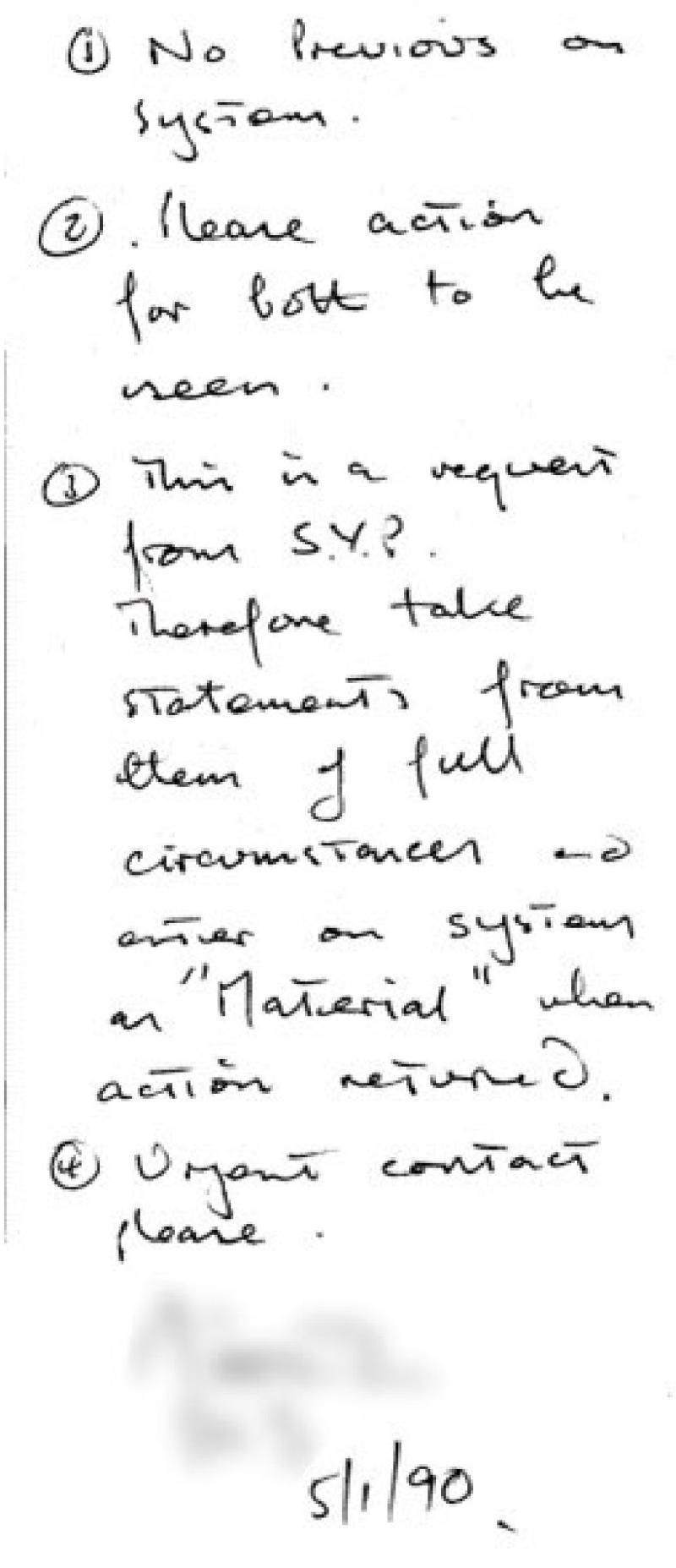
An instruction from D Ch Supt Foster shows that WMP took statements from these two individuals at the request of SYP.
Image
Figure 15A: Note from D Ch Supt Foster, 5 January 1990 (Source: SYP Archive)
The statements were obtained within a week and were very similar in their wording. In particular, both stated: “I was disgusted by the conduct of the football fans, the fact that they had been drinking and were urinating at the side of the road, in full view of other road users.” Both were included in the file WMP submitted to the DPP in March 1990.
In 2016, the wife gave a statement to Operation Resolve. With regard to the allegations made about supporters, she stated she could “no longer recall much of their behaviour. I no longer recall seeing fans urinating in public places.”
It is notable that WMP acted so promptly to obtain these statements—especially given the very small number of actions raised during its criminal investigation. It is also striking that D Ch Supt Foster determined that the information these witnesses could give was “material” before it had been gathered.
Conversely, the IOPC has identified 37 potentially key witnesses that WMP did not approach or take statements from as part of its criminal investigation. As well as some police officers who may have been able to provide vital additional information, such as those in the PCB, WMP did not take statements from SWFC officials, or Eastwood & Partners or SCC employees. All three of these organisations were under investigation for possible manslaughter.
SWFC officials could also potentially have been investigated for health and safety offences; Operation Resolve secured the conviction of Mr Mackrell (SWFC Club Secretary) for offences involving health and safety legislation, almost entirely on the same evidence available to WMP. The HSE had advised the Taylor Inquiry that there had been a repeated failure to adhere to the Green Guide and potential failure to meet obligations under the SSGA 1975. However, at the start of the criminal investigation, the HSE informed ACC Jones that it viewed the issues around the disaster as not falling under its prosecutorial remit. Despite this. the evidence indicates WMP gave little or no consideration to such offences.
Even though some senior SYP officers were identified early on as suspects in the manslaughter investigation, WMP chose not to interview them under caution before submitting its file of evidence. This was a highly unusual decision.
Altogether, this meant that during its criminal investigation, WMP did not substantially add to the evidence that had been presented to the Taylor Inquiry. In a letter to the Taylor Inquiry team in October 1989, ACC Jones acknowledged this, commenting: “You will see, apart from the provision of more detail and improved identifications of the deceased, nothing new has emerged.” He reiterated this in conversation with the Secretary of the Taylor Inquiry team in December 1989. However, in the file it submitted to the DPP, WMP appeared to reach a very different view of that evidence.
On the day the Taylor Interim Report was published, CC Wright wrote to the DPP to ask him to consider the question of criminal offences arising from the disaster. Over the following days, a series of conversations ensued, that led, on 8 August 1989, to CC Wright asking ACC Jones if WMP would undertake a criminal investigation. ACC Jones provisionally accepted this task, and the linked work for a police disciplinary investigation, on the basis that WMP saw these tasks as connected. On 16 August, WMP issued a press release confirming that it had been asked to “undertake a full criminal inquiry into all the circumstances that surrounded the events at Hillsborough on 15 April 1989.”
However, WMP did not immediately start work, even though members of the DPP’s team indicated they would like that to happen. This was due to questions around how the criminal investigation would be funded.
Following extensive correspondence involving the chief constables of both forces and the respective police authorities, on 27 September 1989 these financial issues were finally resolved. The South Yorkshire Police Authority (SYPA) agreed to reimburse WMP for its work, with no limit placed on the costs; the SYPA itself would subsequently be reimbursed by the Home Office. With this confirmed, WMP officially began the investigation.
The IOPC’s terms of reference included investigating: The conduct of officers involved in WMP’s investigations. This will include:
a) the involvement of WMP in the decisions taken about how to gather evidence/obtain witness accounts b) whether police officers involved in this investigation put inappropriate pressure on any witnesses to alter their accounts or influence the content of those accounts c) whether the summaries of evidence WMP presented at the individual inquests were accurate d) whether there is any evidence of bias in favour of SYP on the part of those involved in or leading the investigation e) whether any accounts provided were deliberately lost, inaccurately recorded, amended, or mishandled (including not following up on key witnesses) f) investigating other recorded complaints or conduct matters about the actions of WMP in the gathering or presenting of evidence
This chapter focuses on the criminal investigation WMP carried out in relation to the Hillsborough disaster.
What was found?
• WMP completed just 76 actions related to lines of enquiry for the criminal investigation: a very small number for a major manslaughter investigation.
• Only ten actions were raised in relation to lines of enquiry into the opening of the exit gates at the Leppings Lane end—which the Taylor Interim Report had described as “a blunder of the first magnitude.” Just two of these actions related directly to Gate C and only one of these was completed.
• The IOPC identified 37 potentially key witnesses that WMP did not approach or take statements from as part of its criminal investigation, including SWFC directors, representatives from Eastwood & Partners or SCC employees. All three organisations were under investigation for manslaughter. In addition, it did not initially interview the senior SYP officers who had been on duty.
• Though senior detectives had raised the issue that the SYP officer accounts submitted to the Taylor Inquiry had been amended and were not admissible as evidence for a criminal prosecution, WMP still did not take statements from officers and continued to rely on the SYP accounts.
• Further, in the file of evidence WMP submitted to the DPP for charging decisions, the lead author specifically highlighted that the accounts were not suitable for a criminal investigation—without acknowledging that WMP alone could have addressed that.
• The file of evidence did not accurately reflect the evidence that WMP had at its disposal. This was particularly notable in relation to the impact of traffic delays on supporters’ arrival times and the claim that there was a “consensus” among local residents that the behaviour of supporters at the 1989 Semi-Final was much worse than it had been at the 1988 game.
• In the section of the file where D Ch Supt Foster analysed the evidence submitted, he included repeated references to the behaviour of supporters and how much alcohol had been consumed, and indicated this was a mitigating factor in what had happened.
• When WMP did, belatedly, interview the suspects, the interviews did not meet the expected professional standards of the day.
Significant new evidence
ACC Jones’s policy books were a major source of previously unavailable evidence about WMP’s criminal investigation.
To assist with the review of WMP’s suspect interviews, the IOPC commissioned an expert in police investigative interviewing to review the interview transcripts using a methodology called the Griffiths Question Map.
After the Taylor Interim Report was published on 4 August 1989, strongly criticising SYP, CC Wright asked WMP to undertake a criminal investigation into the disaster. WMP was formally appointed to the task on 16 August 1989, with manslaughter the main offence under consideration. As well as SYP, three other organisations and their staff were under investigation: SWFC, Eastwood & Partners and SCC.
On 30 March 1990, WMP submitted a file of evidence to the DPP. This included the analysis by D Ch Supt Foster of whether there was sufficient evidence to justify bringing charges of manslaughter in relation to the disaster.
On 30 August 1990, the DPP announced that no criminal charges would be laid against any person or organisation.
WMP’s criminal investigation has not previously been re-examined in depth. However, the HIP Report included various observations on the file of evidence WMP had submitted to the DPP—in particular suggesting that it put “the issues of drunkenness and ticketless fans… back on the agenda.”
As part of its wider investigation into the work of WMP, the IOPC sought to re-examine WMP’s criminal investigation. It considered the overall quality and professionalism of the criminal investigation that WMP conducted, comparing it to the standards that would have been expected at the time and assessing whether there was any evidence of bias towards fellow police officers.
On 13 July, Counsel to the Inquiry Mr Collins gave his final observations. These began with some highly complimentary remarks on WMP’s “immense effort in interviewing witnesses and collecting the necessary evidence and in producing for us, often at very short notice, exceedingly helpful reports and summaries of their enquiries.”
Mr Collins then provided a summary of the evidence heard, expressing views on issues such as failings around stadium safety and the fact that Ch Supt Duckenfield did not foresee the consequences of his order to open the gates.
Mr Collins also set out his view of the evidence that had been heard relating to the behaviour of supporters. While he stated that there was “a considerable amount of boorish and loutish behaviour”, he said he believed “it was a minority of fans who were guilty of it.” Crucially, he added that such behaviour “did not cause the trouble.”
D Ch Supt Foster sent ACC Jones a memo in response to Mr Collins’s closing observations. The IOPC found this on one of the floppy disks obtained from the Sheffield Archives. It has not previously been published and was not examined by the HIP.
In the memo, which according to its title was written at ACC Jones’s request, D Ch Supt Foster listed a number of areas where he disagreed with Mr Collins’s conclusions.
For example, D Ch Supt Foster challenged Mr Collins’s assertion that the crush on the terraces was an “inevitable result” of not blocking the tunnel to the centre pens once the gates were opened. D Ch Supt Foster wrote: “I find it difficult therefore to have expected and planned for the majority to have gone down the tunnel to Pen 3 and Pen 4” and later added: “Mr Duckenfield could not have anticipated it.” D Ch Supt Foster offered the view that “If anyone should [have anticipated it] then it is my contention the experience of Mr Marshall, Mr Murray places that responsibility firmly with them.”
However, perhaps the most notable feature of the memo was the number of references D Ch Supt Foster made to alcohol consumption and supporter behaviour.
The first of these was on the first page of the memo, where D Ch Supt Foster wrote: “I would suggest many Liverpool supporters left it late, deliberately having no tickets or consuming alcohol to a greater degree then [than] emphasised at the Public Inquiry.” The IOPC has not found compelling evidence in the wider body of questionnaires or statements taken by WMP to support any of these three suggestions.
D Ch Supt Foster then commented: “I question the use of the word minority in relation to Alcohol etc outside [sic] who forced open the Leppings Lane perimeter gates. I suggest (and the statements confirm) that the final crowd build up were in the majority those who had been drinking.” [Emphasis in original.] It is not clear which statements he was referring to here. Some officer accounts did refer to large numbers of supporters consuming alcohol or appearing drunk; however, there were also plenty of officers who did not suggest this was the case. The overwhelming majority of actual statements WMP had taken, from supporters and other witnesses, certainly did not support D Ch Supt Foster’s assertion.
Next, in a section of the memo subtitled “Alcohol”, D Ch Supt Foster wrote: “I really do believe this is more of a problem than identified. I have to say that the evidence suggests the majority of the latecomers were those who had been detained drinking. There is no other explanation based upon the times of arrival of the coaches, private cars etc. Add to this the evidence of the local residents, licensees, supermarket outlets, Police on duty and the picture is clear.”
The evidence WMP had gathered from local residents and licensed premises absolutely did not support this assertion.
D Ch Supt Foster stated at the end of the memo that his comments were made “straight off the hip with no real preparation time”. It was an internal memo, not intended for external audiences. Nonetheless, the memo appears to set out a very different view of the available evidence to that articulated by Mr Collins.
IOPC investigators asked D Ch Supt Foster about this memo when interviewing him under caution. D Ch Supt Foster stated: “I’ve written that based on the evidence that was before me at that particular time.”
In a response to the summary of proposed criticisms of D Ch Supt Foster sent by the IOPC in 2024, his solicitors wrote that he did not accept that this memo indicated he disagreed with Mr Collins’s conclusions. They emphasised that the memo was an initial reaction to the closing observations and highlighted that the memo also included a number of points where he directly agreed with Mr Collins.
The content of this memo appears to illustrate that D Ch Supt Foster had formed a closed view of the available evidence. While this was arguably of limited impact on the Taylor Inquiry, the consequences of such a closed view became more apparent in the criminal investigation that followed.
Though the IOPC has identified some issues with WMP’s work for the Taylor Inquiry—particularly in relation to its collection of evidence from police witnesses—it remains clear that WMP was working at this stage on behalf of the Taylor Inquiry team. Supporting a public inquiry was an unusual role for a police force; the need to gather so much evidence at speed meant that decisions had to be made about priorities. The IOPC’s concerns should therefore be balanced against the consistent view of the Taylor Inquiry team that WMP performed a complex task very well.
There is some evidence to indicate that WMP—and specifically ACC Jones—may also have contributed to a report submitted by SYP to the Taylor Inquiry. This report was produced on the instruction of Ch Supt Wain and compiled by Detective Inspector Alan King of SYP (DI King) and is informally known as the King report. Its aim was to examine and provide evidence of a so-called ‘conspiracy theory’, apparently circulating within SYP, that large numbers of Liverpool supporters without tickets would intentionally congregate outside a ground then collectively force their way in. The report primarily consisted of information from a number of police forces about the behaviour of Liverpool supporters at matches in their area in the preceding seasons. Despite considering several matches at different grounds, it provided little evidence to support the conspiracy theory.
Paragraph 4.2 of the King report included a comment that appeared to be based on input from WMP. This read: “Whilst the evidence does not have any bearing on the match played between Liverpool and Nottingham Forest at Hillsborough, or the fans who attended the match, the Everton supporters behaviour at Villa Park shows a remarkable coincidence with the Liverpool supporters at Hillsborough which may indicate some Liverpool characteristic.”
This referred to the other 1989 FA Cup Semi-Final, involving Everton (a club based in the city of Liverpool) and Norwich City, which had taken place at Villa Park—a large stadium in Birmingham—on the same day as the disaster. WMP had been the force responsible for policing the match and ACC Jones had been on duty.
SYP submitted the King report to the Taylor Inquiry on 22 June, a few days before the end of the Inquiry hearings.
On 9 June, almost a fortnight before DI King’s report was submitted to the Taylor Inquiry, ACC Jones had written to Peter Whitehurst at the Treasury Solicitor’s Department about the “behaviour of Everton supporters at the semi-final on 15 April 1989”. In the letter, ACC Jones referred Mr Whitehurst to a previous conversation between them in which he had mentioned he had been at this other semi-final. He continued: “I expressed my concern about aspects of that event which reflected similar behaviour to the Liverpool supporters at Hillsborough.”
ACC Jones wrote that, following this conversation with Mr Whitehurst, he had asked senior officers who had been on duty at the Everton v Norwich City game to provide him with statements. He enclosed three statements with the letter, which ACC Jones concluded: “I would only add that, in my opinion, I had not previously experienced dealing with supporters in such great number who had consumed so much alcohol. Consequently the accounts that I have read on Liverpool supporters behaviour at Hillsborough show some remarkable coincidences which may indicate some Liverpool characteristic.”
Aside from questions about the accuracy of such a comparison, this appears a highly inappropriate comment for the officer in charge of evidence gathering to make. It appears to suggest the actions of a small number of football supporters were representative of the alleged behaviour and character of a city of almost half a million people. It further could be taken to imply that ACC Jones had a fixed mindset or preconceptions about the behaviour of people from the city, while investigating a disaster involving those same people.
The similarity between the wording of ACC Jones’s letter and DI King’s report is striking—and indeed a copy of the letter was found in a bundle of papers related to the King report. This raised the possibility that ACC Jones had provided his input directly to DI King; that a colleague at WMP had done so; or, that Mr Whitehurst had done so.
There is no evidence to suggest that, as part of his research in compiling the report, DI King contacted the Treasury Solicitor’s Department. However, he did contact all police forces. It therefore seems most likely that the letter was provided to DI King by WMP.
If ACC Jones himself had submitted a letter to an officer compiling a report in defence of the very force ACC Jones was investigating, this could be construed as a conflict of interest. When interviewing ACC Jones under caution, the IOPC showed him a copy of the letter he had sent to Mr Whitehurst and asked him to comment on it. ACC Jones responded: “I have no independent recollection of writing this letter twenty-five years ago however I accept writing it. I had not recalled using the term Liverpool characteristic before.”
He was then asked about it at the Goldring Inquests and rejected the suggestion that this was an example of a lack of independence and impartiality from WMP.
One of WMP’s key tasks for the Taylor Inquiry was to provide some analysis and summary reports of the evidence that had been collected. In some cases, reports were produced in response to specific requests from the Taylor Inquiry team. In other instances, it appears WMP chose to produce summaries or reports on issues that senior officers viewed as relevant.
The largest of these reports was a document referred to by ACC Jones as “an interim report on the progress of our investigation.” Submitted to the Taylor Inquiry on 26 June, it was 148 pages long and appears to be a compilation of reports written by multiple different authors, some of which had already been submitted separately, such as the comparison of the Operational Orders.
The report was not made available to the HIP. The IOPC found a copy of it in some boxes of papers retrieved from the archives of the Government Legal Department in June 2015.
Towards the end of the report, there was a summary section which began by noting that, to date, because WMP had been “a supply on demand team for Lord Justice Taylor”, it had “made little progress in actual investigation work”. The report suggested: “The time is now approaching when we can assess the vast amount of written and visual evidence with a view to identifying major issues.” It then gave some examples of the issues that would be addressed, such as examining whether there was a link between supporters coming through Gate C, “the 'forcing' of the iron gates, the surges in Pens 3 and 4 clearly visible on video and related in numerous statements and the time the barrier broke.”
Strikingly, it also suggested: “Alcohol has featured to a large extent but there is no direct evidence of drunkenness to the degree of this factor alone being a primary cause. Nevertheless one third of [the] deceased were over the legal driving limit and a further third had traces of alcohol. Consideration is being given to a statistical analysis of this to the total amount of supporters on the terraces. Expert evidence is being sought because it is felt that the behaviour of the crowd was a factor and alcohol was a feature.”
The report did not state who felt that the behaviour of the crowd was a factor or that alcohol was a feature. Further, the observation about the number of those who died who were over the legal driving limit was neither accurate (the figure was far lower than a third) nor relevant in itself, or as the basis for extrapolating a figure for a crowd of over 10,000.
The IOPC has identified that, from even earlier in WMP’s evidence gathering for the Taylor Inquiry, ACC Jones wanted to bring the alleged behaviour of Liverpool supporters to the fore. In notes of a WMP management team meeting on 23 May, there was an action for ACC Jones “to write to Andrew Collins re his opening speech, include in the letter items such as: i) Alcohol ii) Fans without tickets.”
There is no record in the policy books of any letter to Mr Collins to that effect, but ACC Jones did send a letter dated 1 June to Mr Brummell, with information about ticket touts.
The WMP interim report picked up the issue of supporter behaviour, with the authors observing that “The video evidence for 1988 shows a totally different picture to 1989 in the crowd build up at, for example, 2.50pm. This needs to be explored and questions posed on the reasons why.” It included some possible reasons for this: all of these were related to the alleged presence of large numbers of supporters without tickets. However, it did not make any reference to the possibility that this different picture could have been linked to other factors, such as changes in police tactics or traffic delays en route, even though there was evidence available to WMP to suggest that either could have been relevant.
The evidence indicates that WMP was similarly passive when SYP did not provide some of the documentation it had asked for.
On 25 April, at the very outset of WMP’s evidence-gathering process, Detective Superintendent Roy Taylor (D Supt Taylor) requested that the Operational Orders for both the 1988 and 1989 Semi-Finals should be obtained from SYP. An action was promptly raised in the WMP MIR to obtain the original versions, rather than copies, of both. The instructions stated that the 1988 Order was “required urgently” and gave a deadline for obtaining both documents of 4 May, so they could be made available to Lord Justice Taylor and his team before the hearings started.
By comparing the two main Operational Orders, WMP would have been able to identify how SYP’s plan changed between 1988 and 1989. In turn, this would allow WMP to consider whether any such changes may have had an impact on the events that unfolded in 1989.
The action result was recorded on 7 May, noting that SYP did not know where the original versions of either document were. The IOPC has found no evidence to suggest that WMP made any further effort to trace the originals, despite viewing this initially as an urgent requirement.
Using copies, WMP did conduct a comparison of the Operational Orders, which identified a series of changes between the two. This was significant, because SYP officers involved in match planning said in evidence to the Taylor Inquiry that the 1989 Operational Order largely followed the 1988 one. In a report on what the comparison had showed, WMP officers explained that the most notable change was a significant reduction in the number of officers on duty at the Leppings Lane end. WMP’s analysis found that the reduction was higher than had been suggested by SYP officers. Despite this, WMP raised no further investigative actions into the difference.