

Arrival of ambulances and the continued rescue effort
- After alerting the other emergency services to a major incident, one of the next crucial steps is to coordinate the other services. SYP took no steps to do this or to achieve a common understanding of the situation. This was demonstrated when SYMAS did not immediately dispatch the requested “fleet of ambulances.”
- At 15:08:01, SO Higgins informed SYMAS Control that there were casualties and asked for the ambulance that was already on standby to be sent to the gymnasium entrance of the ground. In his 1989 account, SO Higgins said SYMAS Control asked him whether this was the same incident that the police had notified them of. He said that he simply confirmed the location and told them that they would need to access the pitch from the gymnasium end of the ground. He then began to treat other casualties at the ambulance.
- At 3.09pm, the Racal system recorded a phone call from the SYP Force Control Room to SYMAS Control, reiterating that they wanted as many ambulances as possible on site immediately. SYMAS replied that one was on its way, and they would assess the situation. In his 1989 account, SYMAS Supt Clarke said that at this point, he assessed how many ambulances SYMAS would require to maintain normal duty cover and then arranged for the remaining eight vehicles to go to Hillsborough Stadium.
- In a statement dated 8 May 1989, Deputy Chief Ambulance Officer Alan Hopkins (DCAO Hopkins) recalled that he was in the SYMAS Control Room on an unrelated matter when SYP telephoned and asked for a fleet of ambulances to attend the Leppings Lane end of Hillsborough Stadium. He said that he knew the liaison officers inside the ground would have difficulty getting out to Leppings Lane to report what was happening there, so he left the SYMAS Control Room to go to the ground. On his way out, he met Assistant Divisional Officer Rodger Morley (ADO Morley), and they set off for the stadium together. While they were on their way to the stadium, he could hear SYMAS Control sending multiple vehicles to the stadium. He said he told ADO Morley to radio SYMAS Control to instruct all ambulances to make themselves available for redeployment to Hillsborough Stadium as soon as possible, particularly those in the Sheffield area.
- At 3.11pm, SYMAS Control radioed SO Higgins to ask for an update. He advised them that there were a number of people on the pitch, but that they were “probably just winded”. Then at 15:12:08, SYMAS Control contacted him again to say they had received reports from the police that “There could be quite a number crushed.” SYMAS Control asked SO Higgins to look into this. At 15:13:54, he advised them that there was a possibility that some people had died. He suggested that ambulances should not be directed to the Leppings Lane entrance but should come to the gymnasium, which was where he then headed.
- At 15:14:19, the first SYMAS ambulance arrived at Hillsborough Stadium. It drove through the outer perimeter gates at Leppings Lane and stopped outside Gate C. The ambulance team recalled police officers giving them no direction; one said the officers seemed surprised at their presence “and were not aware that ambulances had been requested.”
- They were about to go into the ground when Gate C opened, and they met a group of supporters carrying a casualty with a chest injury. The casualty was taken to the ambulance for treatment. As they were dealing with the first casualty, more supporters began to spill onto the inner concourse from the central tunnel. At the same time, police officers entered the stadium through Gate C, which was open. The scene became increasingly chaotic.
- Supporters and officers began to carry casualties out of the tunnel and either laid them on the ground on the inner concourse or took them through Gate C to the ambulance that was parked there. Supt Marshall later recalled that police officers tried to take casualties out to the service road. He said the casualties “…were there separated into three groups – those apparently dead, those seriously injured, and those less seriously hurt.”
- While ambulances were arriving on the service road, with the number of casualties on the pitch increasing, police officers in front of the West Terrace became concerned about the lack of ambulances at their location.
- Supt Greenwood dispatched a detective sergeant to ask the SJA ambulance to come to the West Terrace. The detective sergeant recalled that this took some persuasion, but at 15:15:29, the ambulance was driven onto the pitch from the vehicle access ramp at the north-east corner of the ground. It continued along the side of the pitch; BBC footage shows it coming to a stop near Gate 3 about two minutes later.
Image
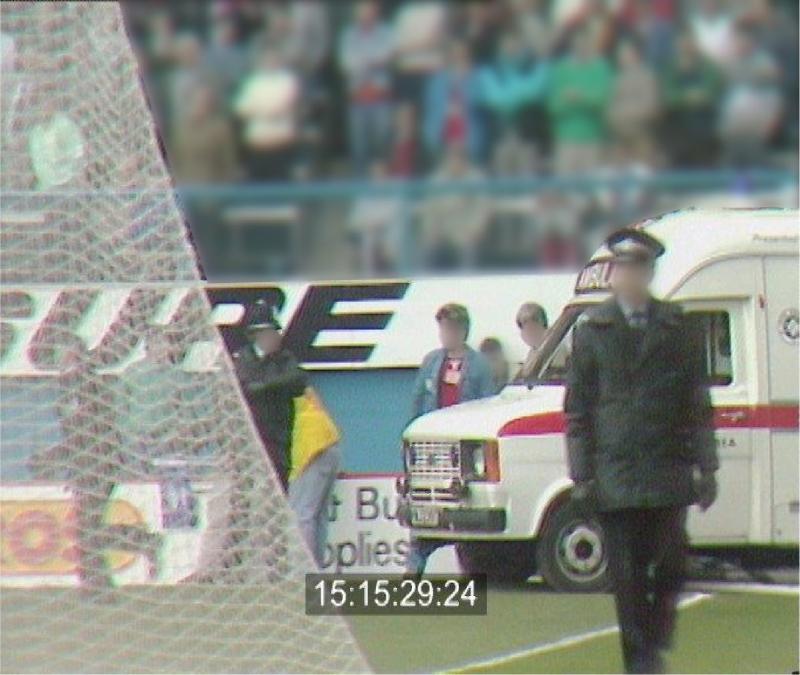
Figure 5I: The SJA ambulance arriving on the pitch (Source: BBC)
- There were still no signs of SYMAS ambulances on the pitch. More had arrived close to the stadium, but due to limited access had parked a short distance away and gone to assess the scene. At 15:18:42, a qualified ambulance officer (QAO) from the crew that had been dispatched at 3.05pm used the radio from the ambulance that was already at Gate C to inform SYMAS Control that this was a major incident. SYMAS Control did not pass the message on.
- In his 1989 account, the same QAO then described the efforts being made by police officers, SYMAS staff and others to resuscitate supporters and help casualties into the ambulance. He observed: “During this time I did not see any sort of command and control structure anywhere around the ground. I saw a lot of police officers but no one seemed to be in control. All the officers I saw were busy treating casualties.”
- This was correct; the police had taken no steps to coordinate the medical response or triage the injured, focusing on rescue and in some cases resuscitation. While both tasks were vital, this meant that the available medical resources were not used as effectively as they could have been. The PCB for example could have identified an officer to oversee triage but did not.
- Instead, its focus was on the lack of response from SYMAS. At 15:19:48, a message was sent to ask the Force Control Room to confirm the situation. The PCB operator said they needed at least 20 ambulances, but at present there were only three, all of which were near Gate C. At 15:20:47, the first SYMAS ambulance arrived on the pitch.
- Though the number of casualties was still uncertain, at 15:21:26, SO Higgins advised SYMAS Control that was this a major incident. SYMAS Control assured SO Higgins that nine or ten vehicles were on their way to the stadium but still did not inform the other emergency services.
In his 1989 statement, SO Higgins recalled that at 3.23pm DCAO Hopkins and ADO Morley arrived and parked next to his ambulance. SYMAS Divisional Superintendent Trevor Dale arrived shortly after. This meant that several senior SYMAS staff were now on site. More ambulances followed shortly after.
- SO Higgins said he told DCAO Hopkins that 30–40 supporters had died and many more were injured; DCAO Hopkins ran down to the pitch to see what was happening for himself.
- In his own account, DCAO Hopkins said he returned almost immediately and told ADO Morley to contact SYMAS Control to get the major incident vehicle and ambulances to go to the Penistone Road end of the ground.
- ADO Morley recalled that the matchday ambulance was parked on the vehicle access ramp with its rear doors wide open, but there were no wheeled stretchers inside and there were no SYMAS staff with it. He commented: “the whole area of the entrance off Penistone Road was bedlam at the time.” He then began to organise the arriving ambulances to receive casualties.
- SWFC CCTV footage timed at 15:28:00 captures the first SYMAS ambulance departing from Gate C taking casualties to hospital. Rather than reversing out, it went along the service road behind the South Stand towards Penistone Road.
- By this stage, several of the tasks that formed SYP’s Major Incident Plan had been undertaken but none of this was done in a controlled or systematic way. In his expert report for the Goldring Inquests dated 29 November 2013, paramedic David Whitmore observed that SYMAS staff had been left to act on their own initiative and without any formal command and control in place. He added that SJA staff had also been left “largely to their own devices.”
- Operation Resolve found no evidence to suggest that the police coordinated the activity of the other emergency services or SJA volunteers. Instead, the evidence highlights a lack of communication and coordination, particularly between SYP and SYMAS.
- At 15:31:38, a radio message was sent from the PCB to the SYP Force Control Room, asking for SYMAS Control to be contacted so that the senior SYMAS officer could be sent to the PCB. While such coordination would have been desirable, this request from the PCB was almost 24 minutes after the initial request from the PCB for a fleet of ambulances, and almost ten minutes after DCAO Hopkins and ADO Morley had arrived at the ground. The ambulance operation was by this stage underway, taking casualties to hospitals. In short, the request was too late.
- No evidence has been found to suggest that SYP took any action to locate the senior ambulance officer at the ground in an effort to coordinate the rescue activity.