

Changes to the barrier layout
- In June 1986, Insp Calvert sent the newly appointed SYP match commander, Chief Superintendent Brian Mole (Ch Supt Mole) a summary of officers' suggestions for improving policing at Hillsborough Stadium. One issue he raised was that some of the crush barriers on the West Terrace caused congestion as supporters entered the centre pens from the central tunnel. He raised the concern that similar problems could occur with getting into the tunnel if an emergency evacuation was needed.
- The primary cause of concern was barrier 144, a 7.625m-wide barrier consisting of three parts, located directly in front of the central tunnel. In evidence to the Taylor Inquiry in 1989, Insp Calvert explained that “the barrier was right across the entrance to the tunnel and the fans got to the barrier and stopped and we would have a build-up right back up the tunnel, fans would not move out and we could not control what was happening.”
- He and some colleagues felt that the West Terrace would be safer if the crush barrier was removed, or at least partially removed. After discussion with senior officers, it was agreed to propose this at the next OWP meeting, where after initial reservations by some members, it was agreed to remove parts of barrier 144.
- In a statement from 1990, the surveyor from South Yorkshire County Council (SYCC), who was part of the OWP, recalled this and said he had agreed with the proposal. However, he noted two key points. Firstly, he understood that the police would be present near the tunnel entrance and would work to keep the area clear of supporters. Secondly, he suggested marking out a ‘sterile area’ in front of the central tunnel mouth that should be kept clear of spectators at all times.
- Two parts of the barrier were removed as proposed and yellow markings painted on the floor to mark the sterile area. These markings are just visible either side of the radial fence in figure 2H, which was taken after the disaster. However, no evidence has been found that either SYP or SWFC managed the sterile area at the 1989 FA Cup Semi-Final or took steps to prevent supporters standing there.
Image
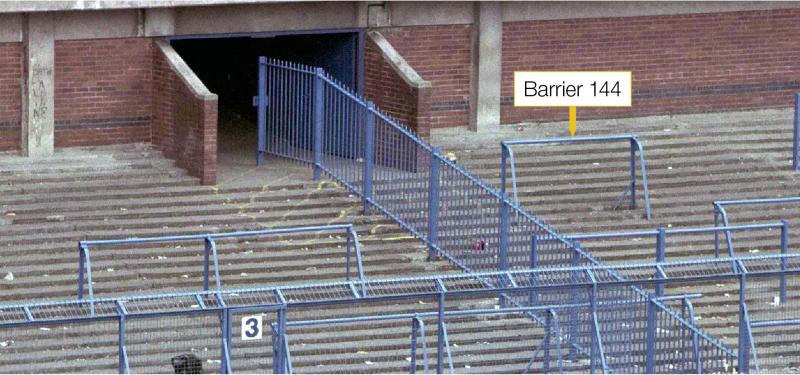
Figure 2H: The location of barrier 144 and the central tunnel, April 1989 (Source: Philip Rich, SYP)
- In his first report, Mr Cutlack commented: “Clearly, it was intended that the removal of part of barrier 144 was to have a beneficial effect on safety however in my opinion the reverse was true.” He explained that “The removal of this barrier created an un-obstructed path for a crowd surge in the tunnel” and added: “In my opinion EP [Eastwood & Partners] should have resisted this alteration and advised the Club and the Police of the likely implications of removing Barrier 144.”
- On the day of the disaster, a crush barrier in Pen 3 collapsed. This has been identified as one of the key moments in the disaster. The evidence does not suggest that the removal of barrier 144 had any direct effect on the barrier that collapsed.
- In his report, Mr Cutlack explained that during the crush, barrier 124A was subjected to a pressure greater than it had been designed to withstand, as a result of three factors:
- crowd density
- the depth of the crowd behind the barrier
- the fact that barrier 136 (higher up the terrace) was substantially lower than recommended, resulting in the crowd behind this barrier exerting a greater forward pressure
- However, he did not believe that the removal of barrier 144 could have had any impact on barrier 124A, because the additional pressure on barrier 124A came from an area outside of where barrier 144 had been.