

The instructions SYP gave about producing recollections
- As detailed at paragraph 9.42, in a CID briefing on 16 April, D Supt McKay told the officers present not to make pocket notebook entries about the disaster. The HIP Report highlighted D Supt McKay’s instruction as the point when “SYP began to shape the investigation that followed.” Others, before and since the HIP Report was published, have suggested that this was a deliberate attempt from SYP to control the evidence that officers gave. The IOPC investigated this issue.
- D Supt McKay has stated that “the decision not to make pocket book entries was mine and the subsequent decision taken by the Force stemmed solely from me and this briefing.”
- However, his initial instruction was given only to CID officers. On the main SYP F Division Operational Order for the game, there were fewer than 40 CID officers among the 812 officers on duty on the day, and it is not certain that all of these same CID officers were at the briefing led by D Supt McKay.
- In a joint statement to Operation Resolve and the IOPC, D Supt McKay recalled that during the meeting with CC Wright on 17 April, he saw ACC Jackson prepare “a telex that was sent out to all stations within the Force area and this highlighted that no delayed entries were to be made in pocket books and notes were to be made.”
- In a statement to Operation Resolve in May 2015, Police Sergeant Philip Whitlam (PS Whitlam) recalled that a “fax” was circulated on 17 April 1989, instructing officers to prepare an aide-memoire. He subsequently sent a copy of this document to Operation Resolve. It is in fact a telex, marked from the Chief Constable for the “Information of Chief Superintendents.”
- The telex was recorded as being sent at 1.24pm on 17 April, which indicates it was produced after the meeting with CC Wright that morning, in which D Supt McKay made the suggestion to obtain recollections. It therefore seems highly credible that this was the document D Supt McKay was referring to.
- The telex advised that all members of the force who had been involved in any way with “the events at Sheffield Wednesday on Saturday 15th April” would probably be interviewed and required to make a statement. It instructed: “In order that there [sic] recollections are as accurate as possible these officers should be seen by a supervisory officer and asked to prepare a note in the form of an aide-memoire – not a statement – of their recollections of what occurred.”
- The guidance continued: “This could usefully include not only information about what these officers did but also what they saw, including crowd behaviour.” Subsequently, officers received further instructions about what to include in their recollections.
- The instruction in the telex clearly differentiated between an aide-memoire and a statement. However, it did not mention pocket notebooks.
- A number of officers have said they received instructions not to make pocket notebook entries. However, they have referred to getting these instructions in many different locations and at different times. For example, some said they were told not to make a pocket notebook entry on Saturday 15 April—so before D Supt McKay’s first instruction. Yet other officers who attended the same debrief meetings did not recall being given any instruction to this effect.
- Some officers recalled being specifically instructed to write recollections on plain paper but did not remember being told anything about their pocket notebook. Others stated that they were given no instructions whatsoever about their pocket notebook and completed an entry as normal.
- The IOPC asked SYP and its former officers for their help in recovering pocket notebooks. This was the first time SYP had been directly asked for pocket notebooks related to the disaster. In a search of its archives, SYP found a large number of notebooks that had been stored with no marking or labelling to indicate they were relevant to the Hillsborough disaster.
- A significant number of officers—or their families—also responded and provided the IOPC with notebooks from the relevant time, which they had kept. Some officers who handed pocket notebooks to investigators did this when first interviewed; others looked for notebooks or other relevant documentation at home after being interviewed by the IOPC and contacted investigators when they found relevant material in lofts, cupboards or other spaces.
- In total, 8,407 pocket notebooks were retrieved and reviewed during the IOPC investigation. Of these, 2,338 related to two crucial periods:
- March – April 1988, which covered the previous year’s FA Cup Semi-Final between Liverpool and Nottingham Forest, including planning and preparation
- March 1989 – April 1991, which covered the planning and preparation for the 1989 Semi-Final, the day itself, the immediate aftermath and subsequent investigations up to the end of the Popper Inquests
- Across all of these, 359 notebooks included entries related to the day. This is not as many as would be expected if all 1,100+ officers on duty had made pocket notebook entries in line with normal practice and if all pocket notebooks that covered the day had been retrieved. However, it is far more than were previously believed to exist.
- The overwhelming majority of the pocket notebook entries that related to the day itself were factual—simply stating when officers came on duty, where they were deployed and when they came off duty. They provided few details of the events of the day, though some referred to various debriefs that took place. For example, 20 notebooks specifically mentioned a debrief taking place in the North Stand at the stadium. However, there was no relevant information in the notebooks about what these debriefs covered.
- D Supt McKay has provided the explanation that pocket notebooks were simply not a suitable tool for officers to record recollections of such a huge event. However, the HIP Report identified a possible alternative reason. It referred to the fact that in a meeting on 26 April 1989, Mr Metcalf from Hammond Suddards commented that “pocket notebook entries can be called for and must be produced.” This meant that if the Taylor Inquiry asked to see any pocket notebooks, SYP would have had to submit them.
- However, this comment was made
- nine days after the date on the fax produced by PS Whitlam
- ten days after D Supt McKay formally instructed CID officers not to make pocket notebook entries
- eleven days after the disaster—on the evening of which several officers have stated that they were told not to make pocket notebook entries
- Any instruction not to use pocket notebooks to record evidence therefore appears to have predated this advice from Hammond Suddards.
- While the evidence around pocket notebooks is unclear, the picture is clearer about what instructions officers were given about their accounts.
- The first instructions were those in the telex on 17 April 1989. The next set of instructions to officers was issued on 26 April, by Ch Supt Wain. He briefed a team of seven detectives to obtain accounts from officers who were deployed in the vicinity of the Leppings Lane end and gave them a document listing five questions that the officers should answer. After basic administrative details, the main two questions were: “What did you see that is in any way relevant to the incident?” and “What did you do?”
- The background to Ch Supt Wain issuing these instructions was that on 24 April he had been given the responsibility for producing SYP’s written response to the Taylor Inquiry. The need for such a response—known as a ‘proof of evidence’—had been identified by Mr Metcalf at the first meeting SYP had with Hammond Suddards after the disaster, on 19 April. At the request of DCC Hayes, Mr Metcalf had then sent written guidance on what this should cover, setting out six broad topics. In the same letter, Mr Metcalf had also advised DCC Hayes that: “In our view, it will be necessary to have statements from as many as possible of the Officers who were deployed at the ground on that day”. He suggested that these statements should cover “when they came on duty, to whom they were responsible, where they were, what they observed and what they did.”
- Notably, he also wrote: “As the statements concerned are not required for the purposes of any criminal investigation, there is no reason for them to be prepared on CJA forms and indeed many can, in our view, be 'self-taken’, in the sense of simply forming a record of the recollections of the Officer concerned on the points raised above.”
- When Ch Supt Wain took on the task of producing the proof of evidence, he asked what statements Hammond Suddards wanted from officers. DCC Hayes initially told him that this was no longer necessary, as WMP would be taking statements. However, after the meeting DCC Hayes followed the matter up with Hammond Suddards.
- Mr Metcalf was on holiday, so DCC Hayes spoke to a junior solicitor, Belinda Norcliffe, who advised him that the Taylor Inquiry would want statements from all officers who had been on duty in the Leppings Lane area, as well as from all officers of inspector rank or above who had been on duty anywhere. This would be in addition to any official CJA statements taken by WMP.
- Following this conversation, Hammond Suddards researched whether SYP officers could produce “self-taken statements”. Miss Norcliffe called DCC Hayes later that day to advise him that this would be fine. The Hammond Suddards note of this second call also mentioned that DCC Hayes asked whether it was acceptable for four senior officers—Ch Supt Duckenfield, Supt Murray, Supt Greenwood and Supt Murray—all to refer in their accounts to the same timeline of events that SYP had produced by using photos and video footage.
- According to the note, Miss Norcliffe replied that this was fine because it was SYP footage, and it was not in conflict with the evidence that was likely to come out at the Taylor Inquiry. She added that if Counsel advised otherwise at the meeting on 26 April, then the officers’ accounts could be amended. This was the first point at which the possibility of amending accounts was raised. No evidence has been found to suggest that DCC Hayes questioned or challenged it.
- The instructions Ch Supt Wain issued on 26 April reflected the guidance from Hammond Suddards to that point. However, at a meeting later that day, William Woodward QC, the barrister appointed to represent SYP at the Taylor Inquiry, suggested that officer accounts could be broader in scope: “You also ought to be aware that the information you give us is privileged so you should encourage anybody giving evidence to put in his feelings, his worries etc.”
- In statements to the IOPC, both DCC Hayes and Mr Metcalf identified this as a significant change.
- Following this meeting, the instructions to officers were revised and further questions were added. Several variations of the revised instructions have been found but the essence is the same: in the versions dated after this meeting, officers were asked to comment on issues such as crowd behaviour and the mood of the supporters, and to include their fears, feelings and observations.
- In addition, on 27 April, DCC Hayes issued a telex, informing all divisions that he had instructed a team of officers, under the command of Ch Supt Wain, to prepare the proof of evidence for the Taylor Inquiry. He asked all officers who had been on duty at the game and had not yet provided an account to produce written accounts. Due to the very short timescales for production of this proof of evidence, he requested the cooperation of all staff in this—noting that, if necessary, officers should be released from normal duties to complete their accounts as soon as possible.
- Towards the end of the meeting on 26 April, DCC Hayes asked Mr Woodward: “The main players in this are doing their own accounts. Is that O.K. or would you rather someone take their statement?” Mr Woodward responded: “It couldn’t be better. They can put all the things in that they want and we will sort them out.”
- According to the meeting notes, Mr Woodward did not elaborate on what he meant by “sort them out”. However, in the context, it would appear to suggest the possibility of revising the accounts the officers submitted in some way, to address any potential issues the legal team foresaw. This then seems to be the second time that the legal team raised the possibility of changing officers’ accounts. Like the first, it went unchallenged by SYP.
- Based on the available evidence, including witness statements taken from several officers involved in the process, the IOPC has built up a broad picture of how SYP collected the accounts and what they did with them.
- Officer accounts were formally received into the MIR and registered on the HOLMES database as reports rather than statements, with an identifying number.
- The handwritten versions were typed up and again stored on HOLMES.
- The typed versions were reviewed and marked up for indexing. This is a standard process in an MIR, where the readers mark points in the document that relate to key investigative themes or topics. The indexers then update the document record on HOLMES to show that it contains information relating to these themes. The database can then be searched thematically.
Image
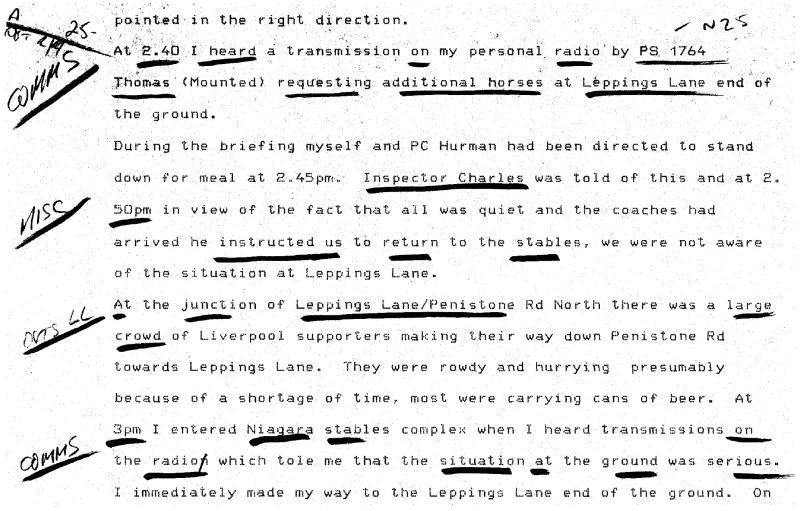
Figure 9C: Indexing marks on an officer’s account (Source: SYP Archive)
- A detective sergeant who was a member of the team under Ch Supt Wain stated to the IOPC that “Ch Supt Wain always read the documents first and then passed them to whoever the matter related to, depending on which area of concern the item related to. He read everything without exception.”
- The detective sergeant also noted that from an early stage, the topics highlighted by the team in officer accounts typically related to “criticisms of senior management, loss of control, lack of communication and lack of leadership.”