

The first amendments
- On 10 May, the first batch of accounts was returned to Ch Supt Denton with suggestions for amendments made by Hammond Suddards. They were sent back as three faxes and included comments that words may be missing or that spelling should be checked or corrected, alongside broader suggestions such as: “We should like him to review the comment on page 10, first paragraph, relating to the apparent lack of organised Police effort”.
- There were a number of requests to check facts. In three cases, it was suggested that the final comment should be removed; in one (the account of Insp White), the fax suggested the removal of a section of several paragraphs that the officer had written under the heading “additional points arising.”
- In total, across the three faxes, Hammond Suddards suggested changes to 28 of the 68 accounts reviewed at this stage. In his first prepared statement to the IOPC, Ch Supt Denton recalled receiving the first faxes and noting that Mr Metcalf was “suggesting fairly significant amendments to a number of the recollections before release, such as the removal of opinion, ambiguity and over-descriptive language.” He stated: “It was immediately apparent that, on Mr. Metcalf’s advice, substantial amendments to many of the recollections would be required before they could be released to WMP.”
- Despite this, the IOPC has found no evidence to indicate that Ch Supt Denton challenged any of these proposed amendments and nor did any member of his team. The ‘suggestions’ were treated as instructions and acted upon.
Image
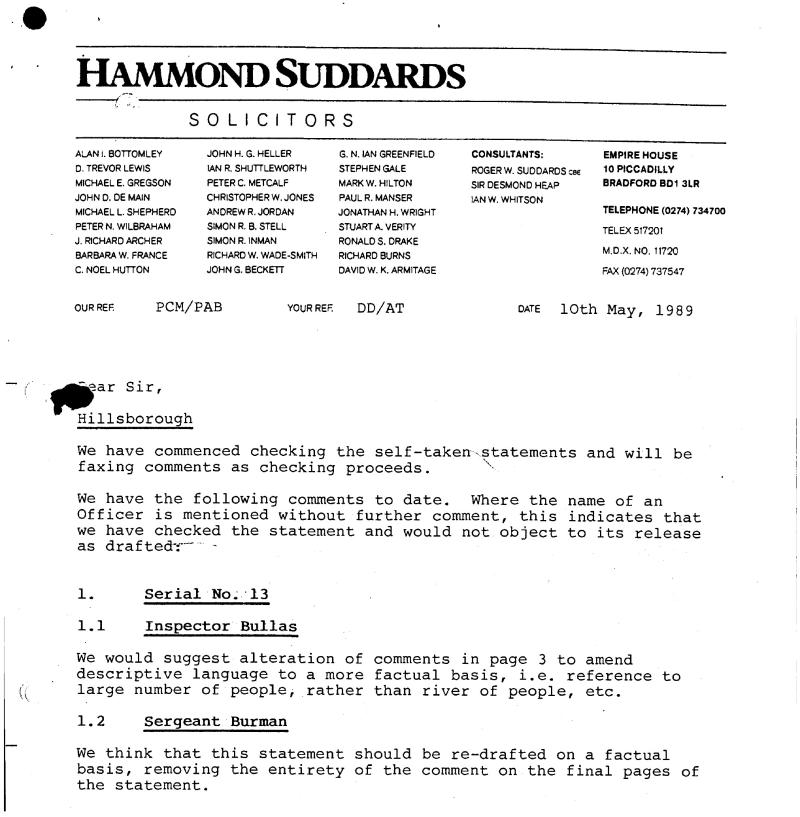
Figure 9D: Extract from first fax sent as part of the review process (Source: Home Office)
- In both his evidence to the Goldring Inquests and his first prepared statement to the IOPC, Ch Supt Denton described a standard process he and his team used in implementing the amendments suggested by Mr Metcalf. The following summary is drawn from Ch Supt Denton’s evidence.
- Ch Supt Denton and DCI Foster reviewed the faxes sent from Hammond Suddards.
- DCI Foster would then retrieve copies of the relevant original accounts.
- Either DCI Foster himself, or another member of the team, determined what wording needed to be changed, annotated the original account accordingly and handed the annotated version to typists to retype.
- The amended versions were then sent back, via various detective sergeants, to the officers who had originally produced them. These officers were asked to review the amended accounts and sign them; they were not necessarily told what had been changed.
- Over the following days, this process was adopted for all accounts that SYP had gathered by that point. In total, 426 accounts were sent to Hammond Suddards for review: these included the accounts of almost all the officers who had been deployed at the Leppings Lane end, whether inside the stadium or outside the entrance, or in other key roles on the day. The lawyers—predominantly Mr Metcalf—suggested amendments to 172 of these.
- Though only the amended versions were sent to WMP, SYP retained the original accounts and the amended versions. In some cases, it also retained a printed copy of the account marked for amendment, with changes written on by hand before the amended version was typed up.
- While Ch Supt Denton has accepted “full supervisory responsibility” for the amendment process, including sending accounts to Mr Metcalf and receiving his responses, the evidence supports his assertion that he did not personally make any amendments. DCI Foster has confirmed he was at the heart of actually making the amendments but also added that two other officers were “involved in carrying out the amendment process in accordance with the legal advice received.”
- Having looked into the process in detail, the IOPC found evidence that one of these officers played a predominantly administrative role in the process. However, the other, Detective Inspector Philip Jones (DI Jones), signed or initialled handwritten notes on 106 officers’ accounts. These included notes implementing amendments suggested by Hammond Suddards as well as, in 16 cases, further suggested amendments, apparently from DI Jones himself.
- In a statement to Operation Resolve in March 2014, DI Jones stated that at some point after the disaster, D Ch Supt Addis gave him a bundle of around 12 accounts on which suggested amendments had been marked up. DI Jones said he was told “to contact the officers, interview them and delete certain parts of their reports.” DI Jones stated to Operation Resolve that he did not know who had suggested the changes but that he was instructed to “have them remove any criticism of senior officers and criticism of the radio communications”. He stated he believed he had been asked to do this because DCI Foster was away.
- When IOPC investigators interviewed him and pointed out there was evidence that he had amended more than 12 accounts, DI Jones accepted that he had been involved in amending more than 12 accounts but stated: “I was acting in accordance with legal advice and under the direction of senior officers.”
- Both DCI Foster and DI Jones have stated that they amended accounts in accordance with legal advice. However, for 94 of the accounts that were amended, there is no record of advice from Hammond Suddards. Instead, the IOPC has established that from around 16 May—the day after the Taylor Inquiry hearings started—SYP reviewed and amended officers’ accounts in-house, without sending them to Hammond Suddards.
- In total, 736 accounts were reviewed by the in-house team of officers: predominantly DCI Foster, DI Jones and one other. The amendments made through this process were similar to those recommended by Hammond Suddards.
- The possibility of SYP reviewing accounts in-house was first discussed on 10 May. According to a file note made by Hammond Suddards, ACC Anderson telephoned the solicitors to discuss the fact that WMP had now asked for accounts from around 600 SYP officers. These were officers that had been on duty at the Semi-Final, but not at the Leppings Lane end.
- Mr Metcalf commented that while they could follow the same process as previously, Hammond Suddards “would be under considerable time difficulties and would not be able to process these prior to the 22nd or even the 29th of May.” In response, ACC Anderson proposed that these officers should be asked to provide a statement that “sticks to factual matters alone”, and that these “would then be vetted by the Police themselves.”
- The accounts of this new group of officers were reviewed and amended by Ch Supt Denton’s team, rather than Hammond Suddards; the solicitors were only contacted if Ch Supt Denton’s team had specific queries.
- For a brief period, this process ran concurrently with the vetting of the previously requested accounts, which was being conducted by Hammond Suddards.
- A range of documentary evidence shows that from an early stage, WMP and the Taylor Inquiry team were aware that SYP had adopted a vetting process for officers’ accounts—though the IOPC has not established who informed them or when. The prime concern from WMP appears to have been that this could delay the delivery of accounts to the Taylor Inquiry team.
- On 15 May, the Taylor Inquiry opened and Andrew Collins QC, Counsel to the Inquiry, gave a preliminary statement in which he explained that “At this stage only witnesses who can give factual evidence will be called” and added: “This is not the stage for witnesses to give evidence of their opinions.” However, he added that “this does not of course mean that the Inquiry will ignore the opinions of those who wish to put them forward” and suggested that these could be offered in writing.
- This stance was confirmed in a letter from David Brummell of the Treasury Solicitor’s Department, who was part of the Taylor Inquiry team, to ACC Jones on 7 June. The letter was sent after an SYP officer was asked questions at the Taylor Inquiry relating to his original account, which had been sent to WMP by mistake, rather than the amended version.
- Mr Brummell dismissed ACC Jones’s concerns about this, commenting: “The main difference between the initial and final versions of the South Yorkshire Police Officers' statements is that any expressions of opinion were (as I understand it, on the advice of Mr. Woodward) removed from the final version.” He added: “As I understand it, Andrew Collins' view is that there is absolutely no reason for excluding such expressions of opinion when they touch on matters relevant to the Public Inquiry and that, in the circumstances, there is no objection in principle to written statements containing such opinions being submitted to the Inquiry.”
- While this reaffirmed that opinions did not need to be removed, WMP had already been alerted to the possibility that some material changes were being made to accounts. On 22 May, an SYP officer telephoned DCI Ross to complain that his statement had been altered.
- DCI Ross informed ACC Jones, who in turn wrote to CC Wright at SYP. The letter began: “I thought I would advise you discreetly that we have had two approaches from separate sources suggesting omissions have been made from officer’s recollections.”
- The IOPC has found no evidence to suggest that either WMP or SYP sought to stop the amendment process or look into the issue. Instead, it appears to have been the catalyst for SYP to issue an internal message, titled ‘The Hillsborough Inquiry – Update II’, which was specifically addressed to “officers of the South Yorkshire Police submitting evidence to the West Midlands Police”. It referred to the fact that officers’ accounts had been amended and acknowledged that some officers had expressed concerns about this. It explained that the amendments were “necessary” and had been made “to remove conjecture and opinion and to leave only matters of fact.”
- The crucial consequence of the amendment process was that WMP only received the amended accounts, so any further actions it took or analysis it conducted could only have been based on those versions. Its investigation was based on the information SYP chose to give it. Similarly, the Taylor Inquiry team could only call witnesses to give oral evidence based on the amended accounts; there may have been information in the original accounts that would have been relevant to the Inquiry, but this was not available for consideration.