By contrast, there was considerable detail of the meeting with Mr Shersby, on 3 October 1989. Minutes show it was organised by the Police Federation and that, along with Federation representatives including PC Middup, several senior officers were there, including DCC Hayes.
From the start, it was made clear to attendees that the purpose of the meeting was “to draw out information that would be helpful to Michael Shersby when Parliament came to debate the Hillsborough disaster.”
Two months earlier, the Taylor Interim Report had been published. The report clearly rejected the views of police witnesses to the Taylor Inquiry that the behaviour of supporters—particularly in relation to allegations of large-scale drunkenness—was a contributory factor. Lord Justice Taylor wrote: “I am satisfied on the evidence, however, that the great majority were not drunk nor even the worse for drink.”
In early September 1989, Mr Shersby met Mr Hurd to discuss various policing matters. Notes of that meeting recorded that Mr Shersby “had heard that morale in South Yorkshire had taken a great knock as a result of Lord Justice Taylor's interim report”, and that he had been invited to visit SYP.
On 3 October, the Police Federation meeting began with a video presentation to Mr Shersby, led by Ch Insp Bettison. This was intended to provide some context about the disaster. According to meeting notes, the video lasted 29 minutes and included, among other things, a history of football disasters, the layout of the stadium and a comparison of the crowd in 1988 and 1989.
While it was being played, DCC Hayes and Ch Insp Bettison, among others, added further comments relating to previous games and pinpointed specific points in the footage. There were also discussions about the impact the disaster had had on officers and an acknowledgement that supporters had helped in the rescue effort.
However, the notes show that about halfway through the morning session, the tone of the discussions changed from concerns for officers to condemnation of supporters. For example, Ch Supt Mole said the behaviour of supporters in 1989 “was the worst seen”. As Ch Supt Mole had only arrived at the ground once the rescue effort was almost complete, this comment could not have been based on his own experience. Other officers strongly stated that the Taylor Interim Report had overlooked key aspects of police evidence about supporters’ behaviour.
Tony Judge was Publicity Director of the Police Federation nationally and Editor of Police, the Federation journal. He was also present at the meeting. At the end of the morning session, he was recorded as saying “evidence that was not given in the Taylor Report should come out”, and then that “we should plan with Michael Shersby the counter attack.”
In the afternoon, individual officers were invited to give their account of the disaster. These officers were, for the most part, not named in the meeting notes; instead, they were referred to as “Officer A”, etc. The majority of their accounts included references to supporters being drunk and aggressive or abusive. Officers identified in the notes as A and B reported extreme drunkenness; Officers C and E differentiated between what they called genuine supporters and “yobbos”. Officer G suggested that when supporters arrived at Sheffield train stations “at 10 or 11 am all you could smell was beer.”
Officers repeatedly stated that they could not understand why the Taylor Inquiry had rejected evidence about alcohol when they themselves had seen so much being consumed. Several officers specifically mentioned that they hoped Mr Shersby would use their account in parliamentary debates around the disaster.
This discussion was facilitated by Ch Insp Bettison, who began by drawing officers’ attention to some positive comments from the Taylor Report: “If you thought Lord Justice Taylor's Report was unfair – paragraph 253 of the Report: ‘Most Officers did all they could. Many supporters paid tribute’, paragraph 278 ‘Over many years the South Yorkshire Police have given excellent service to the public’, paragraph 279 ‘Aggravated by hostility to rescue victims’.”
He then added: “you have the opportunity to present more balance to the Report: fit those paragraphs much more in context.”
Through close comparison of what was said at the meeting with officers’ written accounts and transcripts of evidence, the IOPC was able to identify six of the officers who spoke at the meeting and asked them what they recalled of it. One was medically unfit to be interviewed, and two told the IOPC they had no recollection of the meeting. Two did recall it and said that they were invited to speak openly, so they did.
At the meeting, one of these officers said: “Before the crush I took a wheelchair through because there was no other way in. As we turned round to get out, the crush was so bad we could not move. We asked for horses to come across to stop them pushing. The horses were kicking people back to stop them pushing. Liverpool have been exonerated from this Inquiry because it would be the death of Liverpool Football Club.”
The IOPC has not found evidence of witnesses referring to being kicked by police horses, though one supporter complained to Operation Resolve that a particular police horse was not being adequately controlled. No mounted officer has stated that their horse kicked fans.
In his comments to the meeting, the other officer identified by the IOPC contrasted the behaviour of the supporters who had travelled to Sheffield by special train—who he described as “decent – no yobbos”—with the scene he saw at “the coach park where Liverpool supporters were being disgorged.” He said: “It was crowded outside supermarkets, urinating in streets. There were so many of them, it was ridiculous. The amount that came in the last 15 minutes was like a human tide. The camera was situated looking down Leppings Lane. But they came over the bridge too – no shots of them over bridge but there were just as many people coming over the bridge. They were carrying 4 packs, 6 packs, anything they could get hold of. There was a genuine reluctance to go into the ground.”
The IOPC compared the comments this officer made in the meeting with his initial written account made after the disaster and with his initial statement to the IOPC, where he described his experiences on the day. In neither of these did he refer to supporters urinating in the streets or carrying “4 packs, 6 packs, anything they could get hold of.” While he did say, in both his written account and his first statement to the IOPC, that supporters were drinking before the game and that some seemed reluctant to head into the ground, on both occasions he described the supporters he met as “good-humoured” and, in his written account, he said they were “well-behaved”.
The tone of his comments in the meeting with Mr Shersby—with terms like “a human tide”—therefore appears quite different to his initial account and to the statement he gave to the IOPC.
Three significant actions followed this meeting. The first was that, when Mr Shersby spoke during a debate in Parliament on the Football Supporters Bill on 30 October 1989, he said that “at the match at which the disaster occurred 3,500 individuals were determined to get into the ground at short notice. Unfortunately some of them had been drinking too much.”
The second was that on 8 November 1989, Ch Insp Bettison visited Parliament at the invitation of Mr Shersby, where he showed a group of MPs a video.
The third, also in November 1989, was the publication of an article in the Police Federation magazine that reported on the meeting. The article included several quotes from the meeting about drunken behaviour, though it did not include the names of the officers. It ended with the lines: “if the police version is indeed the unpalatable truth, the Hillsborough Inquiry's interim report has ignored a major cause for concern. If mass drunkenness is to be dismissed as a potential creator of future disaster, how can Taylor be said to have done his job?”
By the end of November 1989, the Sheffield Star and at least five national newspapers had published versions of the story.
Overall, the evidence examined does suggest that the meeting was set up to encourage Mr Shersby to speak up for the view of the police officers and particularly the Federation members, and that the prevailing view of the officers present was that the consumption of alcohol by supporters, and supporter behaviour, had contributed to the disaster. This view was not supported by other evidence.
Officers were entitled to share their views, and the Police Federation was entitled to arrange such a meeting. Nonetheless, the evidence indicates that some officers at the meeting exaggerated aspects of their accounts, in a bid to redress what they perceived as an imbalance in the Taylor Interim Report.
Mrs Thatcher travelled to Sheffield by helicopter on the morning of 6 April. The agenda for her visit included a briefing from SYP, then visits to the stadium and the hospitals to thank staff and speak to the injured and their families. She arrived in Sheffield at around 11.45am, accompanied by the then Home Secretary, Douglas Hurd, and left at around 4.45pm.
The HIP Report contains a suggestion that when briefing the Home Secretary and Prime Minister, SYP attempted to blame supporters for the tragedy. This suggestion appears to be based on two factors:
the HIP’s review of an early draft of the Home Secretary's statement to Parliament about the disaster
comments made by Sir Bernard Ingham, the Prime Minister’s Press Secretary, in the aftermath of the disaster
Any information given by senior SYP officers would be expected to form an important part of the Home Secretary and Prime Minister’s understanding of the disaster. The IOPC sought to investigate whether the briefing given by SYP to the Home Secretary and Prime Minister on the day after the tragedy contained any inaccurate or inappropriate information.
The early draft of the Home Secretary’s statement included the words: “The Chief Constable of South Yorkshire told us that shortly after the start of the match there was a surge of spectators on the Leppings Lane terrace which crushed many at the front against the safety barrier.” It also referred to the behaviour of Liverpool supporters outside the stadium, saying that police officers had needed to use “loudhailers to urge the crowd to be patient”; as the crowd increased, “some supporters started to climb the walls and turnstiles.” While the draft statement indicated that they did so to escape the crowd pressure outside the stadium, this could be read as a criticism of supporter behaviour.
In the final version of the Home Secretary’s statement, the reference to being given information by the Chief Constable was removed, and the description of a surge crushing spectators against the barrier was phrased as a factual explanation of what occurred. The comments about the use of loudhailers and supporters climbing walls were retained.
The IOPC has identified that there are strong similarities between the Home Office Statement and a written update sent from CC Wright’s office to the Home Office at 9.30am on 16 April 1989—before Mrs Thatcher’s arrival in Sheffield. This appears to have been an initial briefing to duty officials at the Home Office.
It is understandable that SYP provided an update to officials and that the Home Office used this as the basis for drafting a statement. The Home Office, in both its early and final versions, added more information; it also expressed sympathy for those affected and thanked those who helped in the rescue attempt. These details were not in SYP’s written update.
As Press Secretary to Mrs Thatcher, Sir Bernard accompanied her when she visited Sheffield the day after the disaster. On multiple occasions, he has stated that while there, the police told them that the disaster had been caused by the actions of “tanked-up” supporters. For example, in a letter sent in 1996 to a man whose friend had died in the disaster, Sir Bernard wrote: “I believe that there would have been no Hillsborough disaster if tanked-up yobs had not turned up in very large numbers to try to force their way into the ground. I visited Hillsborough the day after the disaster and I know what I learned then.”
In a 2014 statement to the IOPC, he said: “We were told that a huge crowd had assembled there late, some of whom I was told were ‘tanked up’.” He did not specify who told him this.
There are no minutes available of the briefing Mrs Thatcher received from officers. Several of those involved in the meeting with Mrs Thatcher had died before the IOPC investigation began, including CC Wright and Mrs Thatcher herself.
However, the evidence from others present offers a very different perspective to Sir Bernard’s. Mr Hurd stated to the IOPC: “There was no hint at the time of what became The Sun story ‘it was all the fault of the Liverpool fans.’ I didn’t know about it until I saw the story – I had never heard that story.” He added: “On the day of our visit I don’t think that I heard anything about how the fans behaved from anyone on the day of the disaster.”
Dominic Morris was the Private Secretary for Home Affairs at the time and also accompanied Mrs Thatcher throughout the visit. He told the IOPC he had no recollection of officers making any reference to alcohol or the behaviour of supporters.
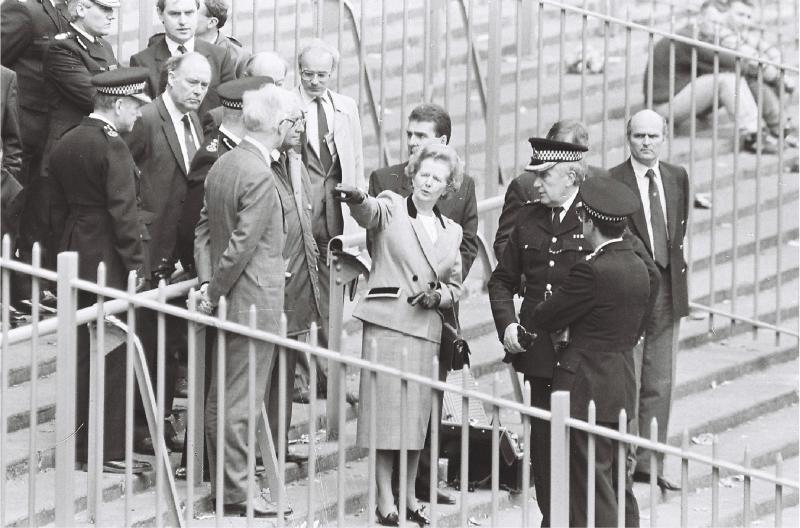
Photographs show Mrs Thatcher visiting the Leppings Lane terraces. Three uniformed senior officers can be seen with her, including Ch Supt Duckenfield (with back to camera) and Ch Supt Mole (next to Mrs Thatcher). CC Wright was known to be present and may be the obscured officer, standing to Mrs Thatcher's right.
Image
Figure 8A: Mrs Thatcher’s visit to the terraces, Sunday 16 April 1989 (Source: NewsCorp/The Times Group)
A number of journalists were also present during Mrs Thatcher’s visit, and some toured the ground with her. Investigators asked them for their recollections; none remembered any comments from the police about supporters. The IOPC also asked officers who were, or may have been, present if they could recall what had been said; none could.
All available AV footage has been scrutinised. IOPC investigators also examined a range of papers and diaries related to the period. These included:
Mrs Thatcher’s diaries
Lord Hurd’s diary, which he handed to investigators when interviewed
Sir Bernard Ingham’s papers, which are held by the Churchill Archive Centre in Cambridge as part of its Thatcher Archive
Despite these wide-ranging efforts, it has not been possible to confirm the details of the discussions between SYP and Mrs Thatcher and her advisers on the day after the disaster.
Under the term of reference covering SYP’s engagement with the media and MPs in the aftermath of the disaster, the IOPC investigated: The interactions of police officers with the press and politicians, in particular:
a) whether any police officer was involved in the passing of inappropriate or inaccurate information to a journalist, including whether any police officer was involved in passing written accounts to the press b) whether any police officers passed inappropriate or inaccurate information to any Member of Parliament—whether individually or at meetings. This will include investigation of the actions of Chief Inspector Norman Bettison in visiting Parliament and the evidence he presented, its content and subsequent use by others c) whether the briefing which was given to the Home Secretary and Prime Minister on the day after the disaster contained any inaccurate or inappropriate information d) whether the evidence demonstrates that such interactions were directed or encouraged by SYP
This chapter focuses on parts b and c. Some interactions with MPs, in relation to what they then said to the media were covered in chapter 7, along with issues under part a.
What was found?
• Despite wide-ranging enquiries, it has not been possible to establish what SYP officers told the then Prime Minister, Margaret Thatcher, when she visited Hillsborough Stadium the day after the disaster. Key witnesses have provided very different accounts of what was said.
• At a meeting with Michael Shersby MP, the then parliamentary advisor to the Police Federation, in October 1989, some officers described the behaviour of supporters in more critical terms than they had done in their original accounts. This was in the context of an attempt to address a perceived imbalance in the Taylor Interim Report, which some officers described as a whitewash.
• MPs who attended an SYP video presentation in Parliament about the disaster felt that the force was trying to present its side of the story. None felt it changed their understanding of events.
Significant new evidence
The IOPC obtained three versions of a similar video, all of which fulfil the description of the video shown at both the meeting with Mr Shersby and the presentation in Parliament. The videos were provided by different sources. The IOPC has analysed these; two are identical and the third is a few minutes longer and has a different voiceover. The IOPC has not been able to confirm which was shown on either occasion.
In addition, the IOPC has taken statements from several MPs and former civil servants who attended one or more of the meetings under investigation for this term of reference.
After the IOPC announced its investigation into the aftermath of the Hillsborough disaster, it received a number of complaints relating to police interaction with MPs. These came from supporters who had been at the game and survived the disaster, and from family members of those who died, and focused on three events.
The visit of the then Prime Minister, Mrs Thatcher, to Sheffield the day after the disaster, and what information officers gave her and her advisers during it.
A South Yorkshire Police Federation meeting on 3 October 1989, where numerous police officers told Mr Shersby that they had been prevented from giving evidence about supporter behaviour to the Taylor Inquiry. At the time, Mr Shersby was the parliamentary advisor to the Police Federation for England and Wales. At the meeting, these officers (who were not named in the meeting notes) recounted their experiences on the day of the disaster. Several expressly stated that they hoped Mr Shersby could use their accounts in parliamentary debates relating to the disaster.
A visit to Parliament by Chief Inspector Norman Bettison (Ch Insp Bettison) of SYP on 8 November 1989, where he gave a video presentation to 12 MPs about the disaster. Complaints referred to both the act of going to Parliament in this way, and the content of the video.
The three incidents above were all referred to in the HIP Report. The central allegation around them was that on each occasion, SYP officers were seeking to influence MPs’ understanding of the disaster and to draw attention to the behaviour of supporters.
The IOPC investigated each incident further, interviewing as many of those who were present as possible—including the police officers involved—to gather their recollections. In each case, investigators sought first to establish what information officers gave to MPs, as a step to assessing whether this was inappropriate or inaccurate.
Ten current or former MPs provided statements; a further four responded to the IOPC by email or telephone to state they had no recollection of the specific incident. In addition, the IOPC contacted and, where appropriate, took statements from civil servants and MPs’ staff who were identified as potentially having relevant information regarding this strand of the investigation. These included press officers and advisers to Mrs Thatcher.
The final topic considered under this term of reference related to media coverage that followed an article based on an interview CC Wright gave to the Sheffield Star in February 1990. This was after the Taylor Inquiry had published its Final Report and CC Wright had announced he would be retiring on 1 May 1990.
CC Wright was quoted in the article as suggesting that he didn’t understand the Taylor Inquiry’s finding that supporters’ alcohol consumption had not contributed to the disaster. He was also quoted as saying “a different picture” would emerge at the forthcoming inquests.
After the interview was published by the Sheffield Star, it formed the basis for articles in several national papers too. CC Wright also gave an interview to The Times. SYP received three complaints about CC Wright’s comments from family members of people who had died in the disaster. The complaints all suggested that CC Wright was abusing his position in relation to his access to the media; that his remarks could prejudice the forthcoming inquests; and that the comments about a “different picture” emerging appeared to be related to allegations of high levels of alcohol consumption among supporters.
These complaints were investigated in 1990, as part of WMP’s disciplinary investigation. CC Wright was interviewed by the investigating officers; he stated that the journalist had linked two distinct and unrelated points he had made, to create a slightly different meaning in the article.
The journalist was also interviewed and provided a full transcript of his conversation with CC Wright. This strongly supported CC Wright’s account. The transcript showed that CC Wright did say that he expected new evidence to emerge at the forthcoming inquests but did not say that this new evidence related to alcohol, as the article had indicated.
The complaint investigation concluded: “There is nothing in the words used by Mr Wright which can be construed as inaccurate, unfair, irresponsible or unjust” and there was “no evidence that Mr Wright was intending to influence the Inquests or any other proceedings”.
The IOPC re-examined this complaint, and found the transcript supports CC Wright’s assertion that his comments were made as separate points and had then been linked in the article.
Nonetheless, making comments that in any way cast doubt on the Taylor Inquiry conclusions was ill-timed ahead of the Popper Inquests and could be seen as an attempt to undermine the Inquiry’s conclusions. His actions were insensitive, and when invited to withdraw his comments, he declined— indicating he did not necessarily disapprove of the manner in which they had been reported.
The IOPC therefore concluded that CC Wright’s actions in relation to the articles could be deemed to have breached the discreditable conduct standard, and that he would have had a case to answer for misconduct, if he had still been serving.
These articles were the final stage in a series of interactions between CC Wright and the media, from the press conference on the evening of the disaster onwards. There, he had asserted that his officers would be vindicated, inferring from the outset that he did not believe the police were to blame, despite his acknowledgement that Gate C had been opened on police instruction. Over the following months, he consistently expressed to colleagues a view that supporters were in some way to blame for the disaster. When he gave the interview to the Sheffield Star, and another to The Times at around the same date, he expressed reservations about the Taylor Inquiry finding that alcohol consumption by supporters had no effect on the events. He also made some veiled procedural criticisms, relating to the way the Taylor Inquiry heard evidence.
These remarks were insensitive, cast at least some doubt on Lord Justice Taylor’s conclusions and could have had the effect of prejudicing the inquests. Having considered all of these interactions, the IOPC view was that CC Wright therefore would have had a case to answer for gross misconduct, on the grounds of discreditable conduct.
While the available evidence indicates that some officers did speak to the media, the IOPC has not found evidence that this was done in an organised way, or at the instruction of SYP senior officers.
In fact, there is evidence on two occasions of senior officers specifically instructing colleagues not to speak to the media.
On 19 April 1989, the day The Sun’s article was published, an entry on the SYP press log stated: “With immediate effect no South Yorkshire Police Officer will make any statement or comment to members of the media about the incident at Hillsborough football ground on Saturday 15 April 1989 without the Chief Constable’s express permission and approval.” An instruction to this effect was circulated throughout SYP that day, suggesting it may have been in response to the media coverage, including officers’ comments, that morning.
Then on 29 April, DCC Hayes circulated a memo reminding all officers that no one was to speak to the press without the express permission of the Chief Constable.
These instructions were in keeping with SYP’s Standing Order 31B (Media Liaison), which stated that “members of the Force, other than authorised, must not supply information to media enquiries on police matters”. This Standing Order instructed that in the case of criticism of the police or matters with which the Police Authority was likely to be concerned, “the supply of information to the media… will be restricted to chief officers.” It is reasonable to suggest that officers of all ranks would have known that the Hillsborough disaster was one such matter.
The IOPC examined the evidence around each of the allegations about supporter behaviour that were reported in the media.
Again, the focus was to look at whether the allegations were based on comments made by police officers and if so, whether there was evidence to support the comments.
In most cases, even where the reports appeared to indicate that police officers may have been the source of the allegation, the evidence of disruptive supporter behaviour was—and still is—very limited.
For example, WMP sought to investigate the allegation about supporters coming to the ground without tickets by including a question on the standard questionnaire it used for Liverpool supporters about whether they had got an advance ticket for the game and whether they still had it.
On 12 June 1989, WMP sent an update on the issue to the Taylor Inquiry team, based on a review of 1,699 questionnaires WMP had completed with Liverpool supporters. Of these, 136 (8%) said they had travelled to Sheffield without a ticket for the Liverpool section. When questioned, 42 said they bought a ticket from a tout. A further 46 said they bought a ticket near the ground, without specifying from whom, while 36 entered the ground without a ticket. WMP applied these figures to the total number of tickets available for Liverpool supporters and suggested that alongside the 24,000 Liverpool supporters with tickets there would have been 2,088 without. This was at best a miscalculation: WMP found that just 36 of the 1,699 entered the ground without a ticket, equivalent to 2.1%, which if applied to the maximum attendance would have amounted to 212 supporters entering without tickets.
WMP did not provide any information about how this compared to other all-ticket games. Further, it would be logical that those who bought tickets from touts would not have then attempted to enter the ground without a ticket.
Detailed analysis by the HSE, carried out in preparation for the Popper Inquests in 1990, concluded that the total number of people on the Leppings Lane terraces on the day did not exceed the maximum allowed capacity of 10,100. It established that 7,494 supporters had entered the Leppings Lane terraces via the turnstiles; the HSE estimated a further 2,020–2,480 came through Gate C when it was opened at 2.48pm and 2.52pm. This indicates that fewer than 10,000 Liverpool supporters entered the terraces in total, undermining the suggestion that the crowd was swelled by people without tickets.
Similar gaps or uncertainties exist around other allegations reported in the first few days. For example, several newspaper reports claimed that police officers had been attacked by supporters as they attempted to rescue people from the crush. Though the IOPC found references in a number of officers’ original accounts to being struck in some way, by the time these officers gave accounts to Operation Resolve or the IOPC they were in general less definite that they had been attacked by supporters, as opposed to simply being jostled in the rescue effort. A comprehensive analysis of video footage and photos taken on the day found very little that depicted or even suggested supporters were attacking police officers.
WMP sent a list of 34 witnesses to the Taylor Inquiry who claimed they had seen officers being spat at. These included some supporters and other eyewitnesses as well as officers. In several cases, the alleged spitting took place outside the ground, or in other places away from the rescue effort. Three of the witnesses specifically noted that the spitting was by Nottingham Forest supporters rather than Liverpool supporters; one PC stated that he was spat at by supporters of both sides.
It is understood that it was not uncommon for football crowds at the time to spit at police officers. Further, it would not have been a cause of the disaster, nor would it have hampered any rescue efforts.
One of the stories in the White’s news feed focused on allegations of stealing. An anonymous officer was quoted as saying: “There was a lot of pilfering going on while the bid to save lives was taking place.” The story included the claim that Liverpool supporters were “picking the pockets of victims”, which was then repeated in The Sun.
At the Police Federation meeting on 19 April 1989, two officers were reported as saying that one of those who died in the disaster had “numerous wallets” in his possession. This was apparently accepted by the meeting as evidence of stealing among the Liverpool supporters. However, this allegation was comprehensively dismissed at the Goldring Inquests, by reference to a police log which listed the property of each of those who died. None had more than one wallet in their possession.
No police force or other investigation has ever received any complaint from a family member of someone who died in the disaster about theft from their loved one.
The central allegation about the behaviour of supporters was that a large number were under the influence of alcohol. Here there was, and remains, a clear divide in the evidence.
In broad terms, supporters have consistently stated that the overwhelming majority of fans did not drink to excess and that there was nothing unusual or remarkable about the level of drinking by supporters before the game. By contrast, a significant proportion of police officers have consistently stated that the level of alcohol consumption was much higher than normal for a football match.
There is insufficient evidence from any other source to say with certainty which of these perceptions was correct. However, perhaps the pivotal point of the media coverage was the inference that excessive drinking had been a factor in the disaster—if not as a direct cause, then at least aggravating the situation in some way and making the rescue effort harder.
This claim was rejected as early as the Taylor Interim Report in August 1989, which suggested that officers had overstated the impact of alcohol as a way of explaining the loss of police control. Further investigations, including most recently the Goldring Inquests, did not find evidence to suggest that alcohol consumption was a factor. The jury at the Goldring Inquests concluded that there was no behaviour on the part of football supporters which caused or contributed to the dangerous situation at the Leppings Lane turnstiles. Similarly, the IOPC has not found any evidence to suggest that the behaviour of supporters caused or contributed to the disaster.
As set out in paragraph 7.45, the first media reports that raised allegations of supporter misbehaviour were published on 17 April. However, it was on 18 April that the allegations escalated, with both the Sheffield Star and White’s producing stories with similar details.
The IOPC sought to establish which of the two outlets had been the initial source of these stories.
Assuming the Sheffield Star followed its normal publication times—and no evidence has been found to suggest it did not do so on 18 April 1989—its article ‘Fans in drunken attacks on police’ would have been available from early afternoon, or possibly even late morning.
For White’s, sending news feeds to the nationals was (and remains) a central part of its business. However, it did also sell stories to the Sheffield Star. Therefore, it is possible that the story in the Sheffield Star could have been based on a White’s news feed. However, the evidence examined by the IOPC suggests this is unlikely.
Firstly, the White’s news feed was built up over the course of the day. The initial feed, consisting of just one story, was issued on the morning of 18 April. According to White’s, the second and third parts were then produced in the afternoon. These would, therefore, have been added after the Sheffield Star’s first edition—which included the article—was printed.
Secondly, in their statements to the IOPC, the White’s journalists indicated that they had not done much investigative work around the disaster in the immediate aftermath. The reason was that the majority of their clients—the national media—had sent their own reporters to Sheffield and so did not need the services of a press agency.
By contrast, one of the journalists whose name appeared on the Sheffield Star article ‘Fans in drunken attacks on police’ recalled producing the article. He told IOPC investigators that it took some time to research and develop. Rumours had been circulating about supporter behaviour, so he and a colleague were instructed to interview local residents and workers near the ground. They sought to substantiate claims before the paper was willing to print the article.
The White’s journalists who gave statements to the IOPC did not have any recollection of speaking to local residents. However, it does appear that White’s did have some contact with police officers in this period.
On 12 June 1989, White’s sent a memo to the news editor of the Evening Standard regarding the news feed it had sent out on 18 April 1989. The Evening Standard had been one of the first papers to print the allegations made in the feed.
In the memo, White’s provided an explanation of how the agency came about the information contained in the feed: “all the allegations in the stories we filed were made, unsolicited, by ranking officers in the South Yorkshire force to three different experienced senior journalists who are partners in this agency.”
The memo further explained that the first claims were received on the night of the disaster, when an officer told one of the journalists about being punched and urinated on. The following day, another of its journalists met by chance with a different officer who said they had witnessed bad behaviour by supporters. At that stage, White’s felt there was not enough confirmation to send a story making such serious claims.
However, when a third officer reiterated the allegations, White’s felt it was appropriate to send the story out.
There were five journalists at White’s at the time who fitted this description of ‘experienced senior journalists’. Two had died before the IOPC investigation began. The IOPC interviewed the other three. None recalled the memo, and none said they were one of the journalists to whom unsolicited allegations were made.
However, all three stated that if they did know the names of any officers who had spoken to the media, they would have been more than willing to disclose them to the IOPC. They commented that the story had damaged the reputation of White’s, and they also all felt that any right the sources may have had to anonymity had been lost by the fact that the stories had been false.
This raises the possibility that officers spoke to both the Sheffield Star and White’s. As noted, the IOPC was not able to identify the officers quoted anonymously. No officer admitted being the source of these quotes. However, it strongly appears that some officers spoke to the media and commented on the behaviour of supporters. A crucial part of the IOPC investigation was therefore to consider whether any of these comments were inappropriate or inaccurate.
There is a range of evidence to indicate that police officers spoke to the media about the disaster.
On Sunday 16 April, the SYP press log recorded an enquiry from Bob Westerdale, a journalist at the Sheffield Star, who said that he had “info from an unnamed officer who said the trouble was caused by 4000 drunken Liverpool supporters.” According to the press log, the SYP press office did not comment.
On Monday 17 April, among the extensive media coverage of the disaster, several newspapers published quotes from police officers—none of whom were named. For example, in The Independent, an officer was reported as saying: “I know my back will be covered in bruises. It’s been kicked all afternoon by Liverpool supporters while I’ve been trying to tend the injured.”
The Times included the comment: “Fellow officers were punched and kicked as they carried a dead girl, about nine years old, from the ground.” As the youngest person who died in the disaster was a boy aged 10, and the youngest woman who died was 15, it is not clear who this officer was referring to.
The SYP press log that day recorded queries from journalists at the Sheffield Star and The Sun asking for police comment on various allegations of misbehaviour by supporters; both reportedly asked about the allegation that officers had been urinated on. The press office did not comment on the allegations.
In its City Late edition (published mid-afternoon), the Sheffield Star named Supt Marshall as the police officer who had opened a gate at the stadium. The front-page article stated that he had made the decision “fearing a wall was seconds away from collapsing on hundreds of fans” outside. The article quoted an unnamed “high-ranking” colleague and an “officer at the scene”, both of whom offered support for Supt Marshall. Neither was quoted as commenting on the behaviour of supporters. However, the article did include references to some fans being “the worse for drink” and arriving late.
The comments in support of Supt Marshall were repeated in the Daily Mail on 18 April. The paper also included quotations from PC Middup, who was the SYP Police Federation representative. He strongly criticised the behaviour of supporters, stating that “they were arriving tanked up on drink”, and that: “Even as our lads were giving the kiss-of-life to victims they were being spat upon and pelted with coins.” The same article also quoted an unnamed chief inspector, who stated: “I have no doubt that a major contributory factor in the disaster was excessive drinking.”
In its first edition of the day, published around lunchtime, the Sheffield Star included an article headlined: ‘Fans in drunken attacks on police’. The article claimed: “Emergency workers were attacked and even urinated on by drunken fans”. One “high-ranking officer” was quoted as saying: “Some were like animals: drunk and violent”. The same quotation concluded: “People were picking coins off the floor as victims lay needing help.”
The same day, White’s News Agency issued a news feed consisting of three stories, all of which included allegations about supporter behaviour. Such feeds were made available to newspapers and other media outlets to reuse for a fee. The first article in the feed quoted three unnamed officers. In the second piece, an unnamed officer stated: “People were picking up coins which had fallen from victim's pockets as they lay on the floor”, and one “high-ranking officer” was quoted as saying: “Some of them were like animals, they were drunk and violent.” These words were almost identical to one of the quotations in the Sheffield Star; however, the White’s feed split the quotation between two officers. The second story also quoted PC Middup, using quotes very similar to those featured in the Daily Mail that morning.
The third story in the news feed was an extended quote from Irvine Patnick, Conservative MP for Sheffield Hallam.
In its West End Final edition that evening, the London Evening Standard published the material from White’s, largely verbatim.
At 6.30pm, the SYP press office received the first of a series of queries from journalists regarding a report they had received from an agency about supporters attacking the police. According to the press log, each caller was referred to WMP, which had by this time been given responsibility for investigating the disaster.
At 9pm that evening, both PC Middup and Mr Patnick featured in a BBC News broadcast. Both made comments about the behaviour of supporters that were similar to the quotes that had already been attributed to them in newspaper coverage.
At 10pm, Mr Patnick was featured in an ‘ITN News’ broadcast, again repeating the allegations. He stated that he had spoken to officers who had been attacked.
On Wednesday 19 April, several national newspapers published articles that appear to have been strongly based on the White’s news feed of the previous day. These included The Times, the Daily Express, the Daily Mail and the Daily Mirror.
The paper that gave the stories the greatest prominence was The Sun, in a now notorious article headlined ‘The Truth’. The key difference between The Sun’s coverage and that of other papers was that, rather than couching the stories in the language of allegations, The Sun published them as facts—emphasised by its headline. It also added two aspects that were not in the White’s feed: a further allegation and a quote from PC Middup, suggesting that The Sun had requested a comment from him.
Though media coverage of the disaster continued, the intensity reduced after this. It is clear that these initial stories were the most influential in terms of public opinion and caused the greatest distress.
The IOPC sought to identify the sources of the stories and in particular the quotes. Aside from official statements made in press conferences by CC Wright, the only police officer who was named as commenting on the behaviour of supporters was PC Middup. He was first quoted on the subject in the national papers on the morning of Tuesday 18 April. Other quotes were attributed variously to “officers who had been on duty”, “senior officers” and “experienced officers”.
There were two similar comments, both attributed to unnamed chief inspectors. In the Daily Mail on 18 April, a chief inspector was quoted as saying: “I have no doubt that a major contributory factor in the disaster was excessive drinking.” Then in an article from a different paper—which appears to be the Sheffield Star—an unnamed chief inspector was quoted as stating: “I am convinced excessing drinking was a major contributory factor.”
In this second article, the chief inspector was described as having “emerged from the temporary mortuary.” There were two chief inspectors known to have been in the temporary mortuary. Based on the strong similarity between these comments and words he has used in other accounts, the IOPC has identified that Ch Insp Sumner was the most likely source of these comments. This clear similarity led to a complaint about Ch Insp Sumner speaking to the media in this way so soon after the disaster. The IOPC has upheld this complaint, as in speaking to the media in this way Ch Insp Sumner did not deliver the level of service the public would expect.
Despite asking dozens of officers, as well as over 100 journalists, IOPC investigators have not been able to identify any other officers who spoke to journalists. No officer has admitted being an unnamed source. Even those officers who have given accounts, as recently as the Goldring Inquests, describing high levels of alcohol consumption among supporters, have flatly denied speaking to the media in the immediate aftermath of the disaster.
None of the Sheffield Star journalists interviewed by the IOPC said they knew where the original allegations regarding supporters’ behaviour came from. Several journalists from other media outlets referred to stories and rumours about supporter behaviour beginning to circulate after the disaster. However, none of journalists interviewed by IOPC investigators were willing or able to identify a police source. Apart from calling the SYP press office, very few even recalled speaking to a police officer.
A common view among the journalists interviewed was that, at the time, they trusted police officers to tell them the truth and did not question what officers had told them. However, most would seek corroboration from at least one other source—potentially, though not necessarily, another officer—before proceeding with a story. This was certainly the view of journalists at both White’s and the Sheffield Star. Once a quote was published by another news outlet, others would feel able to reuse it without seeking corroboration themselves.
Two individuals have acknowledged their role in sharing stories with the media: PC Middup and Mr Patnick.
In a statement to the IOPC, PC Middup confirmed that he had made all the comments attributed to him. He explained that, in engaging with the media in relation to the disaster, he simply repeated what officers had told him. He added that he had not checked whether their accounts were true before sharing them. In fact, the IOPC has found evidence that he did seek to get some of the details confirmed at a Police Federation meeting on 18 April, where according to the minutes, he specifically “asked for the names of people who were abused because the Inquiry will want to know them.” This was after he had first spoken to the media.
Mr Patnick’s own notes from the time show that on the evening of the disaster, he went to the Niagara Police Sports and Social Club, which had been opened as an informal meeting point for officers. While he was there, Mr Patnick spoke to a group of SYP officers who made various allegations about the behaviour of Liverpool supporters. These included reports of officers being assaulted and urinated on by supporters. At the end of the conversation, Mr Patnick was asked by the officers to speak up for them and to tell Parliament what had happened.
Mr Patnick’s notes state that he “was advised by senior officers to take what had been said ‘with a pinch of salt.’” However, Mr Patnick subsequently repeated several of these stories to the media.
Further, on 20 April 1989, Mr Patnick wrote to Lord Justice Taylor, whose inquiry had been announced. He explained that he had deliberately spoken to the media about the behaviour of Liverpool supporters: “Eventually after being sickened by the ‘myths’ that had sprung up about the disaster I repeated the story in part to the media in order to correct the rumours circulating the police officers had related to me.” He added: “I am not aware of names ranks or numbers of the officers but do believe they were telling me the truth.”
Following the publication of the HIP Report, Mr Patnick issued a statement, acknowledging that he had repeated to the media information that he had been given by officers. He apologised for not questioning the accuracy of that information. Mr Patnick died shortly after the IOPC investigation began and investigators did not have an opportunity to interview him.
There is some evidence to indicate that Mr Patnick did seek to check the accuracy of what he had said. On 12 July 1989, Peter Moxon of White’s sent a letter to Mr Patnick including extracts from “sworn statements” made by witnesses. The IOPC has established that these were in fact not signed and sworn statements, but accounts written on plain paper from a small number of police and ambulance officers, apparently sent in response to a request from Mr Patnick. The extracts included references to officers being attacked, spat at and urinated on by supporters. One officer also alleged that he had seen supporters stealing.
Mr Patnick responded on 27 July 1989 thanking Mr Moxon for the accounts. He noted they “actually confirm everything you stated”. It is not clear whether Mr Patnick was referring to what was stated in the content of the news feed or what may have been stated in separate conversations.
The IOPC has not been able to establish how White’s received the accounts. Mr Moxon could not recall it. However, it is unlikely that White’s had received the accounts by the time it sent out the news feed that included allegations around supporter behaviour. The feed was sent on 18 April 1989; most officers had not completed their accounts by that date.
No one who provided a statement to the IOPC—from SYP, WMP and SYMAS officers, to solicitors working for any of these organisations—has indicated in any way that they passed the accounts to White’s or even that they were aware that it was done.
The evidence available to the IOPC gives the strong impression that both Mr Patnick and PC Middup simply repeated stories they had been told, without checking them.
The first reports of an incident came shortly after the match had been stopped. Gerald Sinstadt, working at the ground for the BBC, told viewers of the TV show ‘Grandstand’ that some Liverpool supporters were on the pitch because there had been “too many spectators” at the Leppings Lane end. He noted that some supporters were receiving treatment from SJA.
At 3.25pm, also on ‘Grandstand’, commentator John Motson said: “I have to say that this what [was] not caused by as far as we know by misbehaviour, except the reason it happened was because one of the outside gates here was broken and non ticket holders forced their way in and overcrowded the section at the Leppings Lane end occupied by the genuine authentic ticket holders.”
In a later statement, he said that this was based on information he had been given by the BBC producer, who he believed had been told this by the police. The producer had no recollection of this.
At 3.40pm, in a live broadcast, BBC radio commentator Alan Green stated that there were unconfirmed reports that a door had been broken down at the Liverpool end of the stadium.
This was followed at 4.15pm by an initial media statement from SYP: “About five minutes after game started there was a serge [sic] of fans at the Leppings Lane end of the ground which was occupied by the Liverpool supporters. There was a spillage onto the ground and a number of people were injured.”
At 4.30pm, Mr Green reported on BBC radio that there had been a surge at the Leppings Lane end, “composed of about 500 Liverpool fans and the police say that a gate was forced and that led to a crush in the terracing area.”
At 4.49pm, FA Chief Executive Graham Kelly gave an interview to the BBC and stated that there were “two versions of what went wrong. The first is that a door or doors were forced down the second is that a door or doors was or were opened by someone in authority.”
Cumulatively, this amounted to a series of reports via a national broadcaster that indicated the disaster had been a result of supporters forcing their way into the stadium.
At 7.15pm, CC Wright addressed a press conference at SYP HQ. He informed journalists that 93 people had been confirmed dead (which was correct at the time he gave the information) and at least 200 had been injured. He also stated that a gate had been opened at the request of the police to relieve the crush outside the stadium, but said he was “not aware of any connection between the opening of the gate and the surge on the terrace.” As he left the press conference, he shouted words to the effect that his officers would be vindicated.
Though CC Wright was quite clear that a gate had not been forced, the damage had been done. The next day, some newspapers reported that the gate had been forced by supporters. This, and the initial broadcast media reports, were hugely influential in the growth of an enduring and widespread public perception that the supporters’ actions had caused the disaster.
A range of evidence supports that the most likely source of this story was Ch Supt Duckenfield—albeit indirectly. At 3.15pm, he spoke to Mr Kelly and the FA’s Head of External Affairs Glen Kirton and led them to understand that a gate had been forced by Liverpool supporters. Then at 3.35pm, he gave a similar impression to SWFC directors and others in the boardroom at the stadium.
The IOPC has not found any evidence to indicate that Ch Supt Duckenfield spoke directly to TV or radio broadcasters on the day of the disaster, or to any media in the days that followed. Despite this, the comments he made were widely reported in the media. Lord Justice Taylor confirmed this in his Interim Report, writing that Ch Supt Duckenfield “gave Mr Kelly and others to think that there had been an inrush due to Liverpool fans forcing open a gate. This was not only untruthful. It set off a widely reported allegation against the supporters which caused grave offence and distress.”
A transcript has been found of an interview Mr Green conducted with Mr Kelly, but the exact time is not confirmed on it. In this, Mr Kelly stated that he had “been in the Police Control Box and they tell me that a gate or gates was opened or broken and fans came in.” When Mr Green responded that they had heard reports that a gate was opened under police orders, Mr Kelly replied: “I’ve only spoken very briefly to the Police commander and that wasn’t the impression that I got.”
In his evidence to the Goldring Inquests in 2015, Ch Supt Duckenfield accepted that he had told Mr Kelly and others a lie and said he apologised unreservedly to the families of those who died for doing so.
He stated that immediately after speaking to Mr Kelly and Mr Kirton in the PCB, he realised the partial explanation he had given—that supporters had come through a gate—would be open to misinterpretation as he had not clarified that the gate had been opened on police authority.
If indeed he did realise this, it is notable that he did not seek to correct the impression he had given to Mr Kelly and Mr Kirton. Instead, he offered a very similar explanation shortly after in the SWFC boardroom.
This was a different account to the one he gave to the Taylor Inquiry. There, he accepted that he may have misled Mr Kelly and Mr Kirton, but suggested it was because he was in shock. He added under further cross-examination at the Inquiry that he had acted “in good faith”. He then claimed that he had not told them the police had opened the gate because he “was concerned about the crowd situation, and I didn't want the public at large, via the media or by casual conversation, to become aware… of the opening of the gates by police officers, and the disaster.”
In 2019, Ch Supt Duckenfield faced a retrial for manslaughter relating to the disaster. His barrister said that his client’s admission at the Goldring Inquests that he had lied had been taken out of context and had been made with the benefit of hindsight.
On 22 November 1989, WMP recorded a complaint that Ch Supt Duckenfield “was deceitful and intentionally misled senior police officers and members of the public regarding his command and control of police officers on the day.” Part of this related to the explanation he gave to the FA and SWFC officials.
WMP investigated the complaint and concluded “That Chief Superintendent Duckenfield misled Jackson, Kelly and Kirton seems clear, that he did it deliberately or deceitfully is not supported by the evidence available.”
The PCA, which was the national body that oversaw complaints against police officers at the time, disagreed with this opinion and recommended that SYP should bring disciplinary proceedings against Ch Supt Duckenfield for the lie. These proceedings never took place, as Ch Supt Duckenfield retired early from police duty due to ill health.
When the IOPC began its investigation in 2012, the complaint was reopened, using new powers that the IOPC had requested to allow it to reinvestigate matters that had been dealt with by its predecessors. Having reviewed the evidence, the IOPC found that Ch Supt Duckenfield would have faced a case to answer for gross misconduct, if he had still been serving. This was on the basis that he knowingly made false, misleading or inaccurate oral statements in the PCB and the SWFC boardroom by suggesting that Gate C had been forced open by supporters, when he knew that he gave the order for the gate to be opened.