The focus of the IOPC investigation was not on the accuracy or appropriateness of the coverage itself—the IOPC has no authority to investigate the media—but on the roles played by police officers in the media reporting. The IOPC also looked into the interactions of SYP officers with journalists.
Following the publication of the HIP Report, SYP referred a range of allegations to the IOPC for investigation. This referral identified various potential criminal offences, including attempting to pervert the course of justice by misleading the press, and perverting the course of justice by providing copies of officers’ accounts to White’s News Agency.
WMP also referred some matters to the IOPC, including the leaking of SYP accounts to the media, because evidence suggested that this happened after WMP had collected officer accounts from SYP.
The IOPC also received a number of complaints relating to police interaction with the media.
Some related to Ch Supt Duckenfield’s comments to officials from SWFC and the FA that the disaster had been caused by supporters forcing a gate, which the officials then passed on to the media.
Others referred to an interview with CC Wright, which was published in the Sheffield Star on 5 February 1990. In it, he was quoted as making critical comments about the Taylor Inquiry and suggesting “a different picture” would emerge at the forthcoming inquests. The complainants alleged he deliberately misled the journalist and could potentially have prejudiced jurors at the forthcoming inquests.
To investigate these allegations, IOPC investigators reviewed hundreds of newspaper articles related to the disaster, from national and local publications. This was supported by a review of existing statements and documents held in the archived material, including the SYP press log, which was intended to provide a record of all contact between the SYP press office and the media. Through this approach, the IOPC was able to build a detailed timeline of the evolving media coverage.
When taking statements from (former) SYP officers, investigators routinely asked them if they had any contact with the media in the aftermath of the disaster. The majority said they did not; some recalled being contacted by journalists but said they had not provided them with any information. The IOPC also took statements from SYP officers or civilian staff who were known to have interacted with journalists, including those who worked in the SYP press office at the time.
IOPC investigators traced and, where appropriate, took witness statements from newspaper journalists whose names appeared on the articles, as well as others who were known to have been in the press box at the stadium on the day of the Semi-Final. Almost 200 journalists were contacted and asked about their recollections of the disaster and its aftermath; based on their responses to investigators’ preliminary questions, 44 were asked to provide statements to the IOPC. Of these, 24 worked on local or regional newspapers, six were national media journalists who were in the press box on the day of the disaster, and 14 were national journalists who appeared to have used material from the White’s news feed.
Journalists were also asked about any interactions they had with police officers. Many said they did not speak directly to police officers; a small number recalled they had done but could not remember the officers’ names or any identifying details. Some specifically told the IOPC that if they could remember the officers’ names, they would have willingly disclosed them, as they felt any right the sources may have had to anonymity had been lost by the fact that the stories had been false.
From the afternoon of the disaster onwards, media outlets turned to police forces and individual officers for information about what had happened. The first TV and radio reports from the BBC (which was broadcasting at the game) included suggestions that the disaster had occurred after supporters forced open a gate to gain entry to the stadium. This same explanation had been given by Ch Supt Duckenfield, in his first conversations with senior officials from the FA and SWFC who were at the game.
These suggestions were corrected by CC Wright on the evening of the disaster. In a press conference, he confirmed that the gate had been opened by the police. Nonetheless, the next day some newspapers included the suggestion that supporters had forced a gate.
During the Goldring Inquests, Ch Supt Duckenfield admitted that his account to FA and SWFC officials had been a lie and apologised for it.
In the days that followed the disaster, reports in the national and regional media described Liverpool supporters at the game as drunk, and repeated allegations that supporters had forced entry into the stadium. While this was by no means the tone of all the media coverage, the focus on the behaviour of Liverpool supporters intensified. On Tuesday 18 and Wednesday 19 April, numerous newspapers published articles which alleged that some supporters had attacked police officers and stolen from those who had died. One of these reports was an article in The Sun, headlined ‘The Truth’.
Many of these reports quoted unnamed police sources, making comments that were highly critical of the behaviour of Liverpool supporters. Some of these police sources were described as “senior officers”; The Sun attributed comments to “a high-ranking officer at the ground”.
The HIP Report cited a range of documents and other material that raised questions about the accuracy of the information given to the media by police sources in the immediate aftermath of the disaster. It found no documentary evidence to support many of the stories that had been repeated in media coverage over the years.
It also raised a more serious allegation: that SYP, in an organised and deliberate way, may have sought to use the media as a means of deflecting the blame for the disaster away from the police, on to Liverpool supporters.
Under a term of reference covering SYP’s engagement with the media and MPs in the aftermath of the disaster, the IOPC investigated: The interactions of police officers with the press and politicians, in particular:
a) whether any police officer was involved in the passing of inappropriate or inaccurate information to a journalist, including whether any police officer was involved in passing written accounts to the press b) whether any police officers passed inappropriate or inaccurate information to any Member of Parliament—whether individually or at meetings. This will include investigation of the actions of Chief Inspector Norman Bettison in visiting Parliament and the evidence he presented, its content and subsequent use by others c) whether the briefing which was given to the Home Secretary and Prime Minister on the day after the disaster contained any inaccurate or inappropriate information d) whether the evidence demonstrates that such interactions were directed or encouraged by SYP
This chapter focuses on part a and some interactions with MPs, in relation to what they then said to the media (part b). Chapter 8 covers parts b and c.
What was found?
• The IOPC has not found any evidence to suggest that the behaviour of supporters caused or in any way contributed to the disaster. There was little or no evidence to support the main allegations reported in the media about the behaviour of supporters on the day of the disaster.
• In relation to supporters’ alcohol consumption, there was a clear divide between the evidence of many police officers, who broadly suggested that there was an unprecedented level of alcohol consumption, and the evidence of most supporters, who indicated that there was nothing out of the ordinary. The majority of third-party accounts, images and video do not support the suggestion that drinking was at unprecedented levels.
• The allegation that supporters burned a police horse with cigarettes is not supported by evidence. In fact, the evidence gathered by the IOPC shows that this claim was not only improbable, but implausible.
• Though it has long been assumed that The Sun was the first newspaper to print stories which painted the supporters in a negative light, the IOPC confirmed that similar allegations had been reported by local news outlets the Sheffield Star and White’s News Agency the day before they were published in The Sun.
• The available evidence suggested that a key source of information for the White’s news feed—and possibly the Sheffield Star article—was Irvine Patnick, the then Conservative MP for Sheffield Hallam. Mr Patnick’s own notes from the time show that he spoke to several police officers on the evening after the disaster; they told him various stories about supporters, which he then repeated to the media.
• No officer admitted being the source of the anonymous comments published in The Sun or any of the other media coverage. With just one exception—the probable identification of a chief inspector quoted in one article—the IOPC was not able to identify the officers who spoke to journalists.
Significant new evidence
To investigate police interactions with the media, the IOPC contacted almost 200 journalists who had been at the ground on the day, or whose name appeared on any of the articles published in the days that followed the disaster, asking them about the sources of their stories and whether they had spoken to any police officers.
Media coverage of the Hillsborough disaster has been a source of enduring controversy, primarily due to the way that Liverpool supporters were portrayed.
From the earliest reports, there were suggestions in the media that the disaster had been caused by the actions of supporters. A central allegation was that large numbers of supporters had been drunk. Further coverage then insinuated that supporters had hindered rescue efforts and, in the most notorious article published by The Sun, even claimed that some supporters had acted disrespectfully towards those who had died.
This led to a lasting public perception that the behaviour of supporters was, at best, uncaring and unsavoury; at worst, that it directly contributed to the disaster.
This coverage has been repeatedly discredited, not least following the conclusion of the Goldring Inquests, where the jury found the behaviour of the supporters did not cause or contribute to the dangerous situation at the Leppings Lane turnstiles.
The tone and content of the media coverage has caused enormous distress to many Liverpool supporters and residents, to those who were at the game and to those who lost family members or friends. The IOPC investigation focused on the role of the police in the coverage, looking at what officers may have said to journalists and whether there was any evidence of a coordinated effort to influence media coverage.
A recurring theme across all the locations used in the aftermath of the disaster was an adherence to process rather than a focus on compassion and care. With a lack of overall command and coordination by police, individuals defaulted to procedure and were often overwhelmed by what they were dealing with. While the evidence shows officers taking control of specific aspects of the process—for example, D Ch Supt Addis taking control in the gymnasium and, later in the night, Supt Sleath seeking to coordinate reception facilities for the families—Operation Resolve has found no evidence of any senior leader within SYP taking strategic command of the response.
This was the same overarching issue that affected the emergency response at the ground.
Many individuals at each site tried hard to perform essential tasks such as recording missing persons, providing family reception and ensuring accurate identification. There were large numbers of volunteers from local authorities, support groups and churches of different denominations, who offered practical and emotional support, as did some local residents. Many police officers involved in the disaster response did their best to establish information, organise processes and conduct essential tasks with compassion and sensitivity. However, they were hampered in these efforts by the lack of overall coordination.
It would have been challenging for any organisation to respond to a disaster of this scale, and the initial response to any substantial disaster is always chaotic. Nonetheless, as the evening and night progressed, the lack of leadership and poor coordination became increasingly apparent and had several consequences.
The demands and perceived requirements of the Coroner became the key element in the disaster response. The impact on families and people affected by the disaster often took second place to following procedures. Dr Popper’s instructions were not questioned or challenged, even where a more flexible approach around issues such as viewing the photographs or using earlier identification statements could have reduced distress for the families.
Different functions and sites operated in silos. There was no effective coordination of the different agencies, especially social services and support agencies. These services provided invaluable practical, emotional and spiritual support, but the lack of wider police coordination meant they were not used as effectively as they might have been.
The lack of clear guidance meant individual officers used their own discretion, sometimes appropriately, sometimes not.
The evidence examined by Operation Resolve clearly shows that the lack of control and coordination contributed to and exacerbated a chaotic response that on too many occasions made an already devastating experience worse for families, friends and those affected by the Hillsborough disaster.
By around 5am on 16 April, the majority of those who died had been identified and transferred to the MLC. A decision was made that the remaining individuals, who had yet to be identified, would also be taken to the MLC and identified there. Operation Resolve has established that 17 of those who died were yet to be identified at that stage.
The same process was followed for identifications made at the MLC, but the layout of the building meant that the physical identification had to be done by looking through a window into a viewing area. Because the viewing area was only accessible through the mortuary and examination room, families were not permitted to go through it.
However, some families were not told this before the physical identification, so they were not expecting to be looking through a window and unable to touch or hold their loved one. Others did receive an explanation of the arrangements.
There were family members who went to the MLC simply to see their loved one, who had already been identified by a friend or another member of the family. Many of them were also not informed about what to expect and remembered it as extremely upsetting.
Other issues also recurred at the MLC, including families being questioned about alcohol consumption and officers treating them in an offhand or insensitive manner.
After the conclusion of the original Inquests, Dr Popper sent a letter dated 27 September 1991 to the Secretary of the Coroners' Society. In this, he summarised some of the issues that had been raised by relatives of those who died in relation to their experiences. While many of these related to the wider identification process, Dr Popper did highlight that the viewing arrangements at the MLC, which required families to stay behind the glass partition, had been unsuitable.
Once a family member or friend had identified their loved one, they were taken to a separate area where they gave an identification statement to a police officer. At that stage another police officer completed a standard SYP form, known as a GEN/18, which recorded information about the person who had died and the circumstances of their death. This same process was followed for identifications made at the gymnasium and later at the MLC.
Identification statements are a standard requirement when someone has died suddenly. Their primary purpose is to formally record the identity of the person who has died. Sometimes, those giving the statement are also asked to provide brief details of the person’s movements on the day they died or, where relevant, other details about the person’s health and background.
While the completion of these statements was a necessary step in the identification process, the manner in which this was done has since been subject to a number of complaints and criticisms. A significant number of those who gave identification statements, plus several of the volunteers who supported them, have consistently said that the officers taking the statements questioned them about both their and their loved one’s alcohol consumption. Some also recalled being asked about whether they, and/or the person who had died, had a valid match ticket.
The immediate reaction of many of those giving the identification statements was that such questions were deeply insensitive and sometimes insulting; some also emphasised that they felt these matters were of no relevance to their loved one’s death.
Paul Dunderdale, whose friend Graham Roberts died in the disaster, provided a statement to his solicitors in 2013 for use at the Goldring Inquests. He said that following the identification he was required to make a statement in the gymnasium. He recalled: “The first four questions were all about alcohol and how much Graham had drank…the police officer also asked about tickets and was pushy.”
Andrew Brown identified his brother David Steven Brown (known to his family as Steven) who died in the disaster. In a statement made to his solicitors in 2014, Andrew said that following the identification, police officers took a statement from him in the gymnasium: “They both asked me questions mainly along the lines of how much we had to drink and what time we got there etc.”
Methodist minister Ian Hamilton supported a number of families through the identification process. In a statement made in 2017, he said: “Questions were asked about the age of the deceased, who they went to the match with, and such like. One of the questions asked was whether the deceased had been drinking.” He commented: “Whilst the questions may not have been scripted it did seem to me that the same questions were being asked of all the family members who had made identifications including the one about the consumption of alcohol which I thought was a little inappropriate.”
Having since seen copies of the statements that were taken, some have commented that the questions they were asked were not recorded in their statements.
Operation Resolve has reviewed all of the identification statements made on 15 and 16 April 1989. Of, these, five contained references to alcohol or visiting pubs. All five were provided by people who had been at the match. In the identification statements made by the families and friends who raised the issue to Operation Resolve, there was no mention of the alcohol consumption of either the person who died or the person giving the statement.
Operation Resolve interviewed several officers who had been involved in taking identification statements. Only one thought that he asked about alcohol consumption. In a statement made to Operation Resolve in 2017, Detective Sergeant Russell Hallows said that he believed this to be standard procedure for all deaths he dealt with and said there was no instruction to do so after the disaster.
The consistent response from officers involved in taking identification statements has been that they received no instructions to ask about alcohol consumption and did not do so. Similarly, the senior officers involved in the gymnasium have stated they did not instruct anyone to ask families and friends about alcohol consumption and that doing so would have been inappropriate.
With the evidence indicating there was no instruction to officers about alcohol, the question remains why so many of the families and friends who gave identification statements recalled being asked about it.
In addition to the criticisms family members and friends have made of police officers asking them questions about alcohol consumption and match tickets, a number were also critical about the insensitive way police officers treated them at the gymnasium.
In a statement made to his solicitors in 2015, Leslie Jones described his upset at having to provide three statements to police officers at the gymnasium after he had identified his son Richard and Richard’s partner Tracey Cox. Mr Jones recalled that a senior police officer remained by his side throughout that time and interrupted him as he made the identification statements, questioning anything he said, when all he wanted was to get his family out of the place they were in. In 1989, he asked WMP to identify the senior officer, so he could complain; WMP was not able to do so.
Mr Jones added that by the time they finished making statements, it was 3.30am, some 10 hours after he and his wife had arrived in Sheffield, and when they left the police station no police officer asked about their welfare.
Social worker Howard Waddicor assisted the Jones family during the identification process. In a statement made to Operation Resolve in 2015, he said the most difficult part of the process was the interview the family had with CID officers. He described the questioning as “brutal”, with no effort to comfort them. He said he did not get a sense of there being a conspiracy by the police to treat the family badly, just that there was no feeling or understanding and that it was “really tough” for the family.
It should be acknowledged that other family members and volunteers have said that the police officers they dealt with were sympathetic and handled the situation and overall identification process with sensitivity.
This suggests that families had very different experiences, depending on the officers they engaged with.
Almost a third of those who died in the disaster were aged 18 or under. A significant number of those involved in the identification process were also under 18. Some of those individuals, and members of their families, have since complained to the IOPC that it was not appropriate for them to have been asked to assist in identifying friends or family members and that they should have had better support.
Stuart Hamilton was 15 years old when he attended the match with a group of others, including his uncle and his father Roy. Roy died in the disaster. Stuart and his uncle were at the Boys’ Club for several hours before being taken to the gymnasium just before midnight. They were not told where they were going and assumed they were being taken to a hospital. He said that when they arrived at the gymnasium, they waited in a holding room for several hours, and during that time he told a social worker how old he was.
He said he was then taken to view photographs and saw between 30 and 50 before he identified his father, and the photograph was taken down from the board. He said that he was then taken to another room where he physically identified his father. He explained that his uncle was also there, but he had “broken down” by then and was “in no fit state by this point in time to act as a guardian for me or make an identification.”
Stuart was then taken to a recovery room where he was reunited with other members of his family, who he said by that time had also been shown the photographs. However, because Roy’s photograph had been removed, they mistakenly believed that he was still alive. Stuart had to explain that was not the case, that his father had died, and his photograph had already been taken down.
Reflecting on this in a 2016 statement to Operation Resolve, Stuart said that he believed there had been “a collective and fundamental supervisory failing in the entire identification process.” He commented: “Throughout the process I was never treated as a child, as I should have been. Immediate consideration should have been given for me not to view the photos or be involved in the formal identification. Someone should have taken responsibility and stopped my involvement in the process; yet I feel no-one took my best interests into consideration”.
Stuart made a complaint about the fact that as a minor, he was asked and allowed to view numerous photographs of those who died, to identify his father. His complaint was upheld by the IOPC as SYP and specifically D Ch Supt Addis should have provided guidance regarding the presence of juveniles, to ensure that their welfare and wellbeing was not negatively impacted by the process of identification.
Police Sergeant Stephen Royle supervised the viewings of the photographs. In a statement made in 2016, he said he didn’t recall any children being involved and said that he would have advised that it was not appropriate for them to be there.
However, Detective Constable Michael Dynes told Operation Resolve in a 2018 statement that he recalled some children being present at identifications. However, he said that these children were accompanied by adult relatives and that it “was left to the relative to decide” whether the child should be involved. He added that “if totally inappropriate and the child appeared not fit to do so I personally would have challenged the decision.”
While this appears a superficially considerate approach, Operation Resolve found no evidence of any specific instructions being given to this effect, nor of how officers would deal with a situation where the adult relatives were not fit to make decisions on behalf of the child.
There was no law or guidance in existence that prevented under 18s from being involved in the identification process. However, there was clear legal provision for recognising the vulnerability of those under the age of 18 and treating them differently. In line with this, it may have been expected that at least some additional support or consideration would have been given.
Family members and friends, and the volunteers and care professionals who accompanied them, have raised a range of concerns about both the agreed process and the way it was carried out. These began with the fact that many were transported to the gymnasium by bus, with no idea of what to expect. Once they arrived, they had to queue outside; with numbers inside strictly controlled, some had to wait for a long time on what was becoming an increasingly cold evening. Recognising this, a British Red Cross volunteer returned to his headquarters and collected about 30 blankets to hand out to people as they arrived.
A member of the clergy insisted to the police that families should not have to wait outside and instigated a different system, where families could wait indoors and be supported. Despite his efforts, Operation Resolve has confirmed that the gymnasium did not meet the standards set out in the SYP Major Incident Manual, as the waiting area did not have telephone and toilet facilities available for the families.
The decision to use photographs and its impact on families and friends
The decision to ask families and friends to identify their loved ones from a photograph in the first instance was designed to avoid them having the traumatic experience of looking at a large number of bodies. Dr Popper explained it in his opening remarks at the individual inquests in April 1990, saying he took responsibility and added: “Of course it wasn’t nice, but it was the best I could think of, if you like, at the time and I still think it was the right decision.” In a statement to Operation Resolve and the IOPC in 2014, Dr Popper described it as “one of the few good ideas I had.”
Viewing the photographs was nonetheless harrowing. Some groups went in with no idea of what they were going to see. The photographs were ordered numerically, based on the identification numbers allocated by SYP; there was no separation or grouping of any sort, so families had to look at them all. To aid the process, police officers could have selected pictures of young males for certain groups, or selected only females, so that families and friends did not have to look at all of the photos. Operation Resolve found no evidence to suggest that officers considered this.
Some of those who had to look at the boards have also commented on the impact of seeing how many people had died. This was particularly true for those in the earliest stages of identification, when the boards were full; once an individual was identified, their photograph was removed.
The injuries some individuals had suffered meant that in some cases family members did not immediately recognise their loved ones in the photographs. On occasion this led to officers prompting them to look again, appearing to suggest that the officers already knew the identity of some of those who had died by the time family members or friends were asked to make the identification.
Francis Tyrell’s son Kevin died in the disaster. When they arrived at the gymnasium, Mr Tyrell and his family were asked to look at the photographs. In a statement made to WMP, Mr Tyrell recalled the horror of this, commenting that in some cases, people’s faces were so swollen and bruised that it was difficult to recognise any features.
He said that they looked at the photographs carefully but did not recognise Kevin. They thought one of the photographs might have been him; a police officer went away to check and returned after 10 minutes and told them that it was not. They were then asked to take a second look at the boards.
On their second viewing, there was a person they thought might have been Kevin, but they could not recall him wearing the clothing shown in the photograph. Mr Tyrell said that the police officer went away to check and when he returned this time, he told them that it was Kevin; there had been a coach ticket in his possession which bore his surname and address.
Mr Tyrrell said it immediately became clear that the police had known all along his son had been in the mortuary. He said that he could not understand why they had been put through so much suffering, when it was clear that the police already knew that Kevin had died.
In a 2015 account, he recalled that he twice went to a police officer with a number, thinking it might be his son, but it was not, so he told the police officer, “well he isn't there”. He added: “I had not recognised him, partly because I was in desperate denial, partly because his face was unrecognisable and I was thrown by what looked like a black t-shirt under his outer shirt, when in fact it was his navy ‘Nike’ jumper. To this day I do not understand why we were forced to go through this horrendous and cruel process.”
Mr Tyrell was one of several people who questioned why they had to go through the process of looking at the boards when the police already knew, or had a good idea, of the identity of some of those who died.
Joseph Hughes went to the gymnasium with a number of friends looking for their friend Alan Johnston. He couldn’t see him on the boards, but an officer asked him to take another look, paying particular attention to one of the numbered photos. He realised it was Alan, and that the police would have known this because Alan had photographic ID in his pocket.
In a letter written in 1990, Margaret Aspinall asked why nobody in Sheffield had notified her family about the death of her son James sooner, as he had a bus pass bearing his photograph, name and address in his possession. She said that her husband had to go to Sheffield in the early hours of 16 April to identify their son and then phone the family, when using the bus pass could have spared them a night of anguish.
Evidence from police officers in the gymnasium indicates that they searched most of those who had died, and that several other individuals were provisionally identified using personal property. Property was also documented in ledgers used for this purpose. Operation Resolve has reviewed the lists of personal possessions for all those who died in the disaster and established that at least 25 individuals had items in their possession which may have helped identify them. These items ranged from papers or cards bearing a name, and in some cases an address, such as a driving licence, to photographic identification such as a bus pass or rail card.
Dr Popper and some of the senior detectives have emphasised that, even though the property may have helped identify individuals, they did not feel they could rely on it. D Supt McKay pointed out that it would be worse to misidentify someone as dead, based on property. D Ch Supt Addis said that while he had asked that officers search those who died to try to find identification, no officer came to him with a positive identification based on property.
The Interpol Manual on Disaster Victim Identification was the official guidance in use in England in 1989 relating to methods of identification in a disaster or major incident. It advised that property was “valuable circumstantial evidence of identity, but never proof.” This therefore supports Dr Popper and SYP in saying they could not rely on it. Indeed, property would not necessarily be accepted as proof of identity of someone who had died today. Nonetheless, there was still the potential to have used the property more directly to assist with the identification process.
The requirement to re-identify those who died
There were a number of instances where family members and friends had already identified their loved one before the formal process began, and this was recorded in some way by SYP. Despite this, the families still had to go through the full process, including the requirement to view the boards of photographs.
For example, despite having identified his daughter Victoria twice at the hospital, Mr Hicks was required to identify her again at the gymnasium.
John McCarthy had been at the game with his brothers, Ian and Joseph (Joe) Glover, who were in the West Terrace. Mr McCarthy was in the North Stand. In a statement made in 2013, Mr McCarthy described how, after the match was stopped, one of his friends led him to Joe, who was kneeling by the wall outside the gymnasium in tears. Joe told him that Ian was inside. With the help of some of their friends, they persuaded the officers at the gymnasium door to let them in, and they found Ian. Mr McCarthy described how he was holding Ian, when a police officer came over to them and told them there was nothing they could do.
Mr McCarthy and Joe were then taken to Barnsley General Hospital where they were joined by their father. From there they went to the Boys’ Club and were later taken by bus back to the gymnasium to make a formal identification. Mr McCarthy said:
“Outside the gym, there was a wall with photographs of the dead on it. We had identified Ian earlier and they had put a tag on him, however we were still made to look at all the photographs. At first I did not go over to the board. My Dad and Joe were looking for Ian on the photographs and they could not find him. I went over and picked out Ian's photograph straightaway number 37. I will never forget that my Dad said that that was not Ian. He either didn't recognise him or he didn't want to, I don't know which. We went inside the gym and Ian was wheeled out on a trolley. There was an old jumper covering his face. My Dad went mad. There was a priest in there and he gave Ian the last rites. I looked at Ian once and then had to turn away. I had already seen him.”
Brian Anderson attended the match with his father, John Alfred Anderson (known to his family as Jack), who died in the disaster. The identification statement he gave on the evening of the disaster clearly described how he had to identify his father twice, to the same officer. The first time was behind the West Stand, where he saw some people lying on the floor with their faces covered. He stated: “I was looking at the bodies to see if I could find my father and saw that he was in fact one of them. I realised that he was dead and I identified him there and then to Police Constable 520 Hogg.”
Later in the same statement, he said: “At 8.50 pm (2050) the same day I attended at the gymnasium at Sheffield Wednesday Football Ground. Police Constable 520 Hogg there showed to me, a photograph bearing the number 76. I identified that as being a photograph of my father. I was then shown the body of my father whom I identified to PC Hogg.”
In a statement made in 2014, Dr Popper addressed the issue of why all of those who died on 15 April 1989 had to be identified following the same process, when a number had been provisionally identified already. He acknowledged that the identities of a few of those who had died were known at the time the formal identifications began. He explained that formal identifications were required for coronial purposes and said that at the time the process was agreed, he did not know if anyone had been formally identified.
Again, however, there was an opportunity for officers to show some flexibility around this, and progress straight to the identification statement.
Accounts that the bereaved were prevented from holding or touching those who died
The issue most frequently raised by family members about this next phase of the identification process was that they were prevented from touching or embracing their loved ones, or permitted to do so only briefly. Several families specifically recalled being told that those who had died were “the property of the Coroner”.
Leslie and Doreen Jones are the parents of Richard, who died in the disaster. In an account dated 29 March 2015, Mr Jones said that his son was covered in a black plastic bag when he was brought out to them on a trolley. He said that they tried to bend down to touch their son, but the police officer told them not to. He said the police officer told them that their son was “the property of the coroner”, which caused them extreme distress.
In a statement made to Operation Resolve in 2013, Mrs Hicks said that while at the Northern General, a police officer told her that she could not see her daughter Victoria because “she’s the property of the coroner of South Yorkshire.”
Stephen Kelly went to the MLC to identify his brother, Michael. In a statement made in 2014, he explained that he had to do this through a pane of glass, as is explained at paragraph 6.187. He said that when he saw Michael, it was a huge shock, and he wanted to go into the room with him. He said, “I explained to the police officers that Mike had been on his own all night and that I wanted to give him a kiss and let him know I was there. They told me I was not allowed to and that Mike was the property of the Coroner.”
While these were not the only family members to raise this issue, the majority did not and some specifically stated that they were given time to hold a loved one. In short, the evidence indicates that the approach was highly inconsistent, across all locations.
Operation Resolve found no evidence that police officers dealing directly with the family and friends of those who died were given any instruction about what contact was permitted with their loved ones. In the absence of specific direction, the conduct of SYP officers in the gymnasium should be considered against the relevant Force Standing Order in place at the time, Standing Order 17A – Police Action in Respect of Sudden Deaths. This set out: “When a police officer receives information about a sudden unnatural death, he is in charge of the body and should take measures to ensure that the body and anything on it is not interfered with until it is decided whether it is to be removed to the mortuary…and the Coroners’ staff take charge…”.
Nonetheless, it is hard to see how a bereaved family member hugging their loved one in this situation would cause any practical issue for the coronial process. Further, there was nothing in the Coroners Rules 1984 or the Coroners Act 1988 that set out what contact could or could not be had with those who had died during the identification process. Therefore, there was no reason why families should have been prevented from physical contact with their loved ones. The IOPC therefore upheld all complaints about this matter.
It was notable that when interviewed by Operation Resolve in 2014, D Ch Supt Addis said: “as you know, when anybody dies, and the police are involved, the body becomes the property of the coroner.” Though this was a misunderstanding or misinterpretation of the law, the fact that he used this specific phrase could suggest that he had used the same phrase at the gymnasium. However, Operation Resolve did not find any specific evidence to this effect.
At around 6.45pm–7pm, Dr Popper arrived at the gymnasium with two Home Office pathologists. They met with D Ch Supt Addis, who advised Dr Popper that around 80 people had died. He also confirmed to Dr Popper that formal identification had not yet been started. This was despite the fact that some people had already identified friends or family members to police officers.
They agreed the process that would be followed in all cases, including the use of Polaroid photos, the requirement to give an identification statement and the fact that the identifications could not start until all of those who had died in hospital were returned to the gymnasium and photographed.
Both Dr Popper and D Ch Supt Addis have emphasised that Dr Popper made all the decisions around this process. Having agreed the process and authorised the transfer of all those who had died, Dr Popper returned to the MLC, while D Ch Supt Addis arranged to implement it.
In his statement to Operation Resolve in 2014, he explained that he instructed officers to separate the gymnasium into three sections by using the dividing nets that were in place. These were pulled across the room, and additional blankets were placed on them so that it was not possible to see through into the next area.
He said the first area was where those who had died were. A second area was used for police officers and the third area contained desks for interviewing and taking statements from the relatives and friends of those who had died. He added that there was an area set aside for identification purposes.
D Ch Supt Addis stated that he then “gave instructions to place the bodies in lines, having spaces between so that you could walk round.” He instructed officers to search those who had died, removing personal property to be recorded and placed in bags. He commented: “This is normal procedure, it can help with identification.”
Evidence suggests that many aspects of the process adopted were in line with standard practice at the time.
Dr Popper came back to the gymnasium at around 9.15pm, where he confirmed he was satisfied with the arrangements. The first identifications then began at about 9.30pm.
At the preliminary proceedings to the individual inquests on 18 April 1990, Dr Popper said that his “primary concern was to arrange for the post-mortems to be done as quickly as possible.”
Throughout this period, SYP’s Casualty Bureau was operating. It was opened to the public at 4.23pm. As set out in the SYP Major Incident Manual, it should have been the single point of contact to help families and friends seeking their loved ones, by gathering, processing and providing accurate information about those involved. However, almost from the moment the telephone lines opened, it was overwhelmed by the volume of calls.
With thousands of supporters at the match, thousands of families were anxiously seeking news. The only ways that those at home could gather information about the wellbeing of their loved ones were if someone in Sheffield telephoned them, or through the Casualty Bureau.
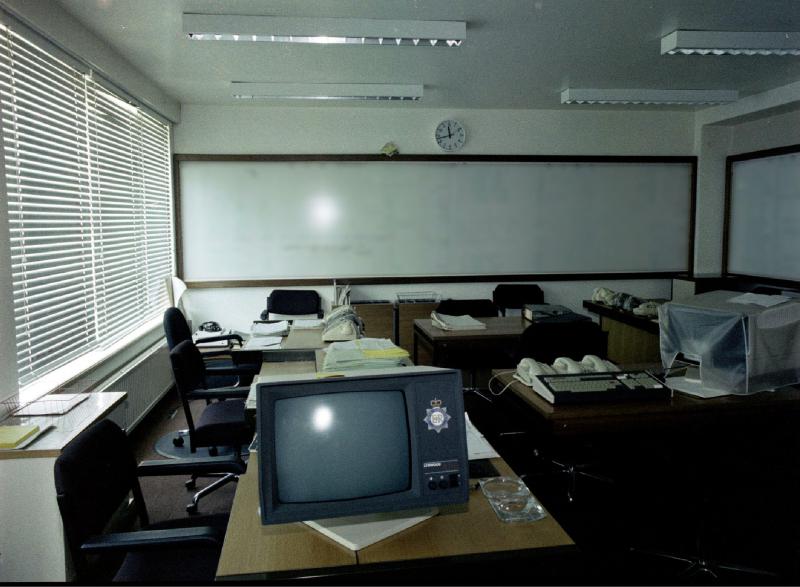
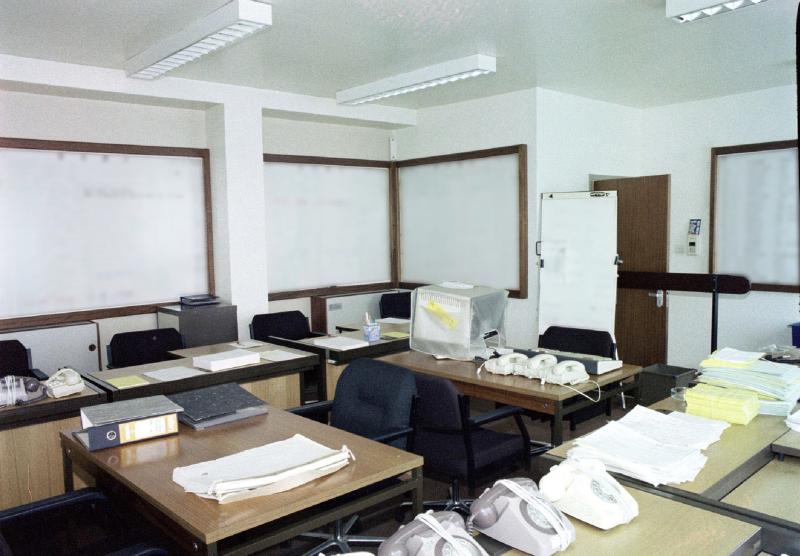
Given this, the Casualty Bureau—a room in the SYP training centre at Ecclesfield Police Station in Sheffield—was clearly too small. Figures 6B and 6C show the set-up at the time. There were eight telephones: four were dedicated for internal use and contact with the gymnasium, the hospitals and other sites. The other four were allocated to receiving calls from members of the public. It also had two direct links with Force HQ. The desks were close to each other, so there would have been limited space for privacy and conversations would have been overheard.
Image
Figure 6B: View of SYP Casualty Bureau, 1989 (Source: SYP)
At the point it opened, the Casualty Bureau had no records of casualties and almost no information to give to callers. The call handlers had received minimal details from the ground, even though the setup of the Casualty Bureau had begun following an instruction from ACC Jackson at 3.17pm.
Staff took the personal details of the callers and the names and descriptions of the people they were enquiring about. Information was handwritten on casualty enquiry forms, with the intention that this could be matched with information received from the gymnasium or hospitals. Names and ages of those missing were then also written on whiteboards on the walls of the Casualty Bureau, so that they could easily be seen by fellow call handlers. However, the number of missing people was so high that the call handlers ran out of space and had to use the blinds in the room as additional whiteboards.
When additional staff were drafted in, they had to sit in a different room and could not see the whiteboards. In some cases, this led to the creation of duplicate records, which added to the overall confusion.
Image
Figure 6C: View of SYP Casualty Bureau, 1989 (Source: SYP)
A further problem quickly occurred. The intention was that the Casualty Bureau should have separate telephone numbers for the public and internal use. However, when the telephone number for the public was released, the internal ones were too. This resulted in all lines being available to members of the public. With large numbers of incoming calls at all times, officers at the hospitals found it virtually impossible to contact the Casualty Bureau with details of casualties. Operation Resolve has not been able to establish who released the numbers, or how it happened.
Further, all of the telephones were on the same loop, which meant that when the Casualty Bureau number was called, all of the available phones rang simultaneously. This resulted in the phones ringing continually and there came a point when call takers left their phones off the hook to have time to complete their paperwork.
Some of these issues had been identified in an SYP Casualty Bureau working party meeting in December 1987. For example, it had been decided that four phone lines were insufficient, and the minimum requirement should be ten lines. However, no action was taken in response to this, until 7pm on the evening of the disaster, when BT installed four more lines.
A Casualty Bureau training exercise on 27 October 1988 had identified that installing a fax machine at a hospital provided better communication between the two sites. Yet fax machines were only installed several hours after the Casualty Bureau was opened.
The Casualty Bureau had only ever been used in response to one live incident, on a much smaller scale, so many processes had not been tested. For example, the forms in use for recording information about casualties were slightly different in each location, meaning there was some duplication of effort, but also some details missed.
Compared to some of the other issues identified in this chapter, the treatment of families and friends by the Casualty Bureau has been subject to few concerns or complaints. In the majority of cases, those who referred to attempting to contact the Casualty Bureau, or attempting to call the emergency numbers, have indicated that they either gave up trying to get through or that they received no useful information. As a result, they set out for Sheffield.
The SYP Casualty Bureau was also responsible for contacting other police forces, including Merseyside Police, which had activated its own Casualty Bureau, to ask them to visit family members of those individuals who had been identified, either formally or provisionally, as having died.
It sent out a series of messages, many of which were specific in their content and stipulated what response SYP required from the recipient police force. For example, there were requests to inform a named individual that a provisional identification had been made. In at least eight cases, the provisional identification had been made using details found on personal items such as rail passes, driving licences or other identification documents. A further six messages requested that a named individual should come to Sheffield “for the purpose of formal identification”.
In some cases, SYP asked Merseyside Police to contact families even though other family members or friends had already identified their loved one. Operation Resolve has also established that on occasion the content of the message sent to another police force contained inaccuracies, which clearly had the potential to cause further distress and upset, beyond that already caused by the nature of the message. For example, one message sent to Merseyside asked for a woman to be visited to be notified of the death of her son; it was in fact her husband that had died. Further, a formal identification was still required.