

Accuracy of comments made by Norman Bettison after his appointment was announced
- This announcement was almost immediately met with protests from some members of the families of those who died, which were covered extensively in Liverpool’s regional newspapers. These resulted in a series of press releases and statements from the MPA Appointments Committee and other parties, including HMIC, explaining the decision and the process that had been followed.
Image
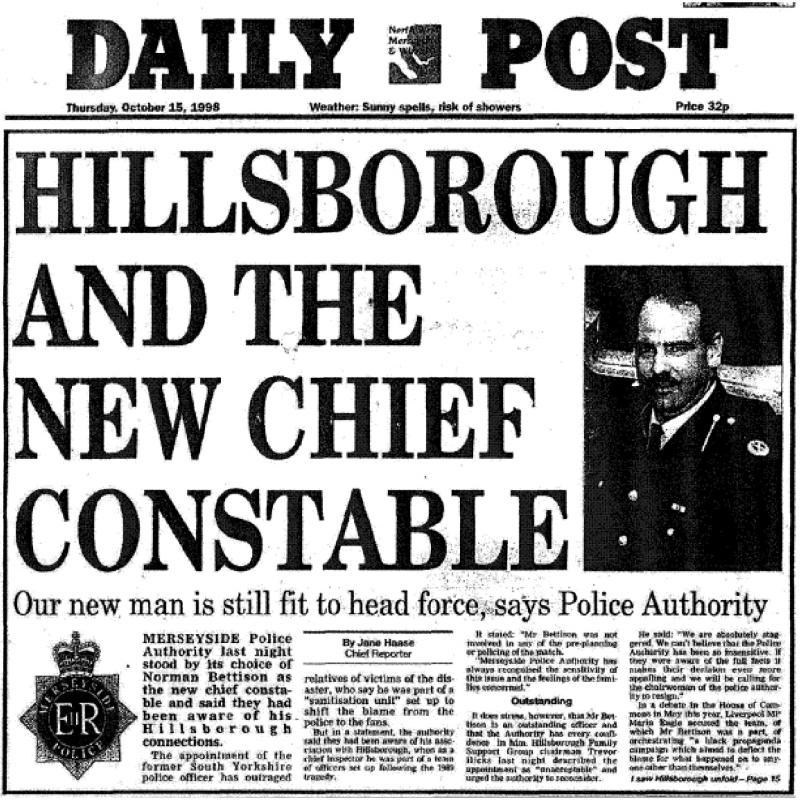
Figure 20A: Copy of front page of the Daily Post on 15 October 1998 (Source: Trinity Mirror Group)
- Norman Bettison also issued a statement via the WYP press office in relation to his involvement in the disaster. In this, he briefly covered his actions on the day itself and then described his involvement in the aftermath. He said he was assigned to a unit “tasked with looking at what had happened on the day of the disaster, making recommendations about the policing of the remaining football matches at Hillsborough before the end of the season and reviewing policing arrangements for football at Hillsborough and other grounds in South Yorkshire the following season”. He also said that later on he “was given a specific role to monitor the public inquiry and the inquest and brief the Chief Constable on progress.”
- On 19 October, the Appointments Committee met to discuss the appointment and the response to it. Part of this meeting was open to the media and members of the public. Meeting notes show that two members of the Appointments Committee—the two who stated they had not seen the HMIC assessment—questioned whether Norman Bettison had deliberately concealed information about his role in the disaster during the appointment process. Mr Crompton was at the meeting and responded that Norman Bettison had also recently applied for the post of Chief Constable with a different force, and that his application had been very similar and similarly focused on his senior command experience.
- A further meeting was arranged for the whole of the MPA (not just the Appointments Committee) on 2 November. Norman Bettison attended; he read out an account he had prepared of his involvement in the disaster and then answered questions from MPA members. One of the Appointments Committee asked him why he had not raised the issue of his involvement in the disaster at any point. He replied that he had simply been responding to the questions asked and had not sought to set the agenda. He stated: “I did not go away from the interview thinking ‘Phew! Hillsborough wasn’t raised’.”
- Having compared the statement he made and responses he gave in the meeting with the evidence set out throughout this report, the IOPC has identified that Norman Bettison did not at any point provide a full account of his involvement in SYP’s response.
- While it could be reasonably claimed that covering every aspect of his involvement was not necessary for the purpose, and that it was possible that, ten years after the events, he had simply not recalled some of the tasks he did, the accounts he gave did not include some aspects of his role that could be deemed significant. For instance, he did not mention going to Parliament on behalf of the SYP Chief Constable to show MPs a video relating to the disaster (see paragraphs 8.45–8.52) or his role in SYP’s preparation for the Popper Inquests (see paragraphs 11.29–11.60). He also did not mention his attendance at almost every day of the Taylor Inquiry hearings, or the tasks he carried out as a result of this, such as taking statements from Supt Chapman and a retired SYP officer to refute evidence given by Mr Lock (see paragraphs 10.106–10.109).
- Following the meeting, the MPA confirmed there were no grounds on which to overturn the appointment. Some members of the MPA have stated to the IOPC that Norman Bettison’s manner and responses during the meeting actually reassured them that he was a suitable person for the job. He served as Chief Constable of Merseyside Police until January 2005.
- The two members of the Appointments Committee that felt he should have disclosed his link to the disaster during the application process both resigned immediately.
- In statements to the IOPC and in evidence to the Goldring Inquests, Norman Bettison has consistently stated that he did not intentionally conceal his involvement in the aftermath of the Hillsborough disaster from the Appointments Committee. He explained that he did not feel that the work he had done in the aftermath of the disaster was relevant to his application and that he was not asked about it at any time before he was offered the post of Chief Constable.
- Broadly, the evidence supports both of these points. However, after he was offered the post, the description he gave of his involvement in the aftermath of the disaster was neither accurate nor comprehensive. Having reviewed the evidence around this, the IOPC identified three occasions in October and November 1998 when what Norman Bettison said about his association with the disaster could be interpreted as misleading. These included the statement issued through WYP’s press office on 14 October, which underplayed the extent of his role, and the written account he gave to the MPA on 2 November.
- The IOPC felt that a reasonable misconduct panel could conclude that he deliberately downplayed his role in the aftermath of the Hillsborough disaster, so would have had a case to answer for gross misconduct, if he had still been serving with the police.