

The initial situation in the gymnasium
- The gymnasium at Hillsborough Stadium was a purpose-built sports hall, situated at the back of the North Stand, as shown in figure 6A.
Image
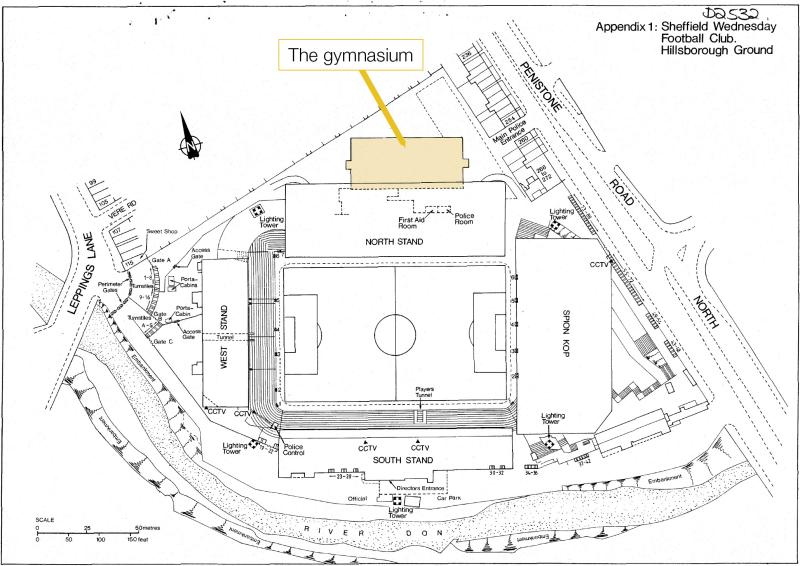
Figure 6A: Map of Hillsborough Stadium showing the location of the gymnasium (Source: SYP Archive)
- After the disaster, the gymnasium almost immediately became a focus of activity. For several reasons, it had been pre-identified as a place to take casualties if needed: it was accessible from the pitch, via the path between the North Stand and the Spion Kop and had some (albeit rudimentary) facilities. It had also been pre-identified as a suitable location for a temporary mortuary if one was needed, and again it fulfilled relevant criteria for this purpose. It had good access from the road and was away from public view. There was also a telephone in the adjoining police room.
- On the day of the disaster, many police officers were already in the gymnasium. Some were on standby, others were completing paperwork relating to arrests they had made, and some were having a scheduled refreshment break. Several have said that shortly after 3pm, Ch Insp Beal came in and shouted for the area to be cleared. Some recalled him explaining that it was to receive casualties, while others recalled him saying that it was to be used as a mortuary.
- The situation there quickly became chaotic and its use as both a first aid centre and mortuary became untenable as the number of those who had died increased. There was a lack of preparedness and limited control and coordination across agencies. This reflected the fact that although the gymnasium had been selected as a suitable temporary mortuary location during a multi-agency meeting in 1986, no detailed consideration had been given to how this would work in practice. There was minimal medical equipment on site and there was no guidance in the Major Incident Manual, or anywhere else, about the possible layout of a temporary mortuary in the gymnasium. SYP had major incident boxes, which included essential documents setting out clear processes for responding to such an incident and standard forms. These were located at key locations across the force area; however, they did not have one at the stadium, so one had to be brought from a police station.
Numerous practical issues emerged, most obviously the need to separate those who had died from those requiring and receiving treatment. There were also no protocols for attending to bereaved family members who had accompanied or followed loved ones into the gymnasium. Advertising hoardings that had been used as stretchers had been left in the gymnasium so that those who had carried them could quickly return to assist more casualties. However, as the number of hoardings left behind increased, they became obstacles.
- There was also a procedural requirement to address body continuity: the process by which police officers and others ensure that, as a body is moved, identified and where necessary examined, all those involved are dealing with the same individual. Normally, the first police officer to attend would stay with the person who has died, but after carrying people to the gymnasium, officers returned to help with the rescue effort.
- Once this was recognised, officers were instructed to write their collar number on the hand of the person who had died, before returning to the pitch.
- Shortly after 4pm, D Ch Supt Addis arrived, having received instructions from ACC Jackson to ensure the temporary mortuary was functioning. He took charge of the situation there, putting in place processes for documenting details of each of those who had died. He also ensured that Dr Popper had been contacted and directed that officers be placed at the entrance to restrict access to the gymnasium. These actions brought some order to the situation.
- D Ch Supt Addis has stated that his main priority was to maintain continuity of the identification and movements of those who had died. However, because identification was the responsibility of the Coroner, D Ch Supt Addis was unable to start a formal process. In the interim, he could have focused on other tasks to make the response more coordinated and effective and to consider the needs of families and friends.
- Dr Popper was told about the disaster by 4.15pm; he was at home at the time. Having been given enough information to understand that a large number of people had died, he telephoned key colleagues, then went to the MLC, where he arrived at about 5.40pm. He met with a group of pathologists and coroner’s officers to discuss options for the coronial response to an incident of this scale. With a smaller group of colleagues, he then went to the stadium to assess the situation. He had no direct contact with D Ch Supt Addis or anyone else in the gymnasium before he arrived at the ground.