

2.30pm: Consideration of delaying the kick-off
- By 2.30pm, the contrast in fullness between the Spion Kop and Leppings Lane ends was increasingly pronounced. The screens in the PCB showed a large crowd outside the Leppings Lane entrance, with supporters tightly packed in front of the turnstile block.
- Police Constable Trevor Bichard (PC Bichard), the officer responsible for monitoring the CCTV cameras in the PCB, estimated that there were over 3,000 supporters waiting to get in. Police Sergeant Michael Goddard (PS Goddard), who operated the personal radio network in the PCB, recalled PC Bichard making a comment about the size of the crowd, and so he looked at the screens. He told Operation Resolve he estimated that there were about 3,000 to 4,000 supporters there and commented: “Only once before have I seen such numbers and that was when Sheffield Wednesday played Coventry City in an FA Cup 6th Round match in 1987 when the Coventry fans came to Sheffield in their thousands.”
- Operation Resolve has established that some supporters at that game experienced severe crushing.
Image
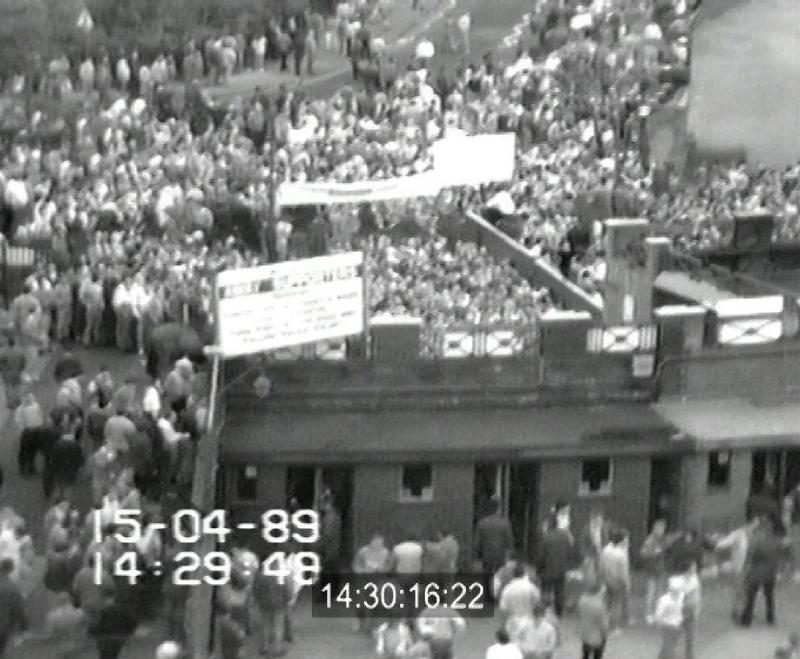
Figure 4E: View of the Leppings Lane entrance from the West Stand, 14:30:16 (Source: SYP CCTV)
- At around 2.30pm, Ch Supt Duckenfield and Supt Murray discussed whether to delay the kick-off, so supporters could get in safely. In advance, they had agreed on a very small set of reasons which would necessitate delaying the kick-off. These essentially amounted to the late arrival of a large number of supporters due to circumstances beyond their control, such as poor weather or a major traffic problem en route.
- They had received no information about any such delays, and Supt Murray assured Ch Supt Duckenfield that there should be sufficient time to get the waiting supporters into the ground by the scheduled kick-off time. They agreed that the kick-off should not be delayed.
- In agreeing this, neither suggested consulting with other officers, such as Supt Greenwood inside the stadium or Supt Marshall outside, nor did they check the turnstile count data, which could have given them more information about how many supporters were still to arrive. Instead, they relied on their own visual assessment of how full the Leppings Lane end was.
- Yet even this basic visual assessment should have been a cause for concern. Officers in the PCB have indicated that at 2.30pm they thought the North Stand was only about half full. Given its official safe capacity was 9,702, this would indicate that just under 5,000 supporters were still to enter. There were ten turnstiles available for the North Stand, so to fill it by 3pm, each of those turnstiles would have to admit more than 450 supporters over the next half hour. As detailed in chapter 2, the Green Guide advised that the maximum number of supporters that could enter through a single turnstile each hour was unlikely to exceed 750—so 375 per half hour. Later analysis by the HSE concluded that, based on the number of people in the stadium at 2.30pm, it would have taken until around 3.40pm for all supporters to have entered safely through the turnstiles.
- Subsequently, it was also established that there had been various traffic problems affecting several of the routes Liverpool supporters would have used if travelling from Merseyside. This information was not shared with officers in the PCB.
- The D Division Operational Order contained an instruction that the Force Control Room at SYP HQ was to be informed of any traffic issues. However, Operation Resolve’s review of the Operational Orders showed that there was no instruction in any of them for officers engaged on the road traffic operation or in the Force Control Room to inform the PCB of problems with the routes into Sheffield.
- There were also no plans in place to liaise with neighbouring forces, to understand if there were issues in their areas that could affect the arrival of supporters into Sheffield. Major delays were reported in Greater Manchester and Derbyshire; it appears the SYP Force Control Room was not made aware of these, nor did it check. Certainly, no information about these was passed to the PCB, but neither did anyone in the PCB ask whether there were any problems on the roads.