In 1989, stadium safety was based on the SSGA 1975 and the Guide to Safety at Sports Grounds, an official government publication widely known as the ‘Green Guide’ due to its green cover. Both had been introduced following the 1971 disaster at Ibrox Park, the stadium of Glasgow Rangers, in which 66 spectators were killed. The report into the disaster recommended a new process of certifying and inspecting football grounds. It also set out some proposed standards for clubs and licensing authorities to follow.
The Green Guide was first published in 1973. It provided detailed guidance on numerous aspects of stadium design and layout, such as how many exits were needed for each area, the use of crush barriers, particularly on terraces, and the construction of stairways. It also explained how to calculate the safe capacity of each area of the ground. It was, and remains, guidance and there is no legal requirement to adhere to it.
In 1976, and again in 1986, the Green Guide was updated, to include additional guidance and clarification. The 1986 version was produced soon after the publication of ‘The Final Report of the Committee of Inquiry into Crowd Safety and Control at Sports Grounds 1985’. This inquiry had been set up following two incidents at football matches on the same day, 11 May 1985: a fatal fire at Bradford City’s stadium, in which 56 people died, and a riot at a match between Birmingham City and Leeds United, in which a 15-year-old boy died. Following the two incidents, Justice Oliver Popplewell, a senior judge, was appointed by the then Home Secretary to undertake an inquiry into the operation of the SSGA 1975 and make recommendations to improve both crowd safety and crowd control. The Final Report is often referred to as the Popplewell Report.
Drawing on recommendations in the Popplewell Report, the Green Guide 1986 included some significant changes, such as:
a requirement for football clubs to have a designated safety officer “of sufficient status and authority effectively to take responsibility for safety at the ground”
additional guidance on the use of turnstiles for spectators entering a ground, including an observation that the maximum number of supporters that could enter through a single turnstile each hour was unlikely to exceed 750
a new chapter on crowd control, which had a specific reference to the need for clubs to work with the police to counter potential disorder
The Green Guide 1986 was the version in force at the time of the disaster.
The SSGA 1975 introduced a requirement for designated professional sports grounds to obtain a Safety Certificate. These were granted by local authorities, who were required to set terms and conditions to “secure reasonable safety” at the stadium. Local authorities were then responsible for checking whether the terms and conditions of the Safety Certificate were being met, and for deciding whether any condition of the Safety Certificate needed to be amended in response to changes at the ground.
Any stadium with capacity over 10,000 could be designated as needing a Safety Certificate, but in practice the requirement was initially just applied to the grounds used for Football League Division 1 (the equivalent of the modern-day Premier League) and those regarded as international football stadiums.
In 1989, Hillsborough Stadium was one of the largest football grounds in England. It hosted World Cup matches in 1966 and had been used several times during the 1980s for major games such as FA Cup semi-finals, including in 1987 and 1988. The 1988 Semi-Final was between Liverpool and Nottingham Forest; SYP, the FA and SWFC all perceived it to have been a success.
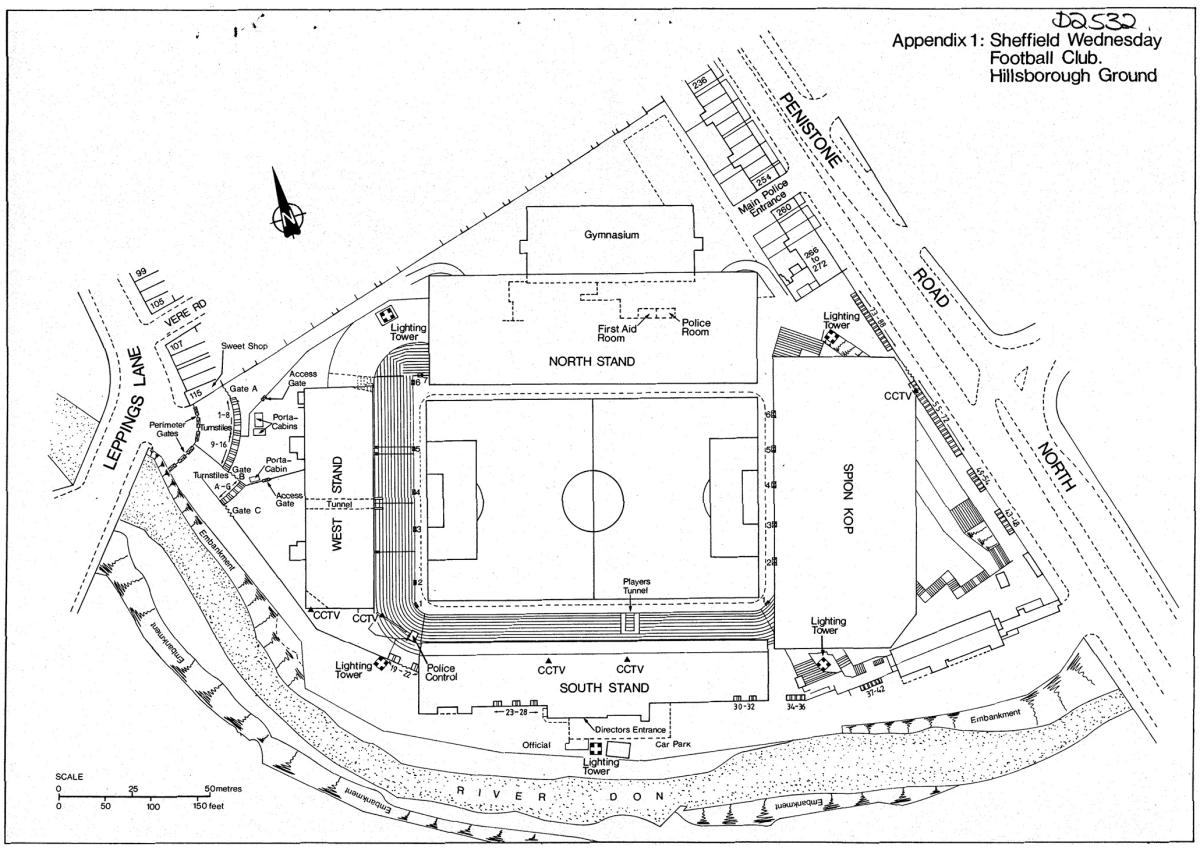
Like most football stadia in 1989, Hillsborough Stadium had a mix of seated areas (called stands) and standing areas (known as terraces). Tickets for terraces were generally cheaper. At the east end of the ground, known as the Penistone Road end, there was a large terrace named the Spion Kop. This was the ‘home’ end, normally used by SWFC supporters. At the opposite end of the ground, known as the Leppings Lane end, there was a smaller terrace, referred to as the West Terrace, below the West Stand.
Image
Figure 2A: Map of Hillsborough Stadium as it was in 1989 (Source: SYP Archive)
Despite its pre-eminent status, there had been various safety incidents at the ground, with supporters experiencing crushing at the Leppings Lane entrance and on the West Terrace. The most severe of these incidents had been at the 1981 FA Cup Semi-Final, where a crush on the West Terrace resulted in numerous injuries and several supporters receiving hospital treatment. However, in the aftermath of the Hillsborough disaster, supporters of different clubs described (including in evidence to the Taylor Inquiry) having experienced uncomfortable overcrowding in the pens of the West Terrace on other occasions, including at both the 1987 and 1988 FA Cup Semi-Finals.
Together, these incidents raise questions about the suitability of Hillsborough Stadium to host major matches and whether it met the safety standards of the day.
Operation Resolve investigated these issues, with a particular focus on what role the police played in any discussions and decisions about the stadium layout.
Under the terms of reference for the managed investigation, Operation Resolve investigated: Issues relating to the stadium, including any role played by the police in:
a) suitability and choice of the stadium to host the event b) the planning and decision making in relation to the ground’s design, alterations and final layout, including the siting and condition of barriers, fences, and gates within the fences c) the design and layout of the pens
What was found?
• The Safety Certificate issued to Hillsborough Stadium in 1979 was based on incorrect calculations about the safe capacity of each area of the stadium. This meant that more people were permitted in some areas of the ground than should have been. On the West Terrace, the permitted capacity was 7,200 but the engineering expert appointed to the Goldring Inquests calculated that, applying a strict interpretation of the guidance at the time, it should have been no more than 4,518 when first set in 1979—and possibly as low as 3,089.
• When changes were made which further reduced the amount of space for spectators on the West Terrace, no steps were taken to reassess the safe capacity of the terrace, either by SWFC or SCC which issued the Safety Certificate for Hillsborough Stadium. Nor was capacity formally reviewed in response to changes in safety requirements for sports grounds during the 1980s.
• Following crushing incidents at previous FA Cup semi-finals at Hillsborough Stadium in the early 1980s, SYP officers proposed changes should be made to the layout of the West Terrace. These were implemented, splitting it into separate pens, which would also allow home and away supporters to share the terrace at relevant SWFC matches.
• SYP officers subsequently proposed significant changes to the Leppings Lane entrance to the stadium, to help segregate rival supporters at that end. The proposed changes were rejected as too expensive; though some changes were eventually made to this area of the stadium as an indirect result, these were very different from what SYP had suggested. This demonstrates an awareness among the police and other organisations that some aspects of the stadium layout presented potential risks to supporters.
• Despite this awareness, recognised risks were not managed with due care. For example, SYP officers requested that a crush barrier near the main entrance of the centre pens of the West Terrace should be removed, so that supporters did not congregate there. Engineering experts raised concerns that this could affect barriers lower down the terrace, but the barrier was removed, on the condition that SYP would keep the area near the entrance clear of spectators. However, there was no mention of this in police planning for the 1988 or 1989 Semi-Finals.
Significant new evidence
The most significant new evidence in relation to stadium safety was the three reports produced by Mr Cutlack, who was instructed as an independent civil engineering expert to the Goldring Inquests.
These showed, among other matters, that the capacity calculations used when SWFC first applied for a Safety Certificate were too high. They also included detailed analysis of key issues such as the causes of a crush barrier breaking on the day of the disaster.
The third report was commissioned by Operation Resolve to address issues that had arisen during its investigation and had not been considered in Mr Cutlack’s first two reports.
The IOPC is required by law to produce an investigation report for each complaint or conduct matter it investigates. These reports are designed to allow the IOPC decision maker to reach a view on appropriate outcomes and, with the decision maker’s additional input, to inform the relevant police force or police and crime commissioner of the IOPC opinions and decisions In the Hillsborough investigations, there are 161 such reports; several conduct reports covered multiple conduct matters, for example where a group of officers were under investigation for the same issue. Complainants and the officers under investigation have been informed of the outcomes, as have those identified as interested persons in any of the individual investigations.
However, none of these reports, on its own, can address the wider scope of the IOPC and Operation Resolve investigations, or respond to the full terms of reference for these investigations. This report therefore fills this gap. As well as explaining the outcomes of complaints and conduct matters, it summarises what the investigations found in relation to unresolved queries around the disaster. It also gives an overview of topics related to police conduct that have not been addressed by previous inquiries or investigations, such as the work of WMP in the aftermath of the disaster.
Notes on language and terminology
All statements and accounts are cited verbatim in this report. In some cases, they include spelling or typographical errors, which are reflected in the quotations.
Unless specifically stated, all police officers are referred to by the rank they held at the time of the disaster. Similarly, if an officer’s name has subsequently changed, they are referred to by the name they used at the time of the disaster.
During the course of this investigation, the IOPC was established, replacing the IPCC. The IOPC took on responsibility for any ongoing IPCC investigations. For clarity, throughout this report, all references to the independent investigation into police conduct in the aftermath of the disaster refer to the actions of the IOPC rather than the IPCC, even where those actions took place before the IOPC was established.
Both investigations gathered a wealth of new evidence. As well as taking witness statements from thousands of those who had been at the match—including police officers, supporters, media, SWFC staff and volunteers—the investigations recovered documents that were assumed to have been lost or destroyed. This included more than 8,000 pocket notebooks belonging to SYP officers and the policy books of the officer that led the WMP investigation, providing a major insight into the way WMP conducted its work. In addition, video material from the day was obtained from various sources, and recordings of radio messages and communications between the PCB and the Force Control Room (made using a system manufactured by Racal) were secured and examined.
Both investigations also:
used witness appeals to attempt to reach people who had not previously given their account
conducted searches of key locations that resulted in new evidence being found
applied to the courts to gain access to video material that had not previously been provided
made use of the evidence of expert witnesses in specific topics. Some of these were appointed by the investigations—for example, a health and safety inspector from the Health & Safety Executive (HSE) was seconded to work as part of the Operation Resolve team—while others were instructed as expert witnesses to the Goldring Inquests
Despite this comprehensive approach, there remain some gaps in the information related to the disaster.
Some potentially significant documents have not been found, such as minutes of debriefs of previous matches at Hillsborough Stadium; others have been damaged and are no longer fully legible.
Some material has, wholly legitimately, been destroyed or disposed of over time.
Some witnesses, who may have been able to provide additional insight, could not be interviewed. In part, this is because the investigations began more than 23 years after the disaster; some witnesses had died, while others were in poor health.
This length of time also meant that many individuals could not recall all matters accurately or in detail.
A small number of potential witnesses declined to engage with the investigations, as is their right; some of these explained that they had already given one or more accounts and had nothing further to add.
Nonetheless, the two investigations had access to more material about the disaster and its aftermath than any previous investigation or inquiry.
The vast quantity of new material gathered by the investigations has been assessed and, where appropriate and where the original owners give their consent, will be transferred to The National Archives for long-term preservation.
The Hillsborough investigations gathered and reviewed a vast quantity of evidence. The IOPC and Operation Resolve re-examined the documents disclosed to the HIP, having brought them back together in a single location from archives around the UK. The investigation teams also obtained, and restored, the HOLMES databases (specialist IT systems used to support large police investigations) used by the previous investigations into the disaster. In addition, the teams reviewed 2,700 individual pieces of AV material from broadcasters, CCTV and audio recording systems, as well as approximately 23,000 still images.
The material disclosed to the HIP included minutes and notes from a large number of meetings involving police officers and other parties. These included meetings after the disaster between SYP officers and its appointed legal team. While these would have been conducted under legal professional privilege, because the meeting minutes were disclosed to the HIP, the documents entered the public domain and could be used as evidence.
In 2012, following the publication of the HIP Report, the then Attorney General applied to the High Court to have the Popper Inquests’ verdicts, of accidental death, quashed. The application was successful, and the Goldring Inquests began in 2013.
The IOPC and Operation Resolve conducted enquiries for the Goldring Inquests and provided more than one million pages of investigative material, such as witness statements and documents, together with hundreds of hours of AV material. Operation Resolve also produced a comprehensive timeline of the movements of each of those who died, built from AV material and witness statements, and its senior investigating officer presented detailed background evidence about the disaster.
The Goldring Inquests hearings ran for 308 days, spread over two years, and heard evidence from more than 1,000 individuals. Having heard the evidence, the jury concluded that all of those who died in the Hillsborough disaster were unlawfully killed—a profound and momentous change from the conclusion of the original inquests.
As part of its conclusions, the jury was also asked to answer a series of questions. One of these was, “Was there any behaviour on the part of football supporters which caused or contributed to the dangerous situation at the Leppings Lane turnstiles?” The jury responded “no”. They were then asked if there was any such behaviour which may have caused or contributed to the dangerous situation; again, the answer was “no”.
As a result of their investigations, both the IOPC and Operation Resolve referred a number of individuals to the Crown Prosecution Service (CPS) for it to decide whether anyone should face criminal charges in relation to the disaster or its aftermath. In June 2017, six individuals were charged with criminal offences.
Ch Supt Duckenfield was the SYP match commander on the day: in other words, he was the officer in charge of the police operation. He was charged with manslaughter by gross negligence. He went on trial in January 2019, and the jury was unable to reach a unanimous or a majority verdict. He then faced a retrial in October 2019, at which the jury found him not guilty.
Mr Mackrell was the SWFC Secretary and designated safety officer at the time of the disaster. He was charged with two offences under the SSGA 1975 and one offence under the HSWA 1974 relating to the turnstile arrangements. He went on trial at the same time as Ch Supt Duckenfield. He was found guilty of the offence under the HSWA 1974 and fined £6,500.
Norman Bettison, a former chief inspector and superintendent with SYP and subsequently Chief Constable of Merseyside and of West Yorkshire. He was charged with four offences of misconduct in public office in relation to the allegation that he lied about his involvement in the aftermath of the Hillsborough disaster and about the culpability of Liverpool supporters. This prosecution was discontinued by the CPS on 22 August 2018, following a review of the evidence. This is examined further in chapter 20.
SYP officers Ch Supt Denton and DCI Foster were charged with perverting the course of justice for their involvement in amending fellow SYP officers’ accounts before they were submitted to the Taylor Inquiry. Peter Metcalf, a solicitor from a firm called Hammond Suddards, which was acting for SYP in 1989–1990, was also charged with the same offence, for his role in the amendment process, including suggesting specific changes to officers’ accounts.
These latter three went on trial in April 2021. On 26 May 2021, the judge ruled that the defendants had no case to answer. This was because the offence they were charged with was perverting the course of justice in relation to the amendment of officer accounts presented to the Taylor Inquiry. As the Taylor Inquiry was a non-statutory departmental inquiry, it was not a course of justice, so the case required the prosecution to demonstrate that the amendment of these accounts was also intended to affect the Popper Inquests or the subsequent criminal investigation conducted by WMP—both of which were courses of public justice. The judge concluded that the prosecution had failed to demonstrate this.
This report includes more details of the evidence provided by Operation Resolve and the IOPC that led to these charges and the trials that followed.
The two investigations were both criminal investigations, meaning they could result in people facing criminal charges—and both did. They were also police disciplinary investigations, which examined whether police officers acted in line with the professional standards of the time (see Appendix B), in planning for the event, on the day of the disaster and in its aftermath.
The two investigations responded to 260 complaints about the actions of the police in relation to the disaster. These ranged from complaints that SYP officers at the stadium failed to respond effectively to the situation that led to the disaster, to complaints about the way WMP officers interviewed supporters in the weeks that followed. Some complaints were discontinued after initial investigative steps were taken. In addition, the investigations identified 92 conduct matters for investigation, some of which involved multiple officers. These were matters where police officers may have committed a criminal offence or behaved in a manner which would justify disciplinary proceedings, but there had not been a complaint about the matter.
Some of the complaints investigated were first made in 1989. Material cited in the HIP Report raised questions about whether these had been investigated properly, in line with the requirements at the time. The IOPC wanted to reopen these complaints, but legislation did not allow it to reinvestigate matters which had been previously investigated under the oversight of the Police Complaints Authority (PCA), the national body that oversaw complaints against police officers in 1989. The IOPC sought an amendment to the Police Reform Act 2002 (PRA) to make reinvestigation possible. The Police (Complaints and Conduct) Act 2012 added a new section, 28A, to the PRA, giving the IOPC discretionary power in exceptional circumstances to reopen complaints that had been investigated by the PCA.
Each complaint and conduct matter has been investigated in its own right and an individual report has been produced, as part of the statutory process for making decisions relating to alleged misconduct by police officers. (See Appendix C for more details of this process and the role of the IOPC in it.) Complainants and the officers under investigation have been informed of the outcomes, as have those identified as interested persons in any of the individual investigations.
In total, the IOPC upheld or found an officer would have had a case to answer (so would have been expected to face disciplinary proceedings) in respect of 92 complaints in relation to police actions before and during the disaster, and in its aftermath. Similarly, it found that in 18 conduct matters, officers would have had a case to answer. In total, the IOPC found that 12 officers would have had a case to answer for gross misconduct, if they had still been serving. That means that if a disciplinary panel agreed, they could have faced dismissal. In a further four complaints, the IOPC found that officers would have had a case for gross misconduct, but it was not possible to identify who the officers involved were.
From the outset, it was understood that no officer would face disciplinary proceedings as a result of the IOPC and Operation Resolve investigations, even if it was found they had a case to answer. This was because they were subject to the legislation in force when the investigations commenced; at that time, officers who were no longer serving with a police force could not be subject to disciplinary proceedings.
Similarly, complaints had to be assessed against the police professional standards at the time of the disaster. These were very different to the standards in place today.
The IOPC can only uphold complaints or find a case to answer for misconduct where the available evidence meets the legal thresholds it must apply.
To be able to uphold a complaint, the IOPC must conclude that, on the balance of probabilities, the force or officer did not deliver the service to a standard that was expected of them.
To give an opinion that there would be a case to answer for a complaint or conduct matter, the IOPC must be of the opinion that there is sufficient evidence upon which a reasonable misconduct panel could conclude there has been a breach of the professional standards that amounts to misconduct.
Reflecting this, the IOPC could not uphold complaints where there was insufficient, contradictory or missing supporting evidence, or where the complaint was made about a decision taken elsewhere. For example, complaints about individual WMP officers using questionnaires to gather information from witnesses could not be upheld, because the decision to gather information in this way was made by others.
The fact that a complaint is not upheld does not challenge the account of the complainant.
The Operation Resolve investigation examined the planning for the 1989 Semi-Final, the events of the day leading up to the disaster, the emergency response and aspects of the immediate aftermath of the disaster—notably the way that the families and friends of those who died were treated by the police and other authorities. In investigating these issues, Operation Resolve looked at the roles and responsibilities of organisations that were involved in staging the match, including (listed alphabetically):
Eastwood & Partners, the engineering firm that advised the stadium owners, SWFC, on ground structure and layout
the FA, which selected Hillsborough Stadium as the venue for the match
SCC, the local authority that, under the Safety at Sports Grounds Act 1975 (SSGA 1975), was responsible for overseeing the safety of professional sports grounds in Sheffield
SWFC, which owned Hillsborough Stadium
SYCFS, which assisted in the emergency response to the disaster
SYMAS, which also took part in the emergency response to the disaster
SYP, the force responsible for policing on the day
Operation Resolve also investigated the actions of individuals who worked for these organisations and whether any of them may have committed criminal offences.
The IOPC investigation focused on key aspects of the aftermath of the disaster—in particular, the allegations that police officers may have deliberately altered or suppressed evidence about the disaster and may have sought to deflect blame away from the police by focusing on the alleged behaviour of some of the Liverpool supporters.
The IOPC examined the actions of SYP officers in preserving, gathering and presenting evidence to the various investigations that followed the disaster, including the Taylor Inquiry and the Popper Inquests. It also examined the work of WMP, the force appointed in the days after the disaster to support these investigations and inquiries and to gather evidence for them.
The full terms of reference for both investigations are included at Appendix A.