
Misconduct proceedings
There are two types of misconduct proceedings:
- For gross misconduct, a misconduct hearing is arranged by the police force (or other authority). The highest level of sanction is dismissal without notice.
- For misconduct, a misconduct meeting is arranged by the police force (or other authority). The highest level of sanction is a final written warning.
Under the previous legislation, in some situations where the appropriate authority decides there is a case to answer for misconduct, management action may be considered instead of misconduct proceedings. Under specific circumstances, a misconduct hearing may be more appropriate than a misconduct meeting. You can read more about these circumstances in our Statutory Guidance.
There are different discipline systems for police officers and police staff. Police officers and special constables are subject to the regulations set out in the Police (Conduct) Regulations 2012 or Police (Conduct) Regulations 2020. Complaints and conduct matters involving staff are covered by individual police force policies.
For police officers and special constables, if a case proceeds to a misconduct meeting, the final decision on whether misconduct is proven and any resulting sanction is made by senior police officer or manager.
If a case proceeds to a misconduct hearing, the final decision on whether misconduct is proven and any resulting sanction is made by a panel, which now is led by a senior police officer. Previously the panel was led by an independent legally qualified chair. All the hearings that are part of the statistics in this report were held under a legally qualified chair.
Figures 2 and 3 describe the various ways in which misconduct outcomes could be reached.
Figure 2: How misconduct outcomes are reached for conduct matters under the Police Reform Act 2002 (after Feb 2020)
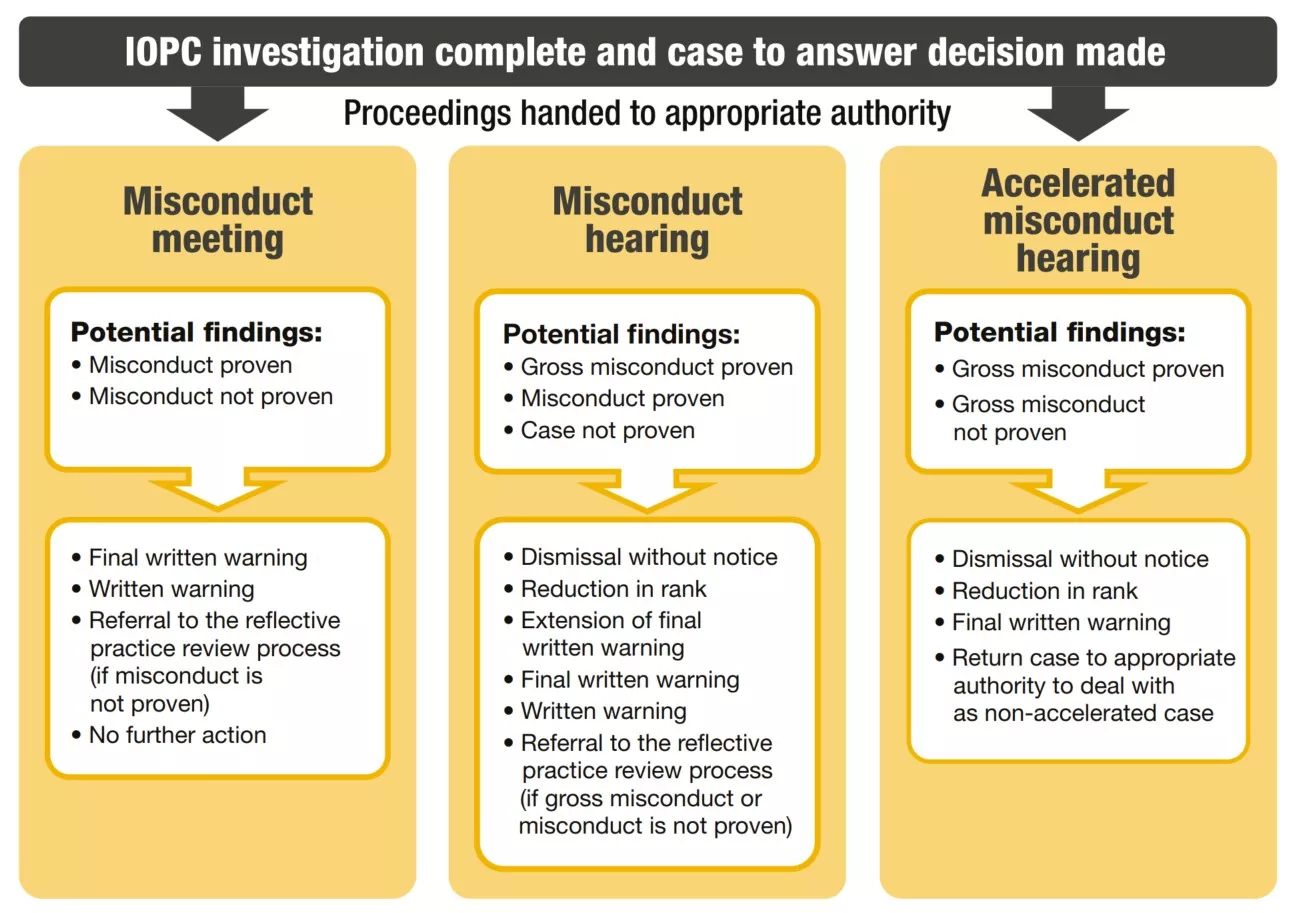
After Feb 2020, when an IOPC investigation is complete and a case to answer decision is made, the proceedings are handed to the appropriate authority.
In a misconduct meeting the potential findings are:
- misconduct proven
- misconduct not proven
The outcome might be:
- final written warning
- written warning
- referral to the reflective practice review process (if misconduct is not proven)
- no further action
In a misconduct hearing the potential findings are:
- gross misconduct proven,
- misconduct proven
- case not proven
The outcome might be:
- dismissal without notice
- reduction in rank
- extension of final written warning
- final written warning
- written warning
- referral to the reflective practice review process (if gross misconduct or misconduct is not proven)
In an accelerated misconduct hearing the potential findings are:
- gross misconduct proven
- gross misconduct not proven
The outcome might be:
- dismissal without notice
- reduction in rank
- final written warning
- to return the case to the appropriate authority to deal with as a non-accelerated case
Figure 3: How misconduct outcomes are reached for conduct matters under the Police Reform Act 2002 (before Feb 2020)
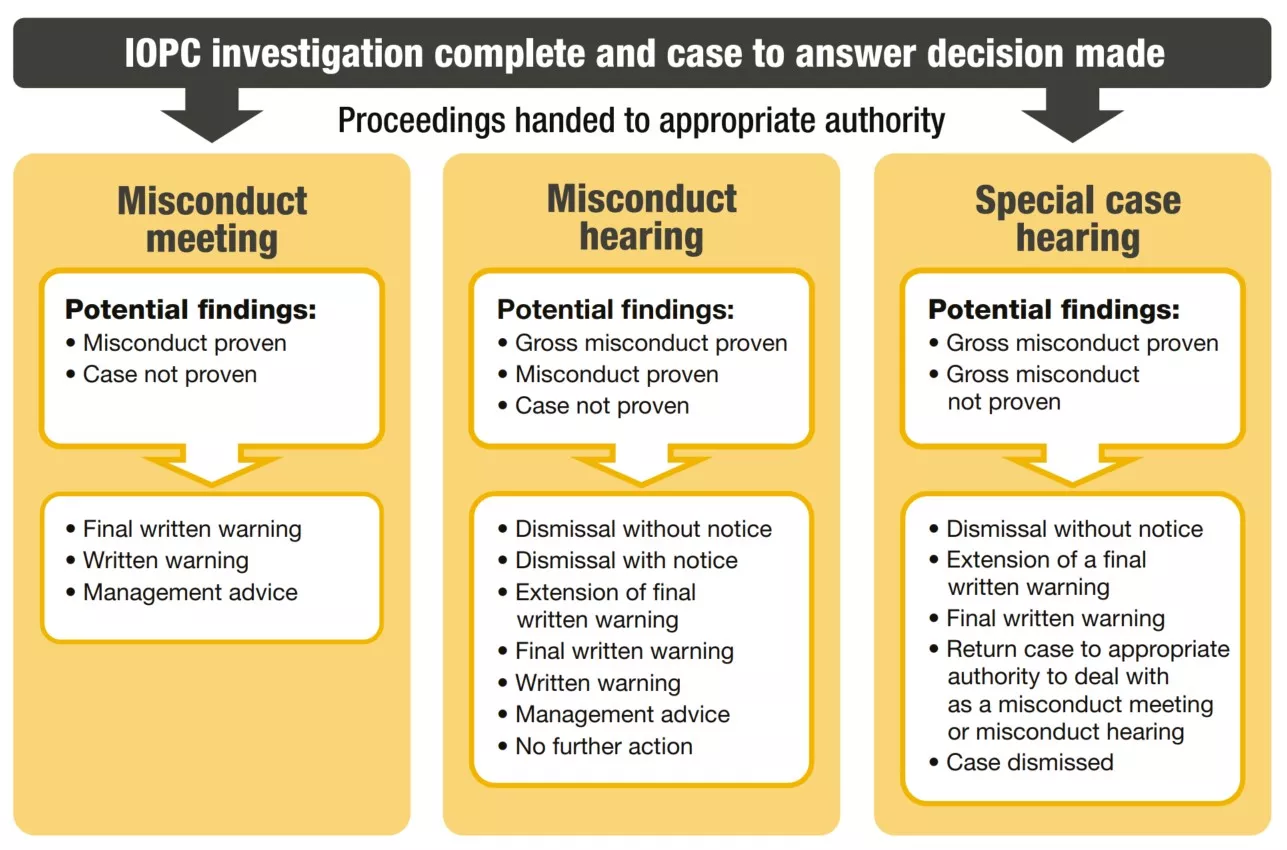
Before Feb 2020, when an IOPC investigation is complete and a case to answer decision is made, the proceedings are handed to the appropriate authority.
In a misconduct meeting the potential findings are:
- misconduct proven
- case not proven
The outcome might be:
- final written warning
- written warning
- management advice
In a misconduct hearing the potential findings are:
- gross misconduct proven,
- misconduct proven
- case not proven
The outcome might be:
- dismissal without notice
- dismissal with notice
- extension of a final written warning
- final written warning
- written warning
- management advice
- no further action
In an special case hearing the potential findings are:
- gross misconduct proven
- gross misconduct not proven
The outcome might be:
- dismissal without notice
- extension of a final written warning
- final written warning
- written warning
- return case to the appropriate authority to deal with as a misconduct meeting or misconduct hearing
- case dismissed
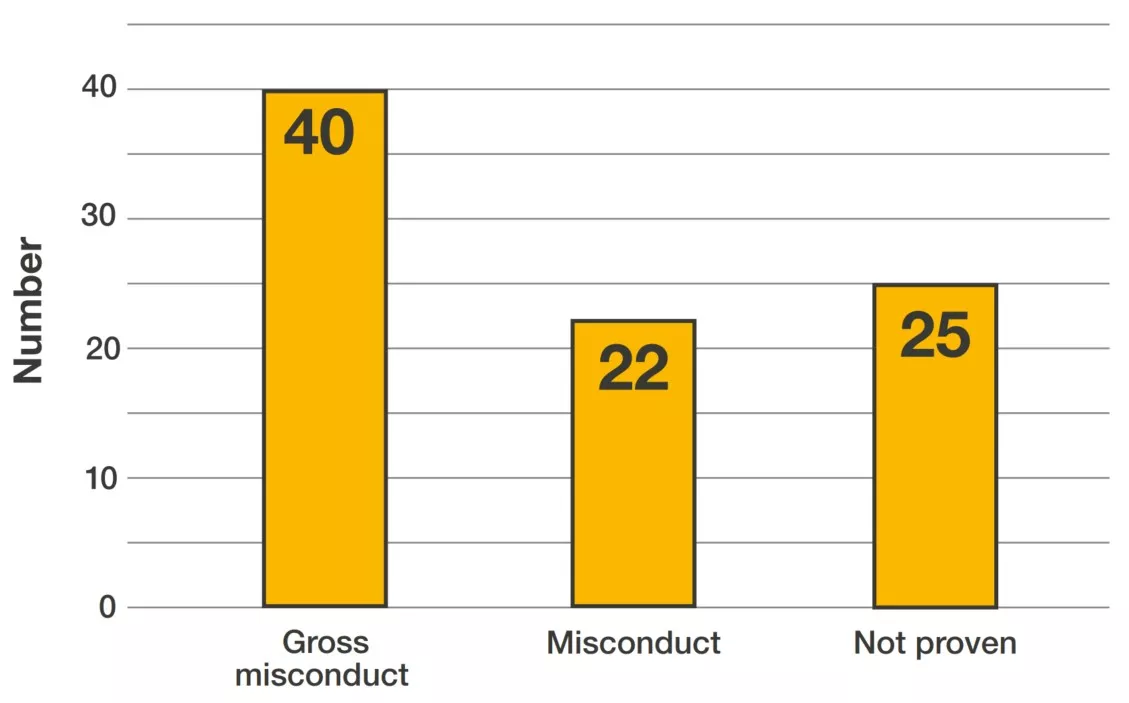
Misconduct proceedings were held for 87 police officers/staff in 2023/24. It was found that 71% (62) of these officers/staff breached the standards of professional behaviour:
- gross misconduct was proven for 40 officers/staff
- misconduct was proven for 22 officers/staff
- misconduct was not proven for 25 officers/staff
Figure 4: Outcomes following misconduct proceedings 2023/24
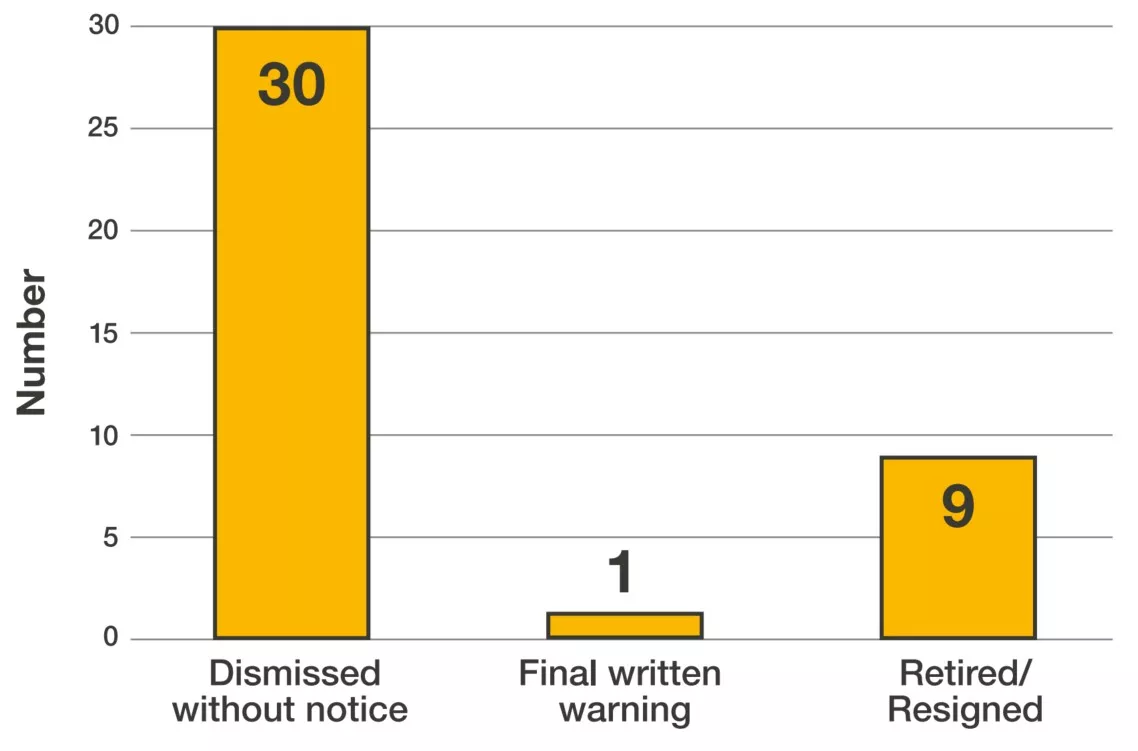
In the 40 proceedings where gross misconduct was proven, disciplinary actions were:
- 30 people were dismissed without notice
- nine people retired/resigned before they could receive their sanction (they would be added to the College of Policing’s barred list if the case to answer decision was gross misconduct)
- one person received a final written warning
Figure 5: Disciplinary actions following misconduct proceedings where gross misconduct was proven 2023/24
In the 22 proceedings where misconduct was proven:
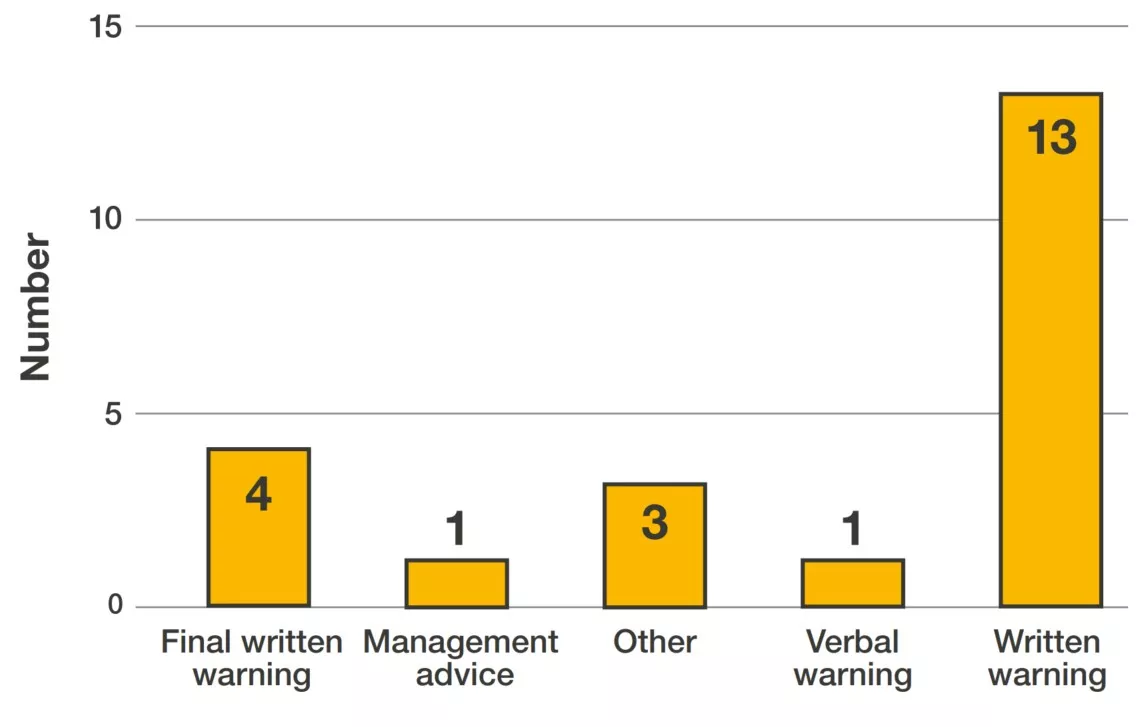
- one person received a verbal warning
- 13 people received a written warning
- four people received a final written warning
- one person received management advice
- three people received other actions
Other actions could include, being referred to the reflective practice review process (RPRP), reduction in rank, or undertaking an unsatisfactory performance and attendance procedure.
Figure 6: Disciplinary actions following misconduct proceedings where misconduct was proven 2023/24