

Decisions following completed investigations
Decisions about conduct
We investigated 377 police officers/staff during 2023/24. We found 49% (186) had a case to answer for misconduct or gross misconduct.
Figure 1: Case to answer decisions in 2023/24
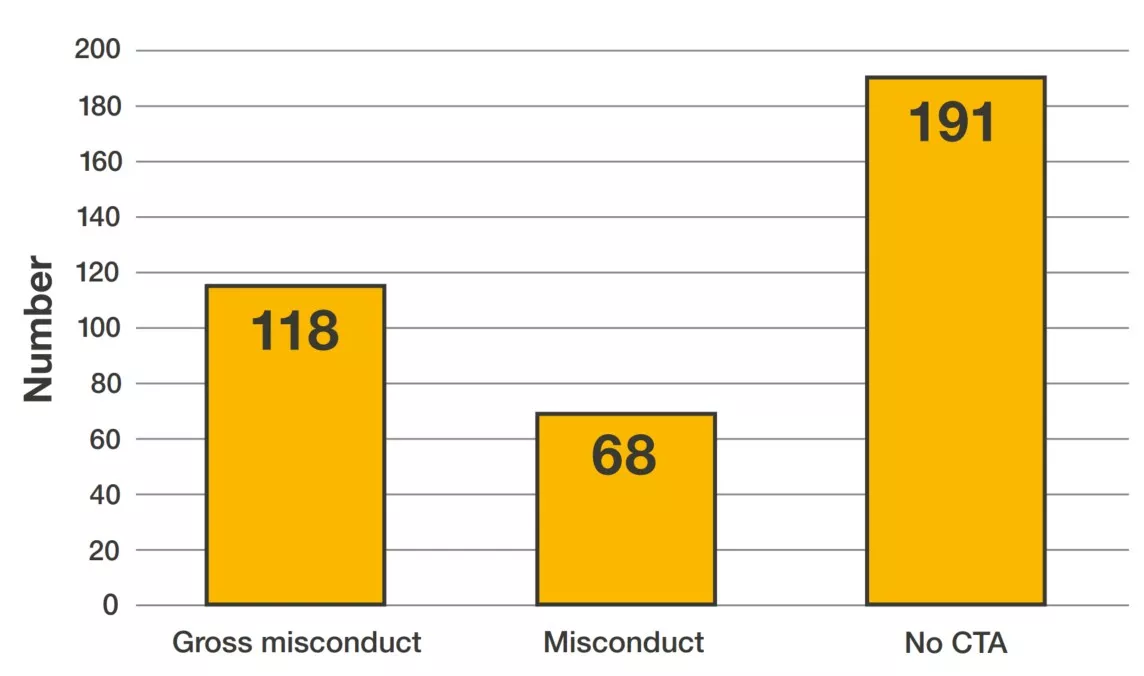
Of the 186 officers/staff who had a case to answer, 68 involved misconduct and 118 involved gross misconduct.
Our investigations found 191 of the police officers/staff we investigated did not have a case to answer for misconduct or gross misconduct. Further action was taken in response to 37% (71) of these people. This included:
- management action or advice to improve the conduct of the officer
- unsatisfactory performance procedures
- referral to the reflective practice review process
In matters we investigate involving staff from PCCs and other elected policing bodies, the question to be determined by the investigation is whether the individual may have committed a criminal offence. Current legislation does not
extend our authority to investigate any allegations of misconduct by PCCs or other elected policing bodies.
Referrals to the CPS
When our investigations suggest that a police officer or member of police staff may have committed a criminal offence, we inform those involved, explain their legal rights, and take their account under criminal caution.
In 2023/24, our investigators took cautioned accounts from 110 individuals across 70 investigations.
We only refer a case to the Crown Prosecution Service (CPS) if, at the conclusion of our investigation, we believe there is evidence that a criminal offence may have been committed. The CPS then decides whether to prosecute, based on its own legal threshold.
Some investigations completed during 2023/24 may still be awaiting a CPS referral decision or prosecution outcome. In some cases, the CPS may decide not to proceed if it concludes there is insufficient evidence to provide a realistic prospect of conviction.
We apply a two-part test, as set out in paragraph 23, Schedule 3 of the Police Reform Act 2002, to determine whether a case should be referred to the CPS. You can read more about this process in our Statutory Guidance on our website.
It’s important to note that the threshold we apply when deciding to refer a case to the CPS is lower than the threshold the CPS uses when deciding whether to prosecute.
In 2023/24:
- we referred 69 individuals to the CPS
- the CPS decided to prosecute 43% (30 individuals)