At 15:05:37—within a few seconds of the referee stopping the match—the Racal system recorded a message from the PCB to the Force Control Room calling for Operation Support to be initiated. Operation Support was a documented contingency under which all available SYP officers would be immediately deployed to assist with an incident. It was generally understood to be used in response to incidents of large-scale disorder.
In his 1989 account, Ch Supt Duckenfield said that he called for Operation Support and evidence has not been found to suggest that anyone else was responsible for the initial request.
Because implementing Operation Support would have a significant impact on operations within the SYP area, the decision to do so required authorisation from the ACC (Operations) or the designated duty chief officer. As ACC Jackson was at Hillsborough Stadium on 15 April 1989, he was in a position to give such authorisation, but he was not in the PCB at the time it was first requested. He arrived a couple of minutes later, of his own volition rather than as a result of a request from the PCB, and authorised Operation Support at 15:09:07.
At about the same time that the request for Operation Support was made, the PCB sent a radio message instructing all available officers at the ground to make their way to the perimeter track at the Leppings Lane end. The message has not been recorded anywhere, but numerous officers have described hearing it. SWFC CCTV footage suggests that the radio message was broadcast at about 15:05:41, as it shows that a number of police officers were standing outside Gate C at that time; they promptly made their way through the gate into the stadium.
Though officers responded immediately, they did not know what they were responding to. Some indicated that the message referred to crowd trouble or disorder; others just assumed this was the explanation. When they saw supporters on the pitch, this appeared to confirm their views.
Inspector John Beresford (Insp Beresford) was dispatched from the gymnasium with Serial 21, to help deal with unspecified “trouble” at the Leppings Lane end. He saw spectators on the pitch and others climbing the fence, but when he arrived at the corner of the North Stand and West Terrace, he could not see the cause. In his 1989 account, he said: “The only police action which seemed obvious to me was to form an open cordon across the touch line from the northwest corner flag towards the goal mouth.” Though Insp Beresford did not explicitly state the purpose of forming such a cordon, it is a relatively standard police tactic to manage the movement of a crowd. On this occasion, the logical reason for establishing one would have been to prevent a pitch invasion.
CCTV footage at 15:06:19 shows Insp Beresford appearing to organise officers into a cordon. However, in his 2013 statement, Insp Beresford recalled that as he neared the goalmouth, he realised that supporters were injured and that “this was no pitch invasion but a rescue operation.” He said his officers quickly left the cordon to assist in different ways.
BBC footage shows the cordon being formed at around 3.06pm but becoming fragmented by about 3.13pm. By 3.16pm, it had fully dispersed.
The formation of this cordon, and others in different locations later, have been the subject of complaints from supporters, on the basis that officers should have been engaged in more practical assistance. The evidence suggests that officers in the cordons felt the same way; they had responded on limited information and followed instructions, but once they saw what has happening, many chose to leave the cordon to assist in the rescue effort.
However, there is also evidence of a further issue emerging: that officers, lacking instruction or coordination, were getting in each other’s way in their frantic rescue efforts.
At 3pm, Supt Greenwood was standing by the players’ tunnel, in front of the South Stand by the halfway line. In an account dated 3 May 1989, he said he saw supporters climbing over the perimeter fence behind the goal at the Leppings Lane end of the ground. Because two or three police officers were with them, he immediately realised there must have been a crowd problem. However, he did not believe it was fighting or a pitch invasion, because he did not expect that to happen so early in a match. He immediately made his way to the West Terrace, along the perimeter track.
At this stage, he was still unaware that there had been any issues outside the stadium.
By 15:01:11, Supt Greenwood was close to Gate 1, which was open. CCTV footage shows that he walked past PC Richardson, who was ushering supporters into Pen 1, and past Ch Insp McRobbie, without apparently speaking to either. He arrived in front of Pen 3 by 15:02:01.
In his first written account of the disaster dated 3 May 1989, which was submitted to WMP and the Taylor Inquiry, Supt Greenwood recalled that he looked at the crowd in Pen 3 behind the goal and saw that people were being crushed against the perimeter fencing. He said the area behind the gate was heavily congested, preventing people from getting out, though police officers were trying to help them.
He climbed on an advertising hoarding to get a better view, and at first gestured to the crowd to move back, as he thought this could help. He said that when this proved ineffective, he decided to stop the match. In a prepared statement dated 27 June 1990, ahead of his interview under caution by WMP, Supt Greenwood said: “I broadcasted by personal radio to the Control Box that there were potential casualties and that the game had to be stopped. I also waived [sic] both my arms towards the Control Box in a signaling motion to the effect that the game must be stopped.”
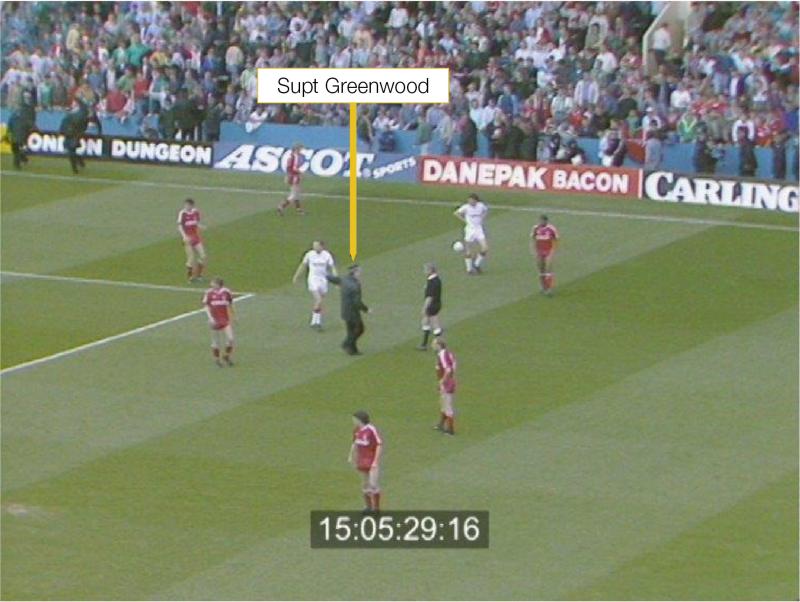
After doing so, he ran onto the pitch to attract the referee’s attention to stop the match. Figure 5F, taken from BBC footage, shows Supt Greenwood on the pitch approaching the referee at 15:05:29. He then returned to the perimeter fence in front of Pen 3.
Image
Figure 5F: Supt Greenwood approaching the referee, 15:05:29 (Source: BBC)
In their original accounts, both Supt Murray and Ch Supt Duckenfield referred to seeing Supt Greenwood signalling towards the PCB that the match should be stopped. Ch Supt Duckenfield said he sent Supt Murray to do this; Supt Murray said he was preparing to go, when Ch Supt Duckenfield confirmed he should.
Supt Murray suggested this was at 3.03pm. They both said that there were increasing numbers of supporters on the pitch by this stage. Racal recordings confirm that at 3.03pm, the PCB sent a radio message to the SYP Force Control Room at Snig Hill Police Station asking for dog handlers to be dispatched to the stadium, indicating they assumed they were dealing with some sort of crowd trouble.
When interviewed under caution by WMP on 25 June 1990, Supt Murray said that when he went onto the pitch, his intention was to stop the match. However, before he was able to attract the attention of match officials, he saw Supt Greenwood speaking to the referee, so returned to the PCB. He said he did not recognise that there was a serious problem on the West Terrace because he had not gone far enough across the terrace.
Figure 5G is taken from BBC footage timed at 15:05:43. It shows Supt Murray on the perimeter track facing the West Terrace, just after the game had been stopped. There were dozens of supporters on the perimeter track and officers at Gates 3 and 4 were engaged in an effort to help supporters out of the pens. Almost all of the D Division officers under PS Swift have given accounts in which they stated they were aware by this time of supporters being crushed. In the background of figure 5G, supporters can be seen on the pitch in front of the pens. It is therefore striking that even at this point Supt Murray and others in the PCB had not recognised the severity of the situation.
Image
Figure 5G: Supt Murray on the perimeter track, 15:05:43 (Source: BBC)
During this same interview under caution, Supt Murray said that when he returned to the PCB, Ch Supt Duckenfield sent him straight out again to clear the supporters from the pitch. However, when he reached the pitch, he realised that the situation was different: he saw people crushed against the fence, so borrowed a radio to contact the PCB and asked for ambulances to be dispatched to the stadium. This call was made at about 3.07pm and is examined further from paragraph 5.79.
Several of the officers closest to the West Terrace described attempting to radio the PCB, to alert them to the situation, request assistance or ask for authorisation to open the gates. However, they said their messages didn’t get through, or at least they didn’t get a response.
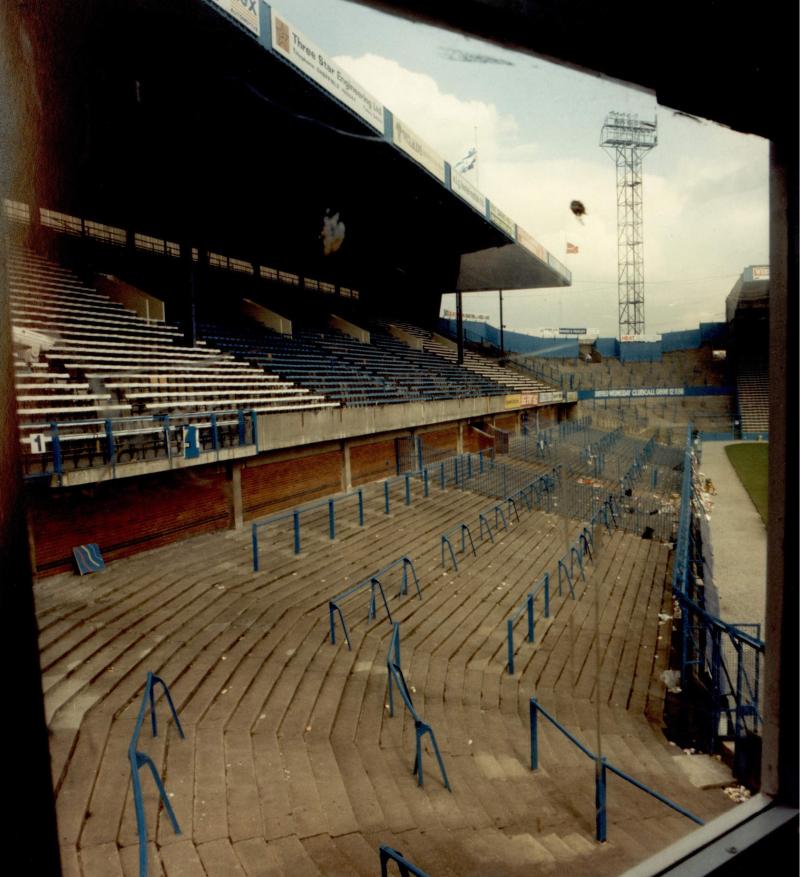
The PCB was located on the corner of the West Terrace and South Stand, below the scoreboard. It had windows in line with the perimeter track and front of the West Terrace. Figure 5E shows the view from the PCB across the West Terrace.
Image
Figure 5E: View of the West Terrace from the PCB, 1989 (Source: Richard Haylor, WMP)
This should have provided those in the PCB with a good view of the unfolding situation—both in terms of seeing the front of the pens and the perimeter gates and having a view from above the pens.
PC Bichard was the CCTV operator in the PCB. In his 1989 account, he said that at about 2.55pm, those in the PCB began to notice Liverpool supporters climbing up into the West Stand from the terracing below, with people in the West Stand helping them up. However, he said that the same thing had occurred at the 1988 FA Cup Semi-Final.
Shortly after this, they saw some supporters climbing the perimeter fence and others on the perimeter track. PC Bichard said that he and his colleagues in the PCB assumed it was some sort of crowd trouble.
In his original account, Supt Murray said that at about 2.58pm he became aware of something happening near the goal area. Though he could not see exactly what was going on, he realised that officers had opened either Gate 3 or Gate 4, or both gates. He said that a handful of supporters were on the perimeter track and were walking calmly and slowly towards Gate 1, while other supporters were standing aimlessly on the track. He recalled that the officer at Gate 1 appeared to be totally unaware of their presence, so Chief Inspector Robert McRobbie (Ch Insp McRobbie), who was in the PCB to observe and not in any operational role, went down to the track to draw the officer’s attention to what was happening.
In his 1989 account, Ch Supt Duckenfield described this scene in a very similar way. As the numbers of supporters making their way onto the track increased, he said he “considered there may have been a pitch invasion or that people were being taken out for re-location in the two wing pens.”
At the Goldring Inquests, he was asked what he thought was happening and whether it occurred to him that it could have been a result of Gate C being opened. He replied that he thought there may have been crowd disorder and that he had made no connection with the opening of Gate C.
In his 1989 account, Ch Supt Duckenfield said that as the numbers on the pitch increased, he asked for Supt Greenwood to go and find out what was happening. Supt Murray similarly mentioned this in his 1989 account. However, Operation Resolve has found no evidence in Racal recordings or the accounts of officers outside the PCB of any communication with Supt Greenwood.
Chapter 4 showed that by about 2.40pm, Pens 3 and 4 of the West Terrace were full, or very close to full, and according to some supporters, the situation there was becoming uncomfortable. By contrast, the side pens still had lots of space in them. Supporters have described in painful and traumatic detail what happened shortly after this point.
One supporter recalled that after getting through the turnstiles at about 2.45pm, he went with his father and sister through the central tunnel. He could see that Pen 3 and Pen 4 were packed, but in his opinion, they were not overly congested. The supporters did not appear to be being crushed and were able to stand still, rather than being moved around by the flow of the crowd. The supporter and his family took a couple of steps down to decide where to stand when there was a sudden surge from the central tunnel and the size of the crowd increased dramatically. He recalled that this surge carried him forward to the centre of Pen 3 with his feet not touching the ground.
A second surge shortly after took him forward further, until he was trapped against a metal crush barrier, which then collapsed. He was caught with his legs underneath the barrier and doubled up on the floor with the bar on top of his stomach. His head was face down on the corner of a step. He heard people screaming all around and could feel people falling on top of him. In his statement, he said that he could not breathe and thought he was going to die, so he just lay there until he lost consciousness. He awoke to feel someone pulling at his arms and managed to whisper to them that he was trapped under the barrier. Rescuers lifted the crush barrier slightly and were able to pull him out. An ambulance took him to hospital where, for several days, doctors treated him for severe injuries to his hips, stomach and back.
Several other supporters recounted similar experiences when the crush barrier collapsed. One supporter was desperately holding on to a man he didn’t know, who was being crushed against the barrier in immense pain; the barrier then gave way. He recalled: “I lost my grip on this lad and fell forward onto the backs of the people in front of me, I totally lost my balance. I did not fall to the floor, but onto the backs of people who had fell over in front of me. I then felt people falling on top of me.” He was unable to breathe or move but could see his brother on the pitch and screamed out to him. Eventually the pressure eased, and he was able to escape with the help of a police officer.
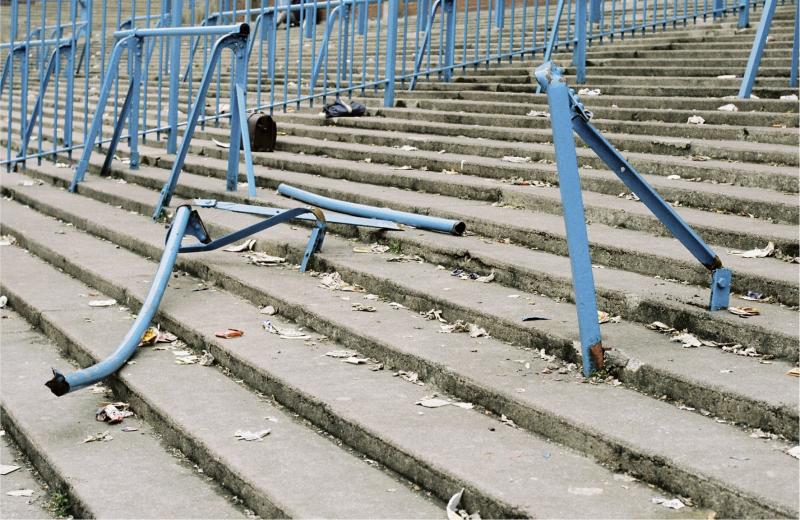
Image
Figure 5A: Photograph of the broken crush barrier, taken in the aftermath of the disaster (Source: HSE)
Others were trapped elsewhere. A woman who had positioned herself behind the goal at about 1.40pm said that at about 2.55pm, there was a push from behind, which knocked her into the perimeter fence. She and others initially managed to push back, which relieved the pressure; she recalled that people were screaming at the police to open the gate at the front of Pen 3, but the police officers shook their heads and turned their backs. There was then a second surge which forced her into the fencing again. She said that this time “my arm was trapped across the fencing, and my legs were forced against the wall by the force of people from behind. I couldn't move my head at all.” She estimated she was stuck in this position for almost half an hour before she was freed.
A supporter in Pen 4 described how they were squeezed down the tunnel into the pen, when almost immediately the person in front of him passed out. He tried to keep hold of the man but said: “My arms and shoulders were on fire with the pain and my legs were turning to jelly. The lad was a dead weight and by this time his head had slumped down to chest level. His legs were dragging on the floor and I felt myself going.” He added: “I couldn't do anything and I was trying as best as I could to keep my feet on the ground to avoid being tripped. I felt my grip on the lad begin to go, his shirt rolled up around his chest and his trousers began to drop. The pain in my arms and shoulders became unbearable and I lost him in the crush.”
While they were there, others were climbing or crawling over them towards the perimeter fence. He recalled officers on the other side of the fence telling them to push back, which they couldn’t do. Eventually, he reached the fence, where a police officer guided his hand to the wire. He gripped on to this to get his breath back, before inching his way along the fence to the gate.
Many supporters witnessed horrific injuries or were acutely aware of others losing consciousness around them. Their fear grew, often worsened by being separated from friends or family.
A common theme is that the crush suddenly and dramatically intensified at around 2.55pm. The obvious conclusion is that this was a result of the rapid influx of supporters following the 2.52pm opening of Gate C. The evidence of Insp Bullas, who was in the West Stand above, supports this. He described how, at a point between the teams coming onto the pitch (which was at 2.54pm) and the kick-off, he saw what he described as a river of people suddenly enter the terracing from the central tunnel. He added: “This wedge of people seemed to go forward down the terracing but unlike the swaying motions that had taken place earlier on did not sway backwards but remained where it was.” He said: “At this stage I could see the people towards the front of the terracing were being 'crushed forward’”. He attempted to radio the PCB but could not get through.
It appears that shortly after this influx, the crush barrier in Pen 3 collapsed. Mr Cutlack believed that similar events were only narrowly avoided in Pen 4, where two barriers were severely damaged on the day of the disaster.
The accounts of supporters broadly indicate that police officers on the perimeter track in front of the pens did not initially recognise the severity of the situation, even when supporters were screaming for help. Many described officers simply telling or gesturing at them to move back, which they could not do.
PC Smith and PC Illingworth were two of the officers on duty on the perimeter track. This was a role they had performed frequently, and they were in their regular positions; PC Smith in front of Pen 3 and PC Illingworth in front of Pen 4. They had both returned there at around 2.50pm, following a meal break.
In his 1989 account, PC Smith wrote that as the teams came onto the pitch at 2.54pm, he made his way to stand in front of Gate 3 in the perimeter fence. He described some supporters jumping up and down and pushing, which caused the crowd to surge forward to the perimeter fence. He said the people at the front shouted and screamed, and the crowd then moved back. However, he didn’t suggest this was anything out of the ordinary; he later told the Taylor Inquiry there were no signs of overcrowding.
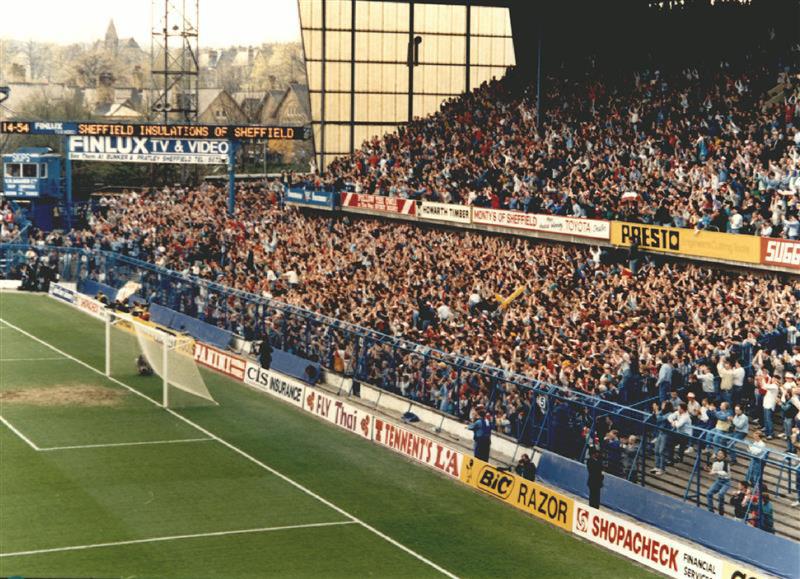
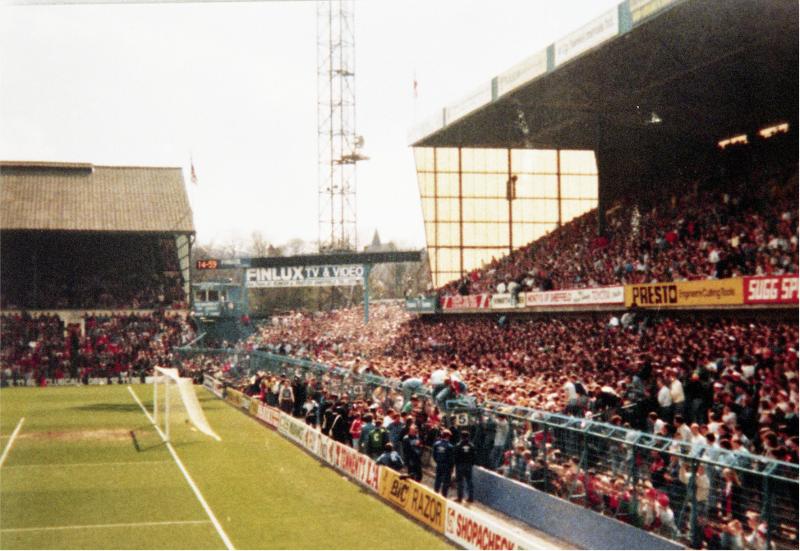
Figure 5B was taken by a supporter in the North Stand at 2.54pm. The contrast between the density of the supporters in the centre pens and outer pens is evident.
Image
Figure 5B: View of West Terrace, 2.54pm (Source: Maurice Price)
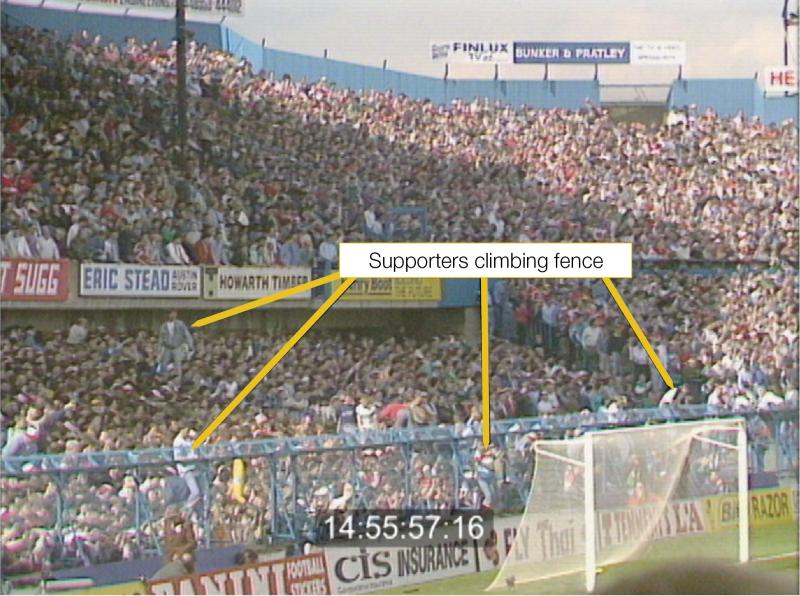
By 14:55:57, supporters could be seen climbing on the perimeter fence or the radial fences.
Image
Figure 5C: View of the front of the West Terrace, 14:55:57 (Source: BBC)
At 2.57pm, Gate 3 burst open; PC Smith closed it immediately. This was in line with instructions to police officers not to allow anyone onto the pitch. In his 1989 account, he commented: “I assumed the pressure of a surge had opened the gate. There was no great pressure on fans at the front after the gate was re-secured.”
PC Smith said that no one came out of the pen at this point. However, some supporters and at least two police officers have said that a small number of supporters did go through the gate but were immediately pushed back into the pen by the police.
One supporter’s account described seeing the perimeter fence gate spring open and his son and two others being pushed through it by the pressure of the crowd. He said the police returned them to the pen. Other supporters indicate that those who went through the gate fell or stumbled out of the pen, rather than walking through it.
However, within under a minute the gate opened again. PC Smith stated he was not able to close it. He said that two other officers came to assist him, and that at this stage supporters were screaming and shouting that they were being squashed. PC Smith said he stepped back from the gate, leaving the other two officers there and saw “people were tight up to the fence, particularly two or three young women to my right of the gate.” He tried to send a radio message to the PCB to ask if the gates could be opened: “I got no reply but think there was some message about a gate being opened elsewhere. The noise was terrible and people were screaming, a different type of scream and I opened the gate 3 fully.” His account of attempting to contact the PCB is supported by Racal recordings, which included a message from an officer with his call sign at this time. The message itself was largely inaudible.
Other officers near the gate have said that when it opened a second time, their perception of the situation also changed.
The supporter whose son had gone through Gate 3 at its first opening said that when it opened again, he, his son and his son’s friends were among the first to go through it. They walked along the track in the direction of the South Stand, where they sat down on a bench near the south-west corner of the pitch. This is confirmed by SYP CCTV footage timed at 15:00:17. He said that a police officer, later identified as Police Constable Fiona Richardson (PC Richardson), told them they could not stay there and took them to Pen 1 of the West Terrace.
Gate 3 remained open from this point and by 2.59pm, all the perimeter gates were open, as shown in figure 5D. A number of supporters can be seen on the perimeter track while others were climbing over the fence in front of Pen 4, or over the radial fence from Pen 4 into Pen 5.
Image
Figure 5D: The West Terrace at 2.59pm (Source: Stephen Loftus)
The officers who assisted PC Smith at Gate 3 were from D Division. Their initial duty had been to escort Liverpool supporters on buses from Sheffield Midland Railway Station in the city centre to the ground. They got to the stadium following the last of these escort trips at about 2.50pm. Seeing the crowd at the Leppings Lane entrance, Police Sergeant Howard Swift (PS Swift) asked their driver to take them to the Penistone Road entrance, where they went to the gymnasium and reported to Insp Sewell as planned.
Almost immediately, a message came over the radio asking for assistance at the Leppings Lane end. PS Swift assumed it related to the situation outside the turnstiles. Insp Sewell sent PS Swift and his serial to the Leppings Lane end, and they walked around the perimeter track, which was the most direct route.
As they walked round, they noticed the difference in fullness between the centre pens and the outside pens. At about 2.58pm, they stopped in front of the centre pens and several members of the serial recognised that supporters were extremely distressed.
PS Swift decided to try to open the gate at the front of Pen 4 so that supporters could move into the emptier pens. He said that due to the noise of the crowd, it was not possible to use his radio to inform the PCB of his intentions, or to hear any radio transmissions. Instead, he waved to the PCB to indicate that he was going to open the perimeter gates. He said he knew that there were not enough police officers on the perimeter track to control the number of supporters he expected to come through the gates but recognised that those at the front of the pen were extremely distressed.
He was waiting for spectators to surge onto the track, but quickly realised the pressure was too great, so they had to pull each one out individually.
His recollections were supported by two other officers from his serial, Police Constable Philip Hooson (PC Hooson) and Police Constable Lillyan Akred (PC Akred). In his 1989 account, PC Hooson recalled: “As I neared Gate 4 I realised that the people in the West Stand were not shouting but were screaming. I realised then that something was seriously wrong and I heard people in the crowd screaming, 'let us out’.” He said there were three police officers standing on the track, but they were not doing anything. In a 2013 statement, he said the situation was worsening by the second.
PC Akred said she didn’t realise the gravity of the situation until she faced the crowd in front of Pen 4. In her 1989 account, she commented: “I then saw that people at the front of the crowd were going blue in the face and were apparently unconscious, only being kept up by the weight of people at each side. I shouted for people to try and ease back, but they were unable to do so.”
She said that once they opened the gate, people were panicking: “Many were ignoring our instructions and just climbing over people who had already stumbled.”
Several supporters who were in Pen 4 have referred to the efforts made by a bald-headed officer and female police officer to lead the rescue effort. These were PS Swift and PC Akred.
Operation Resolve investigated complaints about the initial response of both PC Smith and PC Illingworth; these complaints concerned whether they recognised the situation fast enough and the way they dealt with supporters. Having examined the evidence set out in individual complaint reports, the IOPC was of the view that neither officer would have had a case to answer, if they had still been serving. While they did not immediately recognise the severity of the situation, neither did others: it was not clear that any delay in their response was a result of neglect of duty.
Further, while the evidence—including his own later admission when interviewed under caution by WMP—does suggest that PC Smith did push a small number of supporters back into Pen 3, this was at the point when he and another officer assumed they were dealing with a pitch invasion. He has explained that once he realised the gravity of the situation, he did push some people out of the way as he attempted to rescue those who were trapped.
This chapter includes witness accounts, images and descriptions of scenes that may be distressing.
What was investigated?
Under the terms of reference for the managed investigation, Operation Resolve investigated: Response of the police to the disaster, including:
a) the early police response to the crush at the Leppings Lane end, including allegations that the police were slow to respond/failed to act when it was obvious the people were in distress b) alleged failures/refusals on the part of the police to open perimeter gates, and allegations that officers pushed supporters back when they were trying to climb to safety—this aspect of the investigation will specifically consider complaints made against PC Peter Smith and PC David Illingworth, as well as any other officers who may have been involved c) subsequent police command and control of the disaster d) the communication between the police and the other emergency services e) the activation and implementation by the police of any pre-planned responses and emergency procedures for such disasters
What was found?
• Accounts from supporters describe a sudden change in the situation in the pens at around 2.55pm, when the pressure from the back suddenly intensified. This is consistent with the influx of supporters into the centre pens after the 2.52pm opening of Gate C. Officers and supporters in the West Stand recalled seeing a huge surge of people coming into the pens around this time.
• Officers from Serial 1, stationed in their usual positions on the perimeter track, did not immediately realise the severity of the situation. When Gate 3 in the perimeter fence burst open at 2.57pm, the officer there (PC Smith) immediately sought to close it again and prevent supporters coming through, assuming it was a pitch invasion. When Gate 3 burst open a second time, it was left open and officers allowed supporters through onto the perimeter track.
• At around this time, a serial of officers from D Division, who were not normally involved in policing Hillsborough Stadium, arrived at the West Terrace. Some of them instantly saw there was something wrong and opened Gate 4, to try to free supporters from Pen 4 towards Pen 6. The evidence indicates that Police Constable David Illingworth (PC Illingworth) from Serial 1 had not yet done so. Other members of the D Division serial have stated that they did not immediately think there was a problem inside the pens, but within a matter of seconds they realised there was. By 2.59pm, all the perimeter gates to the West Terrace were open.
• When the officers in the PCB saw supporters on the perimeter track, they initially assumed it was a result of disorder, and their first request was for dog handlers to be sent to the stadium. At 3.04pm, they saw Supt Greenwood signalling to them that the match should be stopped but still did not know why. Supt Murray was sent down to the pitch, but by the time he had got there, Supt Greenwood had reached the referee to stop the match. Supt Murray returned to the PCB but was sent back down to find out what was happening.
• As soon as the match was stopped, Ch Supt Duckenfield called for Operation Support—a request for all available officers to be immediately deployed from across SYP to assist. However, he did not have the authority to do this; it required ACC Jackson to confirm it, which he did a couple of minutes later.
• At almost the same time, the PCB sent a radio message instructing all available officers at the ground to make their way to the perimeter track at the Leppings Lane end. Neither request included any details as to what officers were responding to.
• Most officers who did respond initially assumed that they were dealing with some kind of crowd trouble or pitch invasion. However, as they got closer to the West Terrace, their views changed. Most SJA volunteers and the first SYMAS staff present indicated that their first thought had been the same.
• SYP and SYMAS did not respond in line with their emergency procedures or incident plans. Duties identified as pivotal to the correct allocation of resources and directing the response were not fulfilled. No police officer declared a major incident, so the other emergency services were not correctly alerted to the severity of the situation.
• At first, SYP’s Force Control Room merely advised SYMAS that ambulances may be needed; the Force Control Room received a request from the PCB for a “fleet of ambulances” to be dispatched. This was in response to a message from Supt Murray on the pitch at 3.08pm. However, the Force Control Room was only able to give SYMAS limited information about what had happened, so SYMAS rejected the request for multiple ambulances, instead authorising a limited initial response.
• When further ambulances did arrive, police officers outside the stadium did not know why they had been called or where they were needed. The same issue recurred when teams from SYCFS arrived a few minutes later.
• Rescue efforts were initially hampered by a combination of the narrowness of the perimeter gates, the pressure from the crowd and a lack of organisation. Several officers have described getting in each other’s way as they frantically tried to free trapped supporters. The situation changed after Ch Supt Nesbit arrived at around 3.11pm. He organised officers into chains at each gate, to enable supporters to be carried to safety. Around the same time, other officers, including PS Morgan, entered the pens through the central tunnel at the back, to encourage supporters to move away and help free those at the front.
• There was no central organisation of the rescue effort and no instruction from the PCB. Instead, it was left to those on the pitch to make decisions as best they could. This included SYMAS and SYCFS staff. The PCB did issue requests for help, such as a request for the local radio station to broadcast an appeal for doctors to attend. However, its communications remained poor: at one point, the PCB asked the Force Control Room to set up a “Major Incident Bureau”, confusing two separate functions: a Major Incident Room and a Casualty Bureau. There was also a lack of clarity as to who was in charge.
• Supporters, including some off-duty medical professionals sought to assist, but also received little or no instruction. Numerous supporters helped carry the injured while medical professionals at first attempted resuscitation but were increasingly asked to certify death. There was no police coordination of this, as the SYP Major Incident Manual stipulated there should be. The sole focus appears to have been rescue, with no consideration of how the injured would be managed. The PCB did not offer any direction around this, which also meant that medical resources were not well deployed.
• By 3.31pm, the front of Pen 3 was clear of casualties. However, supporters were still being treated or taken to ambulances. A growing number were confirmed to have died.
• Some of the actions of officers—such as forming cordons rather than assisting in the rescue effort—appeared inappropriate to supporters.
• Evidence has not been found of officers using their truncheons on supporters and there is insufficient evidence to substantiate allegations of officers physically preventing supporters from escaping the pens.
Significant new evidence
There was already a wealth of existing evidence about the emergency response. Operation Resolve enhanced this by time-synchronising it, then using specialist technology to analyse it frame by frame. This provided further insight into the sequence of events and also assisted in the investigation of specific issues, such as the allegations that police officers had used truncheons on supporters.
Operation Resolve also examined in detail recordings and transcripts of police radio communications and telephone conversations, including those between the PCB and SYP’s Force Control Room at Police HQ, and between the different emergency services—some of which had not previously been open to scrutiny.
This chapter focuses on Operation Resolve’s investigation into the short period of time from around 2.45pm, shortly before the exit gates were opened, to 5.15pm when Ch Supt Duckenfield left the stadium. It examines the effectiveness of the SYP response to the situation, comparing what officers did with what—according to SYP’s own Major Incident Manual and Major Incident Plan—they should have done.
It also includes evidence from supporters, police officers and other witnesses describing the situation in the pens, along with some images of the rescue effort. Some may find these accounts and images distressing.
There are, understandably, numerous inconsistencies in witness accounts about precise timings and the exact sequence of events. Where possible, Operation Resolve has used time-synchronised video footage and time-stamped photographs to provide accurate timings.
Operation Resolve investigated a number of complaints and conduct matters relating to the events of the day, up to the opening of the exit gates, and provided reports on each to the IOPC. Having reviewed the evidence detailed in these individual reports, the IOPC opinion was that four officers would have had a case to answer for gross misconduct, if they had still been serving. Some of the grounds for the IOPC’s opinion are set out below.
Ch Supt Duckenfield would have had a case to answer for neglect of duty on several counts, beginning earlier in the day when he did not brief officers in sufficient detail about how they should police the arrival of supporters at the Leppings Lane end. This was then followed by a series of key failings of control as the crowd built.
He did not take reasonable steps to assess the number of spectators yet to enter the stadium, which was directly related to the subsequent decision not to delay the kick-off, also identified as a key failing.
Having failed to prevent a dangerous build-up of supporters outside the Leppings Lane turnstiles, he then authorised opening the exit gates without fully considering the likely impact of doing so. Nor did he give any warning to officers that the exit gates were about to be opened, or any instructions to officers about how to manage the influx of supporters.
Supt Murray would have also had a case to answer for neglect of duty in relation to his failings to prevent a dangerous build-up of supporters outside the gates and to control the movement of supporters following the opening of Gate C. He did not use his additional knowledge and experience to assist Ch Supt Duckenfield: he failed to anticipate that a dangerous build-up of the crowd could occur and advised Ch Supt Duckenfield incorrectly that all the supporters would be able to enter the ground in time for the scheduled kick-off. Neither of them checked turnstile count data.
He also specifically acknowledged that he knew supporters coming through Gate C would be most likely to head to the central tunnel, but he failed to consider the risks of this or give instructions to ensure the safe distribution of supporters.
Supt Marshall would have had a case to answer for neglect of duty because, among other factors, he failed to take steps to ensure that the supporters were able to queue safely for entry through the turnstiles. Once it became apparent that the police had lost control of the situation at the turnstiles, he failed to request that the kick-off should be delayed.
PS Morgan was subject to a conduct investigation, initiated by Operation Resolve rather than as a result of complaints. He would have also had a case to answer for gross misconduct, for the offence of neglect of duty in relation to two issues. The first of these was that he left his allocated area of responsibility on the inner concourse without good reason for over half an hour during the build-up to kick-off. It appears he did not return to this area as swiftly as he could have done, leaving his serial without supervision during the critical period when the crowd built up outside the turnstiles. The second allegation related to his role in the 2.52pm opening of Gate C. With evidence available to indicate that he asked for Gate C to be opened at this time, he failed to consider the impact of opening the gate—even though he had already witnessed the consequences of the 2.48pm opening—and also did not articulate any concerns to senior officers.
Operation Resolve’s investigation demonstrated that throughout the day of the disaster, there was a recurring issue in the way the police managed the situation: a marked lack of effective communication. This began early, when groups of officers chose to apply different tactics to those detailed in the Operational Order, without informing colleagues.
It continued as officers made their own decisions about managing supporters around the city. When PS Miller instructed that certain pubs should be closed, he didn’t advise colleagues at the Leppings Lane end that he would be escorting a large group of supporters to the stadium. He did tell the PCB, but no one passed the message on.
The PCB was not alerted to potentially significant traffic delays further afield, which could have been important in the decision about whether to delay the kick-off. Nor did officers there seek to check the situation.
Most significantly, as the crush built outside the stadium, officers inside had no idea what was happening. They therefore had no reason to be concerned about the unequal distribution of supporters between pens on the West Terrace.
This communication failure culminated in the fact that before Gate C was opened neither the PCB nor the officers inside the gate were informed, so could not prepare. While some did have access to a radio, there were well-documented problems in terms of messages breaking up or simply being inaudible due to the crowd noise. Instructions were not precise and were uncoordinated. The result was the rapid influx of supporters, who took the most logical route to their target destination: the tunnel signposted “standing” which led to the full centre pens. The consequences of this are examined in the next chapter.
SWFC and SYP CCTV footage shows that Gate A opened between 14:58:26 and 15:00:01. The CCTV footage shows that police officers formed a cordon on the inside of the gate and managed the entry of supporters into the ground. No other gate was open at the time Gate A was opened.
Officers close to Gate A made the decision to open it in response to the severity of the crushing outside. They were concerned that it was going to burst open and had stewards attempting to hold the top bolts in place.
By 14:55:02, a group of officers had assembled by the inside of Gate A and formed a cordon. They then requested authorisation to open the gate, which they received, though it is not clear from whom: possibly from Supt Marshall, or PS Goddard in the PCB.
Despite the reluctance of the gate steward, the police insisted that Gate A should be opened. The officers channelled incoming supporters away from the gate to the North Stand. When the pressure outside had reduced, Gate A was safely closed. It is not certain who coordinated this opening, but it stands in stark contrast to the more chaotic situation that was witnessed at both Gate C and Gate B.
SYP CCTV footage shows that Gate B was opened at 14:58:58 and closed almost immediately. Estimates for the number of supporters who entered via Gate B range from 70 to 500, demonstrating the confusion about what happened and how long it was open for. It is not clear where incoming supporters went, but it seems likely some would have headed to the central tunnel. While the opening of Gate B may therefore have helped reduce the crush outside, it is also possible that it contributed to the subsequent crush in the centre pens.
However, after Gate C was closed, Supt Marshall made further radio requests—potentially without realising Gate C had even been opened. The evidence of the police officers in the PCB about this has been consistent. Having heard the increasingly desperate requests from Supt Marshall to open the gate, Ch Supt Duckenfield deliberated on what to do and then gave an instruction to open the gates. It is not clear exactly when this instruction was issued.
At 2.52pm, Gate C was opened again, possibly shortly before the instruction from Ch Supt Duckenfield, and remained open for several minutes. Estimates vary as to how many supporters entered the ground through Gate C at this point, but the commonly accepted figure is more than 2,000.
Despite comprehensive analysis, Operation Resolve has not been able to establish whether Gate C was opened at 2.52pm as a result of Ch Supt Duckenfield’s instruction, as has largely been assumed, or whether it was opened for other reasons.
What is clear is that none of those directly involved in the opening of Gate C has at any point said they heard a radio message or received an instruction from the PCB to open it.
Further, Operation Resolve has found no evidence from the Racal recordings of communications from officers in the PCB, or from officers on duty elsewhere, that any further instruction was issued to officers inside the turnstiles, or inside the ground itself, that the gates were about to be opened, or even clarification of which gates were to be opened or by whom.
CCTV footage shows that Gate C was physically opened by steward Ian Marsh at 14:52:37. He was assisted by another steward. The recollections of both about exactly what happened have been inconsistent. Ian Marsh has accepted various possible explanations put to him, including that he opened the gate to allow a supporter out, and that he opened it in response to a request from a police officer outside.
Several supporters in the crush have described a police officer outside shouting to the stewards inside to open the gate. Others have described a police sergeant outside the ground directing them to Gate C, with the assurance that it would shortly be opened.
PS Morgan has confirmed that he did this, with the intention of allowing small groups of supporters in through Gate C in a controlled way to reduce the crush. However, he did not communicate this plan to other officers, with the possible exception of Insp Purdy.
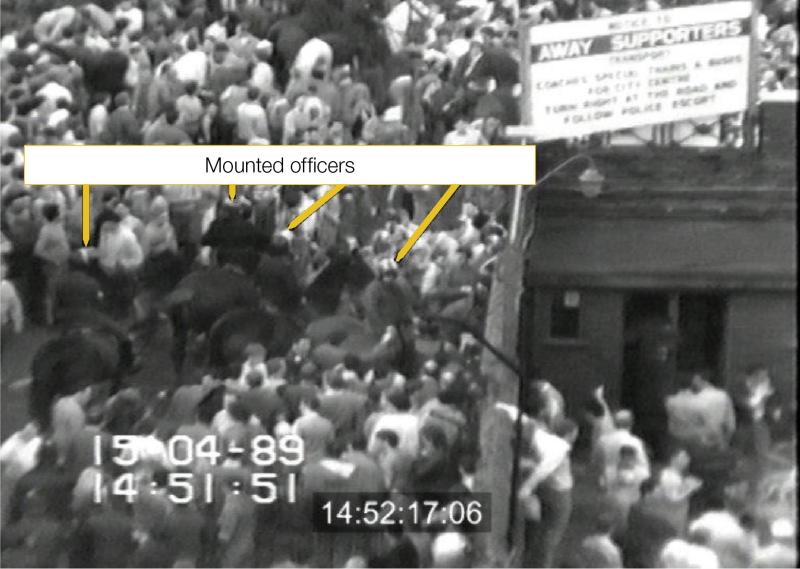
Insp Purdy has also described an attempt to bring small numbers of supporters out of the crush and under the funnel bar, so that they could enter through Gate C in a controlled way when it was next opened. Mounted officers were being used to try to restrict the number of supporters waiting outside.
CCTV footage shows the situation outside Gate C twenty seconds before it opened.
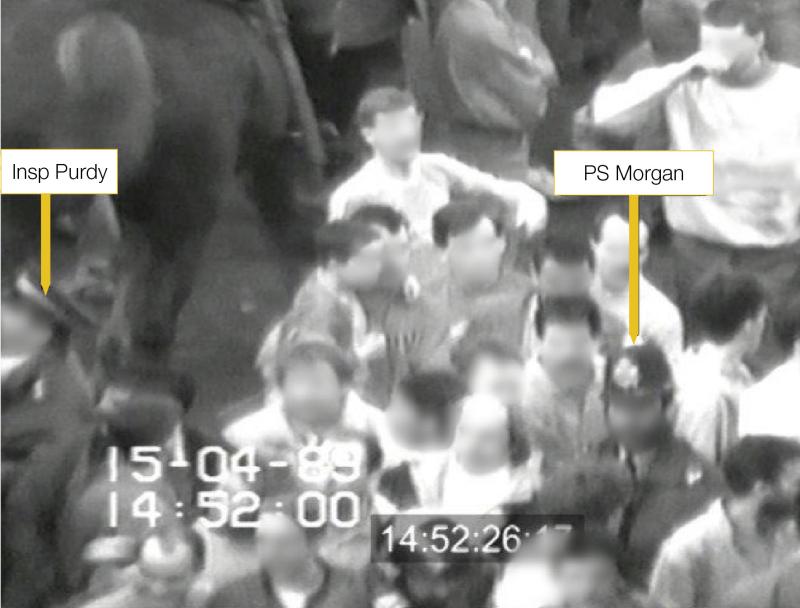
In footage three seconds later, PS Morgan has been pinpointed close to the funnel bar, with Insp Purdy nearby. Figure 4P then shows PS Morgan and a group of supporters making their way along the service road towards Gate C at 14:52:26.
Image
Figure 4P: PS Morgan leading supporters on the service road, 14:52:26 (Source: SYP CCTV)
Ten seconds later, Gate C was opened.
At the Goldring Inquests, PS Morgan was shown this footage. He accepted it was him but insisted he had not requested the gate to be opened at the point it was. Instead, even though he had intended the gate should be opened, his evidence was that it came as a surprise. He accepted the possibility that Gate C was opened by stewards for another reason at this time.
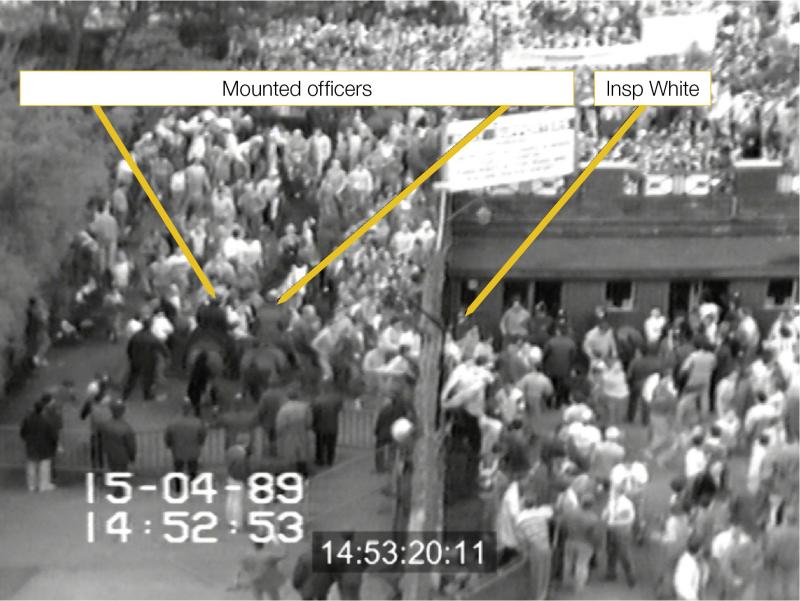
Though there was an immediate surge through Gate C—in which PS Morgan was swept into the crowd—CCTV evidence indicates that at first the opening showed an element of controlled access. At 14:53:20, mounted officers had formed a line of horses across the service road outside Gate C and were guiding supporters through the open gate. Four of the outer perimeter gates were closed and two partially open, being monitored by a line of mounted police officers, which helped control the rate at which supporters were approaching Gate C.
Image
Figure 4Q: The area around Gate C at 14:53:20 (Source: SYP CCTV)
However, just after 2.54pm, one of the outer perimeter gates burst open, and supporters ran through the opening. Almost immediately, this was repeated at the other outer gates. A large number of supporters made their way onto the outer concourse, which had been cleared, and then through the open Gate C.
Crucially, there had been no plan in place for what should happen once supporters entered through Gate C. There were no officers in place to direct the incoming supporters, who made their way across the inner concourse to the most obvious route to the terraces: the central tunnel under the West Stand, leading to Pen 3 and Pen 4.
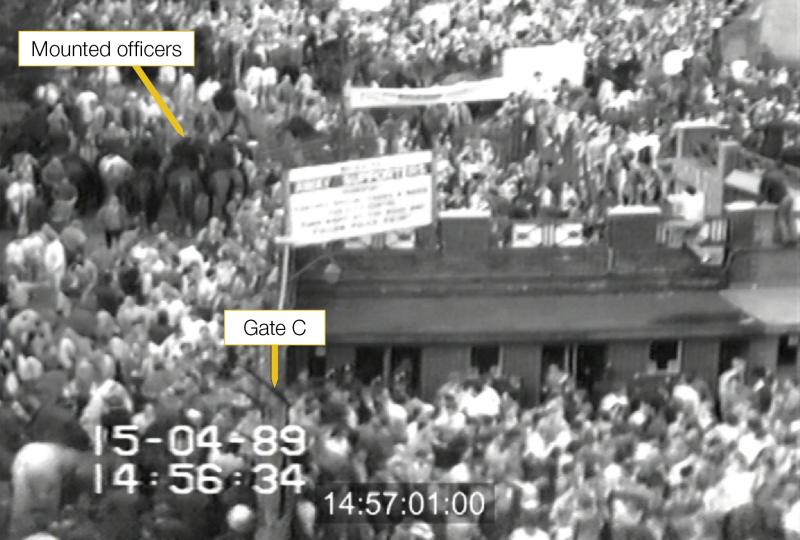
At 14:57:01, large numbers of supporters were still entering the stadium through Gate C, which had been open for more than four minutes. As figure 4R shows, there was still no sign of police control on the inner concourse. However, a line of mounted officers can be seen positioned at the end of the service road, close to the side of the funnel bar.
Not only had the officers at Gate C not communicated with those on the inner concourse, but there is also no evidence to suggest that the opening of the gate was communicated to the PCB. Ch Supt Duckenfield therefore did not know about the intention of officers near Gate C to allow supporters into the ground in a controlled way when he issued his instruction to open the gates. It is also not clear what those in the PCB knew once Gate C had been opened.
Image
Figure 4R: The area around Gate C, 14:57:01 (Source: SYP CCTV)
At the Taylor Inquiry, Ch Supt Duckenfield confirmed that he had not given any specific instruction to police officers or stewards that the gate was going to be opened. He said that he had not thought to give instructions to the police officers on the inner concourse to try to direct the flow, because he had been busy watching what was happening.
He said that his instruction to open the gates was passed over the radio for all to hear at the ground; he hoped that the police officers on the inner concourse, who were trained to act on their initiative, would have done something around the central tunnel. He accepted that he had made a mistake by not giving an instruction for the central tunnel to be closed but said he hoped that others would have remedied that mistake.
At the Goldring Inquests, Ch Supt Duckenfield said he thought that the supporters would have gone onto the inner concourse and gathered themselves for a moment or two to recover. He said that he did not for a moment consider the possibility that they might go down the central tunnel.
Supt Murray and Supt Marshall have also both said, at separate times, that they did not think about where the incoming supporters would go. Crucially, Supt Greenwood was still not aware of the situation outside.
Strikingly, officers on duty on the inner concourse with experience of policing matches at Hillsborough Stadium immediately recognised the likely direction of supporters. Police Sergeant William Crawford told the Popper Inquests that if he had had prior knowledge that Gate C was going to be opened, he could have considered arranging for the central tunnel to be closed.
The cumulative result was a rapid influx of large numbers of supporters into the centre pens, which is examined further in the next chapter.
While it has not proven possible to establish on whose authority Gate C was opened, Operation Resolve’s investigation has reaffirmed that it was opened in response to the fact that the police had lost control of the situation outside the ground. Further, the evidence is clear that the police did not take control of the situation, either inside or outside the ground, when the gate was opened at 2.52pm. The person with overall responsibility for this was the match commander, Ch Supt Duckenfield.
As detailed in paragraphs 4.62–4.71, at 2.47pm, Supt Marshall contacted the PCB to ask for the exit gates to be opened, in an attempt to relieve the crush outside. However, he received no response.
In the meantime, Insp Purdy returned to Gate C with the intention of opening it. In his original account, Insp Purdy described what he did next: “I returned to the barrier on the side of the turnstile. I organised the horses to block off the gates at the perimeter [outer perimeter gates]. It seemed that we could deal with the numbers in there if we contained the people outside. When that was secure by all the horses, now five perhaps, and uniform PC's, I caused the gate [Gate C] to be opened down the side.”
He told the Taylor Inquiry that he had decided to open Gate C to create a space for people being brought under the funnel bar. He added that, because of its concealed location down the side, it seemed the best gate to open. In a 2015 statement to Operation Resolve, he also noted that there was no direct pressure on Gate C at the time.
Gate C, like the other exit gates, could only be opened from the inside. Operation Resolve established that stewards operating Gate C frequently opened it to let police officers and other authorised personnel in and out of the ground. Police officers also used the gate to eject supporters. Between 2.29pm and 2.48pm, Gate C opened 24 times for these purposes. No supporters entered the ground on these occasions.
SWFC CCTV footage shows that at 14:48:23, while Insp Purdy was heading towards Gate C with the intention of opening it, a police officer on the inside approached Gate C with a supporter who was being ejected. (Operation Resolve has been unable to identify the supporter ejected through Gate C, or the police officer with him.) PS Morgan was standing nearby among a group of officers.
This time, when the gate was opened by the steward, it remained open for over 30 seconds. There was a rapid influx of supporters; Insp Purdy was caught up in this and ended up on the inner concourse.
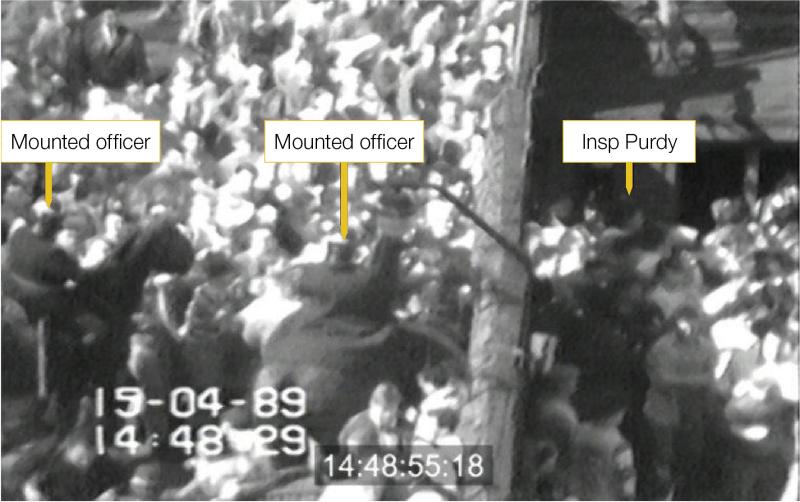
After the initial surprise, officers tried to close the gate. Figure 4M, taken from SYP CCTV footage timed at 14:48:55, shows a mounted officer positioning his horse across the open Gate C to stop the supporters from entering. A second mounted officer approached from the left.
Image
Figure 4M: Mounted officers positioning themselves in front of Gate C, 14:48:55 (Source: SYP CCTV)
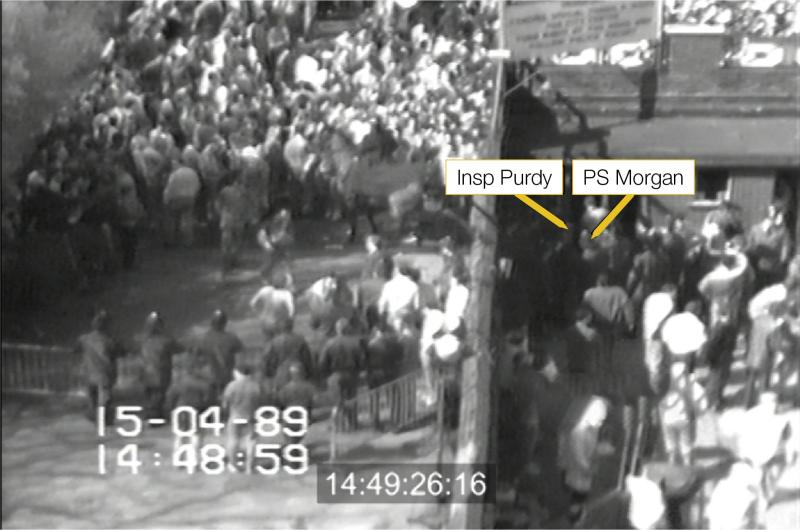
Thirty seconds later, the picture looked very different (see figure 4N). Gate C was closed and mounted officers had cleared the area in front of the gate of supporters. Insp Purdy and PS Morgan have been identified inside Gate C.
Image
Figure 4N: The situation at Gate C at 14:49:26 (Source: SYP CCTV)
Estimates suggest that between 130 and 180 supporters entered the ground through Gate C in this first opening. Once through the gate, they had free access to the stadium. Officers inside received no warning that spectators were entering in this way and had no influence over where these supporters went once inside.
As the evidence considered here shows, there remains a high degree of confusion and uncertainty about exactly who, if anyone, authorised the opening of Gate C at 2.48pm. Though it appears that officers outside—including Supt Marshall and Insp Purdy—wanted to open the gate to relieve the pressure on the turnstiles, there is no clear link between Supt Marshall’s radio request and the actual opening of the gate.
Officers in the PCB have recalled that, though they had heard the request, the 2.48pm opening of Gate C took them by surprise and led them to the view that it had burst open. In his original account, Ch Supt Duckenfield said that while he was considering Supt Marshall’s request, he saw on the CCTV monitor that the gate opened, supporters came in and then mounted officers managed to control the situation and shut the gate again.