More than 700 officers had their accounts submitted to the Taylor Inquiry. In the course of its investigation, the IOPC received specific complaints about the accuracy of the accounts given by seven officers. In two further cases, the IOPC identified material that raised questions about the accuracy of the evidence the officers concerned had presented.
Each of these instances is covered in a complaint or conduct report, and the complainants and officers concerned have been informed of the outcomes.
This section summarises some of these, where the matter under investigation is relevant to the overall understanding of the disaster and specifically to allegations that police officers exaggerated or fabricated stories about the behaviour of supporters.
Though normally a plain clothes officer, Detective Constable James Oakes (DC Oakes) was on duty at the 1989 FA Cup Semi-Final in uniform. He was part of a serial of officers stationed inside the turnstiles at the Leppings Lane end and was close to exit Gate C when it was opened. After the match was halted, DC Oakes assisted in the rescue effort.
He produced an initial account dated 17 April 1989 that is the source of the complaint against him. In this account, DC Oakes described his experiences on the day, from 8.30am until a post-incident debrief in the North Stand. He referred to attempting to resuscitate two supporters. He wrote that as he tried unsuccessfully to resuscitate one of these two, the supporter “was vomiting beer.”
When this victim’s blood alcohol level was tested during the post-mortem, it was found to be zero, a point emphasised by Dr Popper during the original inquests.
However, the comments made by DC Oakes became the subject of a formal complaint from the family, that the account was fabricated and that it had been drafted in a way that conveyed the impression that supporters were drunk.
For health reasons, DC Oakes could not be interviewed by the IOPC or called to give evidence at the Goldring Inquests. However, after a lengthy period of correspondence, he agreed to provide the IOPC with a written response to the allegations.
In the written response, DC Oakes explained the reasons he believed the supporter had vomited beer but acknowledged that this was incorrect and stated he regretted that this comment had caused undue distress to the family.
In response to the allegation about the overall tone of his account, DC Oakes commented that everything he wrote was “what I believed to be true and not influenced by anyone else.” The account included references to supporters being intoxicated, attempting to enter the ground without tickets and being aggressive outside the ground. Many other SYP officers also made similar comments in their accounts; DC Oakes’s account does not stand out as giving markedly more emphasis than others to such comments.
There were two specific points he mentioned that were not supported by other evidence; these were a comment that he saw two supporters being arrested for selling forged tickets, which did not appear in any arrest records, and another that he saw a supporter pick up a match programme from next to someone who had died.
Police Constable David Scott (PC Scott) was a mounted officer on duty outside the Leppings Lane entrance. BBC cameras recorded him swinging his arm and striking a Liverpool supporter in the crush before the game. This footage was shown on news reports in the days following the disaster. In his original written account, PC Scott explained that he had acted to protect his horse from supporters who were threatening to burn it with cigarettes. He added that when he inspected his horse later, he found lumps on its back legs and said the horse’s coat appeared singed.
His account was supported by the statement of Phillip Webb, a farrier who looked after SYP horses. Mr Webb stated that he had seen multiple circular burn marks on the horse. Both repeated their claims in subsequent statements.
The injuries to the horse were accepted as fact by the Taylor Inquiry. WMP investigated complaints about the actions of PC Scott and sought, unsuccessfully, to identify the supporter who had been struck. No disciplinary proceedings were recommended, but PC Scott received management advice about his future actions.
However, after PC Scott’s account and Mr Webb’s statement were published online by the HIP, the IOPC received a complaint that they may have been exaggerated. The complainant suggested that if the injuries were as bad as claimed, the horse would have needed veterinary treatment, but there was no record of any such treatment. He also suggested that SYP would have taken photos of the injuries; again, there were none.
To investigate the complaint, the IOPC reviewed the video footage of the incident involving PC Scott but did not see any signs of the horse being in distress, as might be expected if it was being burned. Investigators then took statements from other members of SYP’s Mounted Section. Though some recalled hearing about a horse being burned, none had seen the injuries. The SYP press log showed that the head of the Mounted Section had expressly denied that a horse had been burned but said it had been threatened.
The IOPC appointed an expert witness—a professor specialising in equine surgery—to review the evidence and explain how a horse might react if it was burned. She stated she would expect a horse being burned multiple times to show signs of distress, such as kicking out or swishing its tail. She saw no video evidence of either. To assess the likely impact of a cigarette burn on a horse’s skin, she conducted a series of tests (with all appropriate consents) to the body of a horse that had recently been euthanised. These included applying a lit cigarette to the horse’s skin: it did not result in the kind of marks that Mr Webb had described.
The IOPC then reinterviewed PC Scott and Mr Webb. When shown some of the evidence that the IOPC had gathered, Mr Webb changed his account and stated that he was not sure if he had actually seen any burn marks. He said it was possible he had made the statement to WMP because he was disgusted at what he had heard from PC Scott about the burns, rather than having seen them himself. PC Scott made no further comment.
The IOPC also established that PC Scott and Mr Webb knew each other socially; PC Scott attended Mr Webb’s wedding.
The claim that supporters burned a police horse with cigarettes was a damaging allegation that painted a picture of supporters being either sufficiently cruel to deliberately cause the injuries, or sufficiently insensitive as to not realise that they were doing so. The evidence gathered by the IOPC indicates this alleged incident did not take place.
Based on the evidence gathered, in June 2017, the IOPC referred PC Scott and Mr Webb to the CPS, requesting a decision on whether both individuals should be charged with the criminal offences of perverting the course of justice and conspiracy to pervert the course of justice. In December 2017, the CPS announced that no charges had been authorised against either individual. The decision was challenged under the Victims’ Right to Review Scheme. The evidence was reviewed by a different prosecutor, who upheld the CPS decision.
The evidence was also set out in a separate complaint report. Having reviewed it, the IOPC’s view was that, if he had still been serving with the police, PC Scott would have had a case to answer for gross misconduct, for falsehood or prevarication.
On 19 April 1989, in the first meeting between SYP and Hammond Suddards after the disaster, Mr Metcalf told those present, including DCC Hayes, ACC Anderson and Ch Supt Denton, that the force would be expected to submit a proof of evidence to the Taylor Inquiry. Though there was no official requirement to do this, it was what a (non-police) party represented by Mr Metcalf had done during a previous public inquiry.
There was some discussion among the officers present about what should be covered in the proof of evidence. DCC Hayes concluded this topic by stating that SYP had little experience of public inquiries and asked Mr Metcalf for some guidance on what should be included. Mr Metcalf suggested some broad headings during the meeting, which he confirmed in a letter to DCC Hayes the following day. These were:
"1. The South Yorkshire Police: history, geographical area, manning and organisation. 2. The policing of sporting events: the statutory and common law background to Police involvement. 3. The approach of the South Yorkshire Police to the policing of major sporting events: the history of such operations and the current standing operational orders. 4. The specific background to Police involvement in the match to be played at Hillsborough on 15th April. 5. Details of the manpower and organisation for the match. 6. The events which occurred.”
In the letter, Mr Metcalf also advised DCC Hayes: “In our view, it will be necessary to have statements from as many as possible of the Officers who were deployed at the ground on that day”.
At some point between 19 and 24 April, DCC Hayes appointed Ch Supt Wain to take responsibility for production of the proof of evidence. Ch Supt Wain was, at the time, divisional commander of the Rotherham division of SYP. He was a highly experienced officer who had worked as a detective, led major investigations and run major incident rooms. He had also been match commander for a large number of football matches. At the Goldring Inquests, DCC Hayes confirmed he had specifically chosen to delegate the task of producing the report to Ch Supt Wain as he saw him as “an extremely good communicator, an extremely good administrator.”
At a meeting in DCC Hayes’s office on 24 April 1989, this responsibility was confirmed. DCC Hayes instructed Ch Supt Wain and his team to have a draft report ready for a meeting with the legal team on 26 April.
The minutes recorded that, by the time of the meeting, Ch Supt Mole had already produced initial drafts of content relating to headings 4 and 5 and Ch Insp Beal, who was not present at the meeting, had begun drafting the content for heading 3. The other headings were then allocated to different members of the team.
At the meeting on 26 April, Ch Supt Wain gave the first draft of the proof of evidence to Mr Metcalf and Mr Woodward. He advised all present that the document had been “hastily pulled together” and pointed out: “We have not taken any evidence yet with which to back up the comments contained herein.” However, he said that they “should be able to validate it given time.”
He added that “Parts IV and V in particular ought at this stage to be treated with care.” These were the sections relating to the background to the police operation for the 1989 Semi-Final and the events of the day; SYP had produced the document in five sections, rather than adhering to the six Mr Metcalf had recommended.
The minutes recorded Mr Woodward describing the document as “magnificent”.
There were two major topics of discussion during the meeting. Firstly, the lawyers asked whether the police were responsible for monitoring the capacity of the pens and closing the tunnel to the centre pens of the West Terrace if capacity was reached. This was with reference to the case of Harris v Sheffield United (see paragraphs 9.151–9.153). As detailed in chapter 9, Ch Supt Mole stated that there was a known contingency among senior officers to close the tunnel when the pens were full; both DCC Hayes and the legal team sought to confirm whether this was documented anywhere.
The second major topic was that Mr Woodward asked the officers present what had changed between the 1988 FA Cup Semi-Final between Liverpool and Nottingham Forest at Hillsborough Stadium and the parallel game in 1989. After Ch Supt Mole detailed some specific changes that had been made to the Operational Order, DCC Hayes stated: “Now there were other changes and I think this is what Mr Woodward wants. People tell me for example, that they had never seen at other similar football matches to this one so many non-ticket holders arriving, so much alcohol brought to the football matches, and therefore having to be consumed or disposed of at the turnstiles.”
ACC Anderson and Ch Supt Wain then gave examples of stories they had heard from officers about Liverpool supporters’ consumption of alcohol. None of these three officers—DCC Hayes, ACC Anderson or Ch Supt Wain—had been on duty at the game, so all were relying on information they had received from those who had been present, which they all acknowledged during the meeting.
Following this meeting, the draft proof of evidence was updated substantially to become the document known as the Wain report. Both the topics discussed at the meeting on 26 April were covered in detail, but in a way that did not replicate the full breadth of the discussions.
For example, on the subject of closing the tunnel, the Wain report overlooked Ch Supt Mole’s comments at the meeting and only included references that indicated it was not a safe or appropriate tactic. It also included several references to the roles and responsibilities of SWFC stewards, including a comment that “over the years, the clubs [sic] attention has been drawn to the fact that stewards were not performing their duties to the full.”
Some 15 paragraphs were allocated to a discussion of the case of Harris v Sheffield United. Towards the end of the section, the Wain report made clear that the 1989 FA Cup Semi-Final was not covered by the contractual agreement that had been in place with clubs following the conclusion of the case.
In part 4 of the Wain report, relating to police planning for the 1989 Semi-Final, there were multiple negative references to the behaviour of football supporters generally, plus some specific references to previous matches involving Liverpool.
There were also multiple points of comparison between the 1988 game and the 1989 one—including comprehensive details of changes in the number of officers on duty at the two games.
In the very first draft of the proof of evidence, part 5 consisted of a chronological summary of the events of 15 April 1989, from 2pm to 3.33pm. In the Wain report, part 5 was over 100 pages long and quoted extensively from 81 officer accounts. Full versions of these accounts were also included in an appendix.
In a section with the subheading “Events to 2.30pm”, numerous quotes were included from officers about supporters drinking large amounts of alcohol and/or attempting to enter the ground without tickets. Some of these were potentially misleading. For example, in an extended quote from Supt Marshall describing supporters “drinking openly”, he commented: “all of the fans I encountered were Liverpool supporters”. This arguably gave the impression that only Liverpool supporters were drinking. However, as he was on duty at the Liverpool end, it was in fact no surprise that he only encountered Liverpool supporters.
The subsection on the emergency response also included several accounts where officers referred to their efforts being hampered in some way by the actions of supporters under the influence of alcohol.
At the Goldring Inquests on 20 April 2015, Ch Supt Wain was directly asked about the reasons behind the inclusion of this material, and whether it stemmed from discussions at the meeting with the legal team on 26 April 1989. He confirmed that was the case and that he had picked up “a concern among senior officers to ensure that any evidence about changes in fan behaviour was highlighted”.
At the Goldring Inquests, the barrister representing Ch Supt Wain pointed out that of the 81 accounts appended to version B of the proof of evidence, 31 officers stated they had witnessed the consumption of alcohol and a further 29 either referred to the effects of alcohol on supporters or made other observations about the involvement of alcohol. This therefore appeared to support Ch Supt Wain’s assertion—both at the Goldring Inquests and in his prepared statement to the IOPC—that the focus on alcohol consumption in the proof of evidence reflected the evidence of the SYP officers.
However, it overlooked the fact that SYP had control over which accounts it chose to include. According to dates on SYP’s HOLMES account, up to and including 8 May 1989, some 429 officer accounts (including seven statements) had been registered. There is no clear explanation of how the 81 accounts used were chosen.
Having reviewed all these accounts, the IOPC has established that 44% of them included a reference to Liverpool supporters behaving in a way that could be seen as negative. By comparison, 72% of the accounts referred to in part 5 of the Wain report referred to negative supporter behaviour. This indicates that the accounts SYP selected for inclusion over-represented these issues.
These topics were then reintroduced in a section under the subheading “Observations”, which was written in a different style to the rest of part 5. As the subheading suggested, it was mostly comment; however, it did not accurately reflect the evidence of the preceding sections. More significantly, the section as a whole squarely pointed the finger at supporters, with a series of observations that had not been substantiated in the evidence included as part of the Wain report, or since. Examples of this were:
“Saturday 15 April 1989 was a warm and sunny Spring day, which should have provided the perfect atmosphere for a major sporting attraction. Instead, however, it would appear that many visiting spectators used this as an opportunity to find local public houses and off licences where they could purchase and consume alcohol, to the extent that in so doing their arrival at the stadium was seriously delayed.”
“The situation was exacerbated by the obvious influx of a large number of Liverpool supporters who did not have a ticket.”
“Despite substantial police resources which had been allocated for the event, senior officers found themselves suddenly and unexpectedly overwhelmed by several thousand spectators who had converged on the Leppings Lane entrance within a few minutes of the designated time for kickoff, many of whom being the worse for drink embarked upon a determined course of action, the aim of which was to enter Hillsborough Football Stadium at all cost; irrespective of any danger to property or, more importantly, the lives and safety of others.”
Strikingly, the Observations section was introduced with the comment: “the Chief Constable is content to make a number of observations which he feels may be pertinent to the Committee of Enquiry”. This firmly placed the responsibility for these observations on CC Wright.
On 9 May, the 288-page Wain report was given to the legal team. In a phone call before the legal team received it, ACC Anderson told Mr Metcalf that the draft was two inches thick. Mr Metcalf replied that “this was not too bad and that if we could cut it down to 1 inch thick with just a few crucial documents included as appendices to the report itself, then I would be really quite satisfied.” Having seen the draft, Mr Metcalf spoke to ACC Anderson again later that day and informed him that they intended to edit part 5, which would “be limited to factual comment up to about 2.00pm” on the day of the disaster.
The legal team edited the document extensively. The submitted version included no officer accounts. Clear points of comparison between the 1988 and 1989 Semi-Finals, such as differences in officer numbers, were mostly removed, as was the section on Harris v Sheffield United. The references to supporter behaviour on the day were cut, but some earlier references to previous matches involving Liverpool supporters were retained. Most notably, the section on the events of the day was cut from over 100 pages to just seven, and ended at 12 noon, when the turnstiles opened. The submitted version included the following explanation: “With a view to avoiding comment prejudicial to the Enquiry this background material does not seek to cover the tragic events which followed thereafter.”
The majority of the observations were removed from the version submitted to the Taylor Inquiry, leaving only a section of three paragraphs, with a very different tone:
“The South Yorkshire Police has been deeply involved with the tragic events which occurred on Saturday 15 April 1989. Police officers and civilian personnel involved in the operation have been deeply grieved by the death and suffering which they witnessed on an occasion which should have been an enjoyable sporting event. Many have had to seek professional counselling.
“For those most directly involved, memories and a deep sense of sorrow will remain with them for the rest of their lives, particularly those officers who tried so desperately to save the lives of men, women and children.
“The Force extends it sincere condolences to the relatives and loved ones of those who died.”
By the time the Wain report was handed to the legal team, there had been some significant developments in terms of the evidence that the Taylor Inquiry had requested from SYP. Notably, the accounts of the SYP officers on duty now had to be submitted to the Taylor Inquiry—a decision that led to the review and amendment process described in the previous chapter. This may explain why the legal team removed references to officers’ accounts from the proof of evidence.
At the Goldring Inquests, Ch Supt Wain acknowledged he was responsible for the proof of evidence, regardless of its authorship. Under cross-examination, he also accepted that the document he had overseen was potentially misleading.
The IOPC investigated: The evidence that was put forward on behalf of SYP, or by individual officers, to the WMP investigations, Lord Justice Taylor’s Inquiry, the contribution proceedings, and the inquests, or in the immediate aftermath of the disaster, considering:
a) whether any police officer gave or produced evidence that was inaccurate, false or deliberately misleading (or was involved in attempts to do so) b) whether such evidence contained inaccurate, misleading or irrelevant criticism of supporters’ behaviour c) whether the ‘Wain Report’ was an accurate and complete picture of the evidence d) whether any police officer was party to, or directed the production or selection of, evidence that was inaccurate or misleading, including irrelevant criticism of supporters’ behaviour and evidence regarding operational police tactics/actions to control supporters
This chapter focuses on the evidence presented to the Taylor Inquiry only, looking at the written submissions from SYP and the oral evidence given by individual officers.
What was found?
• The IOPC has found clear evidence the ‘Wain report’ was an internal draft of the proof of evidence SYP was required to provide to the Taylor Inquiry and was edited substantially by the legal team before submission. This is a different sequence from that proposed in the HIP Report which suggested that SYP expanded its proof of evidence to create the Wain report.
• The proof of evidence did not include any information about SYP being involved in monitoring safety in the pens, or about previous police tactics to control access to the centre pens at the Leppings Lane end by closing the central tunnel. There had been references to both of these topics in the Wain report.
• The widely reported claim that supporters deliberately burned a police horse with cigarettes outside the stadium was not true. Detailed investigation found no evidence to support the claim; when this was put to a key witness, he changed his account of what had happened.
• Before senior officers gave evidence to the Taylor Inquiry, most attended a meeting with Mr Metcalf, where those present agreed some “appropriate answers” that they could use in response to some of the expected questions. In some cases, officers then used these appropriate answers in their evidence, even where they included information the officer could not have known at the time.
• In their evidence to the Taylor Inquiry, several SYP senior officers stated, to differing degrees, that they had no knowledge of police actions to close the tunnel at the 1988 Semi-Final (or on other occasions) and that they did not see the police as having responsibility for monitoring the pens. This contradicted what some of them had said at internal meetings.
• In SYP’s closing submissions to the Taylor Inquiry, delivered on 6 July 1989, there was no mention whatsoever of past actions to close the tunnel. This submission was written by the legal team, and SYP did not have sight of it before it was submitted.
Significant new evidence
The IOPC took statements from many of those involved in the production of SYP’s proof of evidence and from several officers who gave evidence to the Taylor Inquiry. In some cases, this required multiple requests, culminating in agreement that written statements could be provided without interview, where the witness was in poor health.
As part of its investigation into the allegation that supporters had burned a police horse, the IOPC appointed an expert witness in equine health, who provided a comprehensive report.
In his Interim Report, Lord Justice Taylor made some deeply critical remarks about the quality of evidence SYP had provided to his inquiry. At paragraph 280, he commented that—with some exceptions—senior officers had been “defensive and evasive witnesses.” He then extended this criticism at paragraph 285, writing: “It is a matter of regret that at the hearing, and in their submissions, the South Yorkshire Police were not prepared to concede they were in any respect at fault in what occurred.”
Reflecting that “the police case was to blame the fans for being late and drunk, and to blame the Club for failing to monitor the pens”, he concluded: “Such an unrealistic approach gives cause for anxiety as to whether lessons have been learnt. It would have been more seemly and encouraging for the future if responsibility had been faced.”
It has since been alleged that the evidence presented by SYP and its officers was not just unrealistic, as Lord Justice Taylor described it, but deliberately misleading.
The HIP Report commented that a document known as the ‘Wain report’, because it was produced under the direction of Ch Supt Wain, “placed significant emphasis on ticketless fans, alcohol and crowd behaviour.” The HIP Report showed that such emphasis was, at best, disproportionate. It also called into question the accuracy of some of the material in the Wain report, which it suggested was SYP’s main written submission to the Taylor Inquiry.
There were also questions raised in the HIP Report about the accuracy of the oral evidence some senior officers gave to the Taylor Inquiry.
Having reviewed the material cited in the HIP Report and received a referral from SYP that acknowledged the concerns about it, the IOPC made the evidence presented by SYP one of its terms of reference. The IOPC also received some complaints, from family members of some of those who died and from some supporters who were at the game, about the written and/or oral evidence given by certain officers. These were investigated under this term of reference.
The core of this strand of the investigation was to examine the evidence that was presented by SYP to the Taylor Inquiry, from written submissions to the Inquiry transcripts, and to compare this to other evidence. That included accounts given by officers at other times, to establish if there were any significant differences, and looking at a wider range of material, including photographs and video footage from the day of the disaster, to assess if anything said in evidence was inaccurate.
To investigate the accuracy and completeness of the Wain report, the IOPC conducted a close comparison of the three different versions of the proof of evidence that were in the archived material held by the investigations. By looking at documentary evidence—in particular meeting minutes and correspondence between senior SYP officers and SYP’s appointed solicitors, Hammond Suddards—investigators were able to clarify the sequence in which the three versions were produced and gain a greater understanding of who had been involved in drafting the various iterations. This was corroborated as far as possible through interviewing the senior SYP officers involved in producing the Wain report and members of the legal team.
The evidence clearly showed that the Wain report was the second internal draft of the document that would eventually become the proof of evidence, provided to the legal team on 9 May 1989. It was 288 pages long and included extracts from 81 officers’ accounts. The section covering the events of the day of the disaster amounted to over 100 pages. It was then radically edited by the legal team, to just 122 pages, and submitted to the Taylor Inquiry on 12 May. The extracts from officers’ accounts had been removed and the section on the events of the day reduced from over 100 pages to just seven, with no details whatsoever of events beyond 12 noon.
This sequence of events is different from that set out in the HIP Report, which suggested that the substantially longer Wain report was produced after the shorter version had been submitted. This is significant because it means that, rather than ‘expanding’ its case with more information, as the HIP Report suggested, SYP (via its lawyers) actually reduced it prior to submission.
The fact that the Wain report was not presented as evidence to the Taylor Inquiry means that it is primarily of investigative interest in understanding the development over time of SYP’s proposed evidence to the Inquiry.
The IOPC also recorded and investigated several conduct matters relating to SYP’s collection of evidence. These focused on the actions of senior officers involved, including Ch Supt Denton and DCI Foster, but also CC Wright, DCC Hayes, ACC Anderson, Ch Supt Wain, Ch Insp Beal and DI Jones. The main allegations related to the officers either overseeing, or being directly involved in, a process to amend accounts, removing factual information which would have been of significance to the Taylor Inquiry. In some cases, officers were also alleged to have pressured colleagues to amend their accounts.
Having reviewed the evidence in the conduct report, the IOPC’s opinion was that DCI Foster would have had a case to answer for gross misconduct, in relation to the allegation that he directly or indirectly brought undue pressure to bear upon those SYP officers who refused to make changes to their original accounts.
However, none of the officers would have had a case to answer for misconduct in relation to the amendment of accounts.
Though the evidence clearly showed there was a deliberate and concerted effort to amend the accounts—and that officers up to CC Wright were aware that amendments were being made—there was not (and still is no) duty of candour that applied to non-statutory public inquiries, such as the Taylor Inquiry. This meant that, as long as they did not mislead the Taylor Inquiry, there was no obligation for police officers, or any other party, to disclose information which might undermine the version of events they had portrayed or wished to portray, unless they were specifically asked for it.
In simple terms, officers and, by extension, the force were legally entitled to present their best case within these parameters.
However, it could also be suggested that there was a greater public interest in enabling the Taylor Inquiry to thoroughly examine all the causes of the disaster. By amending accounts, as part of presenting its best case, SYP did not act in that public interest.
This is one of the reasons the IOPC welcomes the introduction of a new, stronger statutory duty of candour for all public officials, including the police, as set out in the Public Office (Accountability) Bill.
The extent and consistency of the amendment process led the IOPC to refer several individuals who had been involved in overseeing or implementing the process to the CPS, for decisions on whether they should face criminal charges of perverting the course of justice and conspiracy to pervert the course of justice.
Having reviewed the evidence, the CPS announced that Mr Metcalf, Ch Supt Denton and DCI Foster would be charged with perverting the course of justice. The three men went on trial on 19 April 2021. However, on 26 May 2021, having heard arguments from legal experts for the prosecution and the defence, the judge, Mr Justice William Davis, ruled that the defendants had no case to answer.
This was because the offence they were charged with was perverting the course of justice in relation to the amendment of officer accounts presented to the Taylor Inquiry. Before the trial, a different judge (Sir Peter Openshaw, who had been the judge in the trial of Ch Supt Duckenfield and Mr Mackrell) ruled that as the Taylor Inquiry was a non-statutory departmental inquiry, it was not a course of justice. The case against Mr Metcalf, Ch Supt Denton and DCI Foster therefore required the prosecution to demonstrate that the amendment of officers’ accounts that were submitted to the Taylor Inquiry could also have affected the Popper Inquests or the subsequent criminal investigation conducted by WMP—both of which were courses of public justice. The judge concluded that the prosecution had failed to demonstrate this.
Of the 68 amended accounts that were submitted by the CPS, Mr Justice Davis identified just four where he believed the amendments were significant enough to potentially mislead and therefore support a charge of perverting the course of justice, if the Taylor Inquiry had been a course of justice. However, he acknowledged that a key part of the prosecution case related to the consistency of the amendments and the impact this had on the overall body of evidence SYP presented.
Mr Metcalf, Ch Supt Denton and DCI Foster were all interviewed by the IOPC under caution in relation to their role in amending officers’ accounts. Mr Metcalf provided a prepared statement to the IOPC and did not answer investigators’ questions, as is his legal right.
In the prepared statement, he explained his rationale in reviewing the accounts was “to keep the statements as factual as possible, to clarify inconsistencies or ambiguities within statements and between other statements, to remove comment and irrelevant or otherwise inadmissible evidence, to tone down intemperate language, and to allow the witness to present the whole of their admissible evidence.” He accepted that in following this rationale he may, on occasion, have inadvertently suggested the removal of some factual content but emphasised this was not his intention. He further stated that his review comments were advice, not instructions. In a later response to the IOPC, he highlighted numerous instances where he had not suggested the removal or amendment of comments that appeared to criticise senior officers or that referenced communication difficulties on the day.
While reiterating that he did not at any point intend to remove any facts from officers’ accounts, Mr Metcalf stated to the IOPC: “I am willing to accept that in a small number of cases my exercise of judgement could be criticised.” The IOPC’s evidence indicates that this significantly underplays his role. At his recommendation, factual information was removed repeatedly, following a consistent pattern: in particular to remove any reference to SYP having previously taken action to control access to the centre pens or close the central tunnel. While it may have been beneficial or desirable to SYP to put forward a set of accounts without inconsistencies, this did not assist with the Taylor Inquiry’s role of understanding how the disaster had occurred.
Ch Supt Denton also exercised his right not to answer investigators’ questions. In a prepared statement provided to the IOPC at the start of the interview, he accepted “full supervisory responsibility” for the amendment process. However, in this statement he said that “amendments of the recollections were undertaken purely to ensure that they complied with the advice of the legal advisors and the requirements of formal witness statements for legal proceedings”.
At the Goldring Inquests, Ch Supt Denton was asked for his views on some of the amendments. He accepted that in a couple of instances, facts had been removed and should not have been but argued that this was the result of errors of judgement and not anything more intentional.
DCI Foster provided a prepared statement to the IOPC and answered investigators’ questions. He confirmed he was the person mostly responsible for implementing amendments to officers’ accounts but consistently stated that he was acting in line with legal advice. When investigators asked him how that applied to the accounts that SYP reviewed and amended in-house, rather than through Hammond Suddards—a review process he had been central to—DCI Foster stated that he was following the broad principles and direction set by the legal team.
Very few officers recalled being asked to amend their accounts themselves. Instead, most said they were presented with a typed version of the account and asked to read and sign it.
The majority of officers did sign the amended accounts, effectively giving their approval to the changes. Some stated they did so in full knowledge of what had been changed and why.
Other officers stated that they were aware that their accounts had been reviewed but had signed the amended versions without checking them thoroughly. When shown the amended versions, they were surprised at the extent of the changes.
A further group stated they were not told about the amendments at all before being asked to sign the typed version of their account.
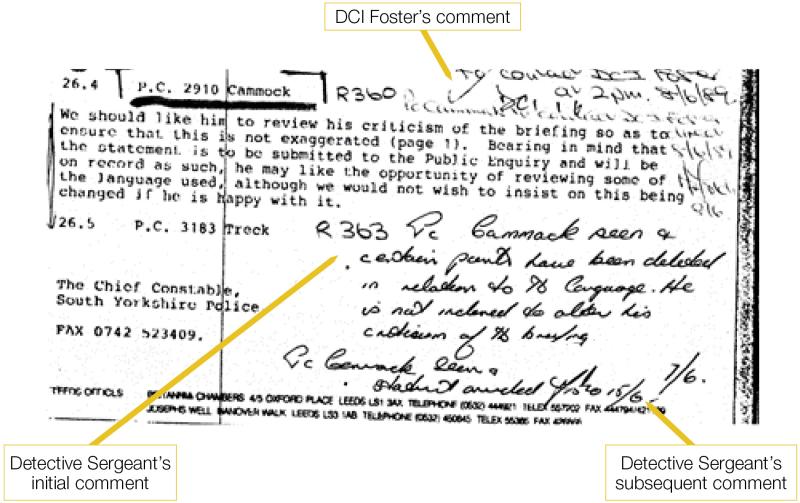
One such officer was Police Constable Gary Cammock (PC Cammock). A series of handwritten notes on a copy of the fax from Hammond Suddards show that there was some discussion with PC Cammock about proposed amendments to his account (see figure 9E).
The first note was dated 7 June 1989 and stated that PC Cammock had been seen and had agreed to the deletion of some swear words, as suggested by Hammond Suddards. However, the note continued: “he is not inclined to alter his criticism of the briefing.” This referred to comments PC Cammock had made about the main briefing given to all SYP officers on duty at 10am on the day of the disaster. He described the microphone system as “next to useless” and said he and others round him “could hear very little of what was actually said.” He added that this led to officers having to check the operational orders “to see exactly what we were supposed to do.” Hammond Suddards had suggested he review this.
A second note on the same fax was made by DCI Foster on 8 June. It instructed that the account should be retyped as amended. There is no indication that there was any further discussion with PC Cammock before this.
Image
Figure 9E: Notes made by SYP officers regarding the amendment of PC Cammock’s account (Source: SYP Archive)
PC Cammock told the IOPC that he did not remember being asked to sign an amended version, nor being spoken to by any senior officers regarding his account. When shown a version of the account with changes marked on it, PC Cammock acknowledged he had initialled the deletion of swear words but stated: “I do not think I would have agreed to that paragraph [regarding the briefing] being removed.”
Some officers who signed amended accounts have since gone on record to say they were pressured into doing so.
They described different degrees of pressure being placed on them, ranging from being threatened with transfer or dismissal, to one officer being told that if he didn’t agree to the amendments, his account would not be submitted to the Taylor Inquiry.
Two of the officers said that after refusing to accept the amendments, they were sent to see DCI Foster. A third believed he had seen a different senior officer, but DCI Foster separately stated he had made the amendments to this third officer’s account. DCI Foster recalled meeting some officers regarding their accounts but denied putting pressure on them.
A fourth officer said that he was called in to see Ch Insp Beal and that one of the others who had refused to accept the amendments was there at the same time as him.
Ch Insp Beal accepted he “may have been tasked to speak with officers about amending statements” but said this would have been on legal advice. In a later statement to the IOPC, he directly denied having met this fourth officer.
While the evidence is inconclusive in relation to Ch Insp Beal’s alleged interaction with this fourth officer, Ch Insp Beal accepted—during the Goldring Inquests—that he had been involved in the amendment of a specific set of accounts. These were the accounts of four communications officers who had been in the PCB at the ground on the day of the disaster.
The amendments to all four accounts were proposed by Mr Metcalf in a fax sent to Ch Supt Denton on 19 May 1989. Mr Metcalf noted that the officers had “slightly different perspectives as to exactly what happened in relation to the communications problems.” He suggested that they should “be seen again to go through their recollections of this crucial period.”
This only happened in one case, of a civilian communication officer. The other three accounts were amended by Ch Insp Beal, without him contacting the officers who had produced them. None were aware that their accounts had been amended; two felt the changes were minor. The last of the group had more substantial amendments made to his account but told the IOPC that the new text actually clarified the situation.
The IOPC’s investigation has established that, via the two amendment processes, a total of 327 SYP officers’ accounts were amended. This was 133 more than identified in the HIP Report and amounts to approximately 1 in 4 of all SYP officer accounts relating to the day.
Of these amended accounts, 297 were sent to WMP.
The IOPC analysed all the amendments in depth, including
looking at the amendments thematically
examining how closely the amendments that SYP made as a result of the first amendment process reflected the advice from Hammond Suddards, which in practice in almost every case meant Mr Metcalf
comparing the amendments made in the second review process, conducted wholly by SYP officers, to those made in the first, based on input from Hammond Suddards
In addition, the IOPC re-examined the accounts that were not amended, to establish if any included the kind of content that was removed from or amended in other accounts. This was to assess the consistency and rigour with which the amendment process was applied.
The suggestions provided by Mr Metcalf included the following:
Type of suggestion
Examples drawn from different accounts
Corrections of fact, grammar, spelling, or style.
on the last line of p3, we think the word “not” is a misprint for “riot”.
We think that the quoted serial number 31 is a mistake for 32.
Direct or indirect questions, typically to seek clarification.
We wonder if there is a word missing from paragraph 5 on page 9.
Comment at page 3 as regards lack of discernible comment from match control: is he saying that there were no messages at all, or that there were messages, but they were too distorted to hear?
Suggestions that a particular word or sentence should be amended. Sometimes, Hammond Suddards provided a possible replacement.
I would suggest substitution of the words “extreme urgency” for “panic” on p4.
Suggest remove last sentence
Suggestions that sections should be reconsidered or reviewed.
Insofar as the references to communications difficulties represent comment, rather than part of the narrative, these could perhaps be reviewed.
Suggest he may wish to review the final paragraph.
Observations based on comparisons with other accounts.
Could we check whether the reference to 1.15pm on page 2 should really be to 2.15pm which would be more consistent with the other evidence.
His perception of the crowd position at page 5 do seem at odds with most other officers but, obviously, this should not be altered if it is his clear recollection.
Suggestions that a section could be removed.
Suggest this ends at “…Mexborough”, i.e. first paragraph on page 8.
suggest this ends at off duty on page 3.
Hammond Suddards’ opinion.
We should like him to review his criticism of the briefing so as to ensure that this is not exaggerated (page 1). Bearing in mind that the statement is to be submitted to the Public Enquiry and will be on record as such, he may like the opportunity of reviewing some of the language used, although we would not wish to insist on this being changed if he is happy with it.
I am not particularly happy about the comment on page 4 about the packing of the terraces. I should like to omit this, unless it has already been accepted in the statements of both Murray and Mr Creaser, copies of which I do not have to hand.
The comments received resulted in amendments ranging from changing a single word or phrase (for example, “panic” to “extreme urgency”) to substantial cuts or changes. Some of these were of minimal consequence: for example, in response to the suggestion to end the account at “Mexborough”, three paragraphs were cut. This was the account of a police sergeant who had been on duty: the three paragraphs detailed the officer’s return to his home police station and the response of his colleagues over subsequent days.
In other instances, potentially significant information was removed. The suggestion that an account could end at “off duty on page 3” resulted in the deletion of the following sentence: “At the time of the incident there seemed to be no communication between the officers directly involved on the ground and officers in the control room and no senior officer could be seen to be in charge of directing officers at the Leppings Lane end.” While it could be argued that the first half of this paragraph was comment or speculation—in that the officer said there seemed to be no communication—the second half described what he saw (or didn’t see).
In the accounts that were amended in-house, some of the marked changes were extremely similar to those suggested by Hammond Suddards. For example, on one account the phrase “a sound of panic” was changed to “a sound of urgency”—an almost direct repeat of a wording change cited in the table above.
Of the 327 amended accounts, in 85 cases, the amendments were purely corrections to spelling and grammar or matters of style.
The stated rationale for the review and amendment process was the removal of opinion and comment. Of the 172 suggestions for amendment made by Mr Metcalf, 16 specifically referred to text in the officer’s account being “comment”—thus inferring it should be removed or amended—and others were described as including “hearsay”, “impressions” or in two instances “personal and graphic” recollections.
The amendments SYP made based on these comments frequently went beyond the removal of opinion—for example, deleting aspects of officers’ recollections of events both at the 1989 Semi-Final and at previous games. The amendments also went beyond the correction of information, with changes that removed certain details often altering the meaning of a sentence.
Having established the full extent of the amendments, the IOPC then refined this analysis, looking at the amendments made in relation to six themes, agreed with the CPS as a useful means of analysing them for the purposes of demonstrating to a jury the extent and impact of the amendment process.
Content that referred to communication issues—such as problems with police radios—was amended in 40 accounts (31 on the basis of suggestions from Hammond Suddards). Typically, the amendments involved changing generic comments (for example, that radios weren’t working) to individual ones (that the officer’s radio wasn’t working). However, the IOPC identified at least 80 accounts where comments about communication issues were not amended.
Comments about aspects of police planning and tactics, including pre-match briefings, an apparent shortage of officers and a lack of coordination in the rescue effort were amended in 31 accounts, but left unchanged in 13.
References to the failure of police controloutside Leppings Lane were amended in 29 accounts but not amended in 45. A common theme among the amendments related to the decision not to delay the kick-off.
There were 63 accounts from which criticisms of senior officers and/or police command and control were removed or reworded, typically to remove comments that suggested a lack of leadership or direction. However, the IOPC also identified 49 accounts where criticisms of the senior officers or overall police command and control were not changed.
References to the police having contingency plans to close the tunnel to the centre pens of the West Terrace in the event of overcrowding, or having previously taken action to do so, were removed from all five accounts in which they appeared.
Comments that indicated SYP had any responsibility for monitoring safety in the pens—including any actions to monitor the capacity of the pens at previous matches—were removed from all eight accounts where they appeared.
By reviewing the amendments in detail, the IOPC has established that there was a high degree of consistency between the amendments suggested by Mr Metcalf and those made by the SYP team. The evidence also indicates that particular care was taken to remove references to SYP being responsible for monitoring safety in the pens or taking steps to control access to the centre pens by closing the tunnel. These were potentially pivotal points; if SYP accepted any such responsibility or acknowledged it had previously taken action to close the tunnel, this could indicate that the force had failed to fulfil these responsibilities on the day of the disaster. As is examined in the next chapter, references to both topics were also removed from the written proof of evidence that SYP submitted to the Taylor Inquiry.
The amendments to the accounts and proof of evidence were made after these two topics were discussed in detail in meetings between SYP and its legal team—notably at the meeting on 26 April 1989 referred to in paragraphs 9.84–9.90.
In this meeting, the lawyers and DCC Hayes advocated a position that SYP was not responsible for safety in the pens or controlling access to the tunnel, arguing that no such responsibility was documented anywhere.
However, Ch Supt Mole stated that there was a known contingency among senior officers to close the tunnel when the pens were full—although he subsequently added that it was only a contingency and may never have been used. This appeared to align with the views expressed by CC Wright, in the meeting on 17 April, when he had commented: “you were well aware there were contingencies to deal with the filled stand, i.e. the shutting off of the tunnel.”
While this responsibility was not documented in the Operational Order, in a court case a few years previously, SYP had argued that it should be paid by football clubs for policing matches, because they were undertaking special police services beyond maintaining law and order: namely, taking responsibility for safety on the terraces. In evidence to the court, SYP officers had described how they did this. SYP won the case, known as Harris v Sheffield United. In meetings between SYP and its legal team, there were repeated references to the case; on 26 April, Mr Woodward even read from the case transcript at one point.
It is important to note that in the case, SYP was only seeking payment for policing the normal ‘home’ league and matches of clubs in the South Yorkshire area, not for matches when a stadium was being used as a neutral ground, such as FA Cup semi-finals. This was reflected in the meeting when DCC Hayes noted that the 1989 Semi-Final was not within the contract SYP had with SWFC.
However, when giving evidence in court, none of the officers who testified stated that the responsibility for safety on the terraces only applied to scheduled home games for clubs in South Yorkshire. Further, none of those present at the meeting on 26 April questioned the relevance of the case, or its applicability to the policing of Hillsborough Stadium on the day of the disaster.
Amending accounts to remove references to monitoring safety on the terraces therefore appears a material change to the evidence that SYP officers had given. It meant that SYP presented a more consistent argument to the Taylor Inquiry, but an incomplete one. For example, the amendment to the account of Insp White involved the removal of a 200-word section describing his “practice over the years” to climb the steps of the PCB so that he could monitor the build-up in the pens. The same change removed Insp White’s explanation of some practical considerations around tunnel closure, which included the comment: “Although on rare occasions in the past I have used the gates nearest the concourses to control flow away from the tunnel around to the south pen.”
Insp White was recognised by SYP colleagues as one of the officers with the most experience of policing the Leppings Lane end. This description of how he had monitored the pens and closed the tunnel in the past was simply removed from his account, so the information was not available to WMP or the Taylor Inquiry.
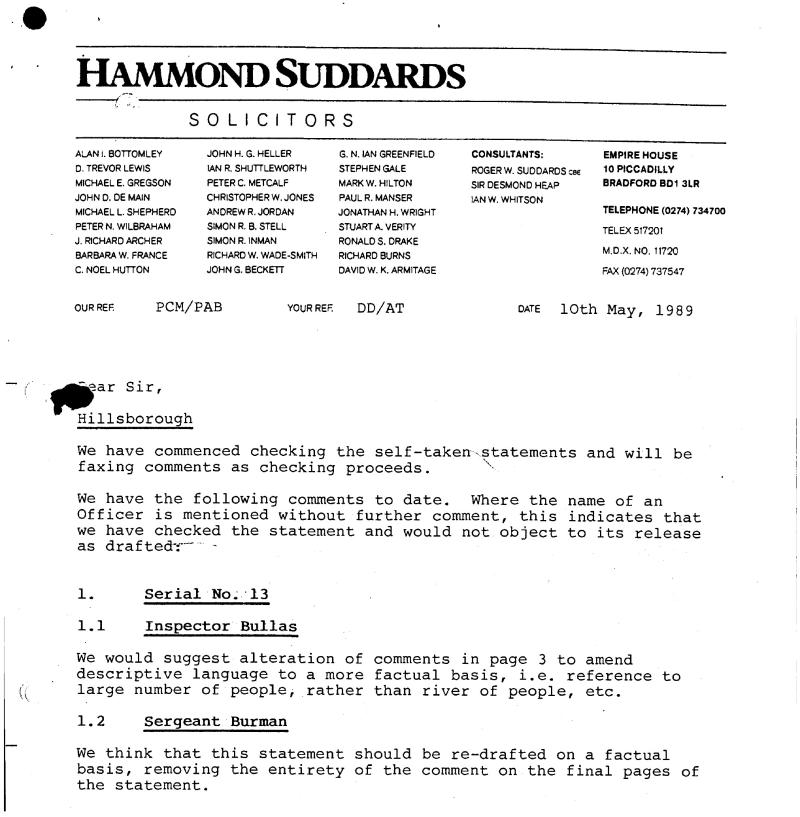
On 10 May, the first batch of accounts was returned to Ch Supt Denton with suggestions for amendments made by Hammond Suddards. They were sent back as three faxes and included comments that words may be missing or that spelling should be checked or corrected, alongside broader suggestions such as: “We should like him to review the comment on page 10, first paragraph, relating to the apparent lack of organised Police effort”.
There were a number of requests to check facts. In three cases, it was suggested that the final comment should be removed; in one (the account of Insp White), the fax suggested the removal of a section of several paragraphs that the officer had written under the heading “additional points arising.”
In total, across the three faxes, Hammond Suddards suggested changes to 28 of the 68 accounts reviewed at this stage. In his first prepared statement to the IOPC, Ch Supt Denton recalled receiving the first faxes and noting that Mr Metcalf was “suggesting fairly significant amendments to a number of the recollections before release, such as the removal of opinion, ambiguity and over-descriptive language.” He stated: “It was immediately apparent that, on Mr. Metcalf’s advice, substantial amendments to many of the recollections would be required before they could be released to WMP.”
Despite this, the IOPC has found no evidence to indicate that Ch Supt Denton challenged any of these proposed amendments and nor did any member of his team. The ‘suggestions’ were treated as instructions and acted upon.
Image
Figure 9D: Extract from first fax sent as part of the review process (Source: Home Office)
In both his evidence to the Goldring Inquests and his first prepared statement to the IOPC, Ch Supt Denton described a standard process he and his team used in implementing the amendments suggested by Mr Metcalf. The following summary is drawn from Ch Supt Denton’s evidence.
Ch Supt Denton and DCI Foster reviewed the faxes sent from Hammond Suddards.
DCI Foster would then retrieve copies of the relevant original accounts.
Either DCI Foster himself, or another member of the team, determined what wording needed to be changed, annotated the original account accordingly and handed the annotated version to typists to retype.
The amended versions were then sent back, via various detective sergeants, to the officers who had originally produced them. These officers were asked to review the amended accounts and sign them; they were not necessarily told what had been changed.
Over the following days, this process was adopted for all accounts that SYP had gathered by that point. In total, 426 accounts were sent to Hammond Suddards for review: these included the accounts of almost all the officers who had been deployed at the Leppings Lane end, whether inside the stadium or outside the entrance, or in other key roles on the day. The lawyers—predominantly Mr Metcalf—suggested amendments to 172 of these.
Though only the amended versions were sent to WMP, SYP retained the original accounts and the amended versions. In some cases, it also retained a printed copy of the account marked for amendment, with changes written on by hand before the amended version was typed up.
While Ch Supt Denton has accepted “full supervisory responsibility” for the amendment process, including sending accounts to Mr Metcalf and receiving his responses, the evidence supports his assertion that he did not personally make any amendments. DCI Foster has confirmed he was at the heart of actually making the amendments but also added that two other officers were “involved in carrying out the amendment process in accordance with the legal advice received.”
Having looked into the process in detail, the IOPC found evidence that one of these officers played a predominantly administrative role in the process. However, the other, Detective Inspector Philip Jones (DI Jones), signed or initialled handwritten notes on 106 officers’ accounts. These included notes implementing amendments suggested by Hammond Suddards as well as, in 16 cases, further suggested amendments, apparently from DI Jones himself.
In a statement to Operation Resolve in March 2014, DI Jones stated that at some point after the disaster, D Ch Supt Addis gave him a bundle of around 12 accounts on which suggested amendments had been marked up. DI Jones said he was told “to contact the officers, interview them and delete certain parts of their reports.” DI Jones stated to Operation Resolve that he did not know who had suggested the changes but that he was instructed to “have them remove any criticism of senior officers and criticism of the radio communications”. He stated he believed he had been asked to do this because DCI Foster was away.
When IOPC investigators interviewed him and pointed out there was evidence that he had amended more than 12 accounts, DI Jones accepted that he had been involved in amending more than 12 accounts but stated: “I was acting in accordance with legal advice and under the direction of senior officers.”
Both DCI Foster and DI Jones have stated that they amended accounts in accordance with legal advice. However, for 94 of the accounts that were amended, there is no record of advice from Hammond Suddards. Instead, the IOPC has established that from around 16 May—the day after the Taylor Inquiry hearings started—SYP reviewed and amended officers’ accounts in-house, without sending them to Hammond Suddards.
In total, 736 accounts were reviewed by the in-house team of officers: predominantly DCI Foster, DI Jones and one other. The amendments made through this process were similar to those recommended by Hammond Suddards.
The possibility of SYP reviewing accounts in-house was first discussed on 10 May. According to a file note made by Hammond Suddards, ACC Anderson telephoned the solicitors to discuss the fact that WMP had now asked for accounts from around 600 SYP officers. These were officers that had been on duty at the Semi-Final, but not at the Leppings Lane end.
Mr Metcalf commented that while they could follow the same process as previously, Hammond Suddards “would be under considerable time difficulties and would not be able to process these prior to the 22nd or even the 29th of May.” In response, ACC Anderson proposed that these officers should be asked to provide a statement that “sticks to factual matters alone”, and that these “would then be vetted by the Police themselves.”
The accounts of this new group of officers were reviewed and amended by Ch Supt Denton’s team, rather than Hammond Suddards; the solicitors were only contacted if Ch Supt Denton’s team had specific queries.
For a brief period, this process ran concurrently with the vetting of the previously requested accounts, which was being conducted by Hammond Suddards.
A range of documentary evidence shows that from an early stage, WMP and the Taylor Inquiry team were aware that SYP had adopted a vetting process for officers’ accounts—though the IOPC has not established who informed them or when. The prime concern from WMP appears to have been that this could delay the delivery of accounts to the Taylor Inquiry team.
On 15 May, the Taylor Inquiry opened and Andrew Collins QC, Counsel to the Inquiry, gave a preliminary statement in which he explained that “At this stage only witnesses who can give factual evidence will be called” and added: “This is not the stage for witnesses to give evidence of their opinions.” However, he added that “this does not of course mean that the Inquiry will ignore the opinions of those who wish to put them forward” and suggested that these could be offered in writing.
This stance was confirmed in a letter from David Brummell of the Treasury Solicitor’s Department, who was part of the Taylor Inquiry team, to ACC Jones on 7 June. The letter was sent after an SYP officer was asked questions at the Taylor Inquiry relating to his original account, which had been sent to WMP by mistake, rather than the amended version.
Mr Brummell dismissed ACC Jones’s concerns about this, commenting: “The main difference between the initial and final versions of the South Yorkshire Police Officers' statements is that any expressions of opinion were (as I understand it, on the advice of Mr. Woodward) removed from the final version.” He added: “As I understand it, Andrew Collins' view is that there is absolutely no reason for excluding such expressions of opinion when they touch on matters relevant to the Public Inquiry and that, in the circumstances, there is no objection in principle to written statements containing such opinions being submitted to the Inquiry.”
While this reaffirmed that opinions did not need to be removed, WMP had already been alerted to the possibility that some material changes were being made to accounts. On 22 May, an SYP officer telephoned DCI Ross to complain that his statement had been altered.
DCI Ross informed ACC Jones, who in turn wrote to CC Wright at SYP. The letter began: “I thought I would advise you discreetly that we have had two approaches from separate sources suggesting omissions have been made from officer’s recollections.”
The IOPC has found no evidence to suggest that either WMP or SYP sought to stop the amendment process or look into the issue. Instead, it appears to have been the catalyst for SYP to issue an internal message, titled ‘The Hillsborough Inquiry – Update II’, which was specifically addressed to “officers of the South Yorkshire Police submitting evidence to the West Midlands Police”. It referred to the fact that officers’ accounts had been amended and acknowledged that some officers had expressed concerns about this. It explained that the amendments were “necessary” and had been made “to remove conjecture and opinion and to leave only matters of fact.”
The crucial consequence of the amendment process was that WMP only received the amended accounts, so any further actions it took or analysis it conducted could only have been based on those versions. Its investigation was based on the information SYP chose to give it. Similarly, the Taylor Inquiry team could only call witnesses to give oral evidence based on the amended accounts; there may have been information in the original accounts that would have been relevant to the Inquiry, but this was not available for consideration.
On 28 April 1989, Lord Justice Taylor held a preliminary hearing for the Inquiry at Sheffield Town Hall. The hearing set out his expectations for the Inquiry. Lord Justice Taylor stated: “I emphasise that during the first phase of the Inquiry what is required is factual evidence as opposed to mere comment or non-expert opinion.”
The following day, ACC Jones, who was leading WMP’s work for the Taylor Inquiry, wrote to CC Wright that he had “been directed by Lord Justice Taylor to invite senior police officers who were involved at Hillsborough on Saturday 15 April 1989 to submit, in writing their recollection of the events prior to and during the match.” He listed six officers from whom recollections were sought. He did not specify that comment or opinion was not required.
SYP swiftly conveyed this request to its lawyers. A handwritten file note from Hammond Suddards indicated that Ch Supt Wain phoned the same day and explained the development. After further conversations between DCC Hayes and Mr Metcalf, on 2 May, Mr Metcalf met with some of the senior officers to review their accounts. In a short note of the meeting, Mr Metcalf recorded: “I made various suggestions for alterations to their statements, the principal change being that in respect of ACC Jackson, who had not included any of the details of the planning of the match.”
In what appears to be a direct consequence, ACC Jackson submitted a ten-page account, plus an appendix. This was shared with WMP, who recorded it as his statement.
On 7 May, ACC Jones wrote to CC Wright again, advising him that the Taylor Inquiry had now requested written recollections from a large number of SYP officers, to be drafted in line with “the same criteria as for the senior officers before.” The following day, Detective Chief Inspector Malcolm Ross of WMP (DCI Ross) sent Ch Supt Denton a list of 122 SYP officers from whom recollections were required.
According to a Hammond Suddards attendance note, Ch Supt Wain and Ch Supt Denton jointly telephoned Hammond Suddards and spoke to Miss Norcliffe about WMP’s request. She noted they were “concerned” as some of the accounts they already had from officers on the list “go beyond mere fact.” According to the note, Ms Norcliffe advised them that “as the statements already taken were provided for Legal Advisors, this would not necessarily be a problem, that all the statements would have te [sic] be vetted before release and consents from all Officers would be required.”
Having confirmed this with Mr Metcalf, she then telephoned Ch Supt Wain back to advise him that the best course of action would be “for us to read through every single statement requested that we already had, to ok the ones that should be released and to suggest alterations possibly to others.”
This was therefore the third point at which the legal team suggested that officers’ accounts might need to be amended. Again, there was no recorded response from SYP.
On 9 May, Ch Supt Denton sent Mr Metcalf a bundle of accounts, with the specific acknowledgement: “You agreed to vet the initial batch of those statements.” The decision to send accounts to Hammond Suddards for vetting was communicated promptly within the SYP teams involved in the collection of evidence. On 10 May, Ch Supt Wain instructed the SYP MIR that “nothing currently in our possession will be released to W/Mids until it has been vetted by our legal representatives.”
It is important to acknowledge that WMP’s request meant that officer accounts would now be used for a very different purpose: whereas SYP had asked for them to inform its production of a proof of evidence for the Taylor Inquiry, they were now being treated as primary evidence by another police force.