A number of family members have raised concerns about how police officers treated them at the gymnasium, commenting that as they went there to look for their loved ones, some police officers prevented them from entering and did not provide them with any information.
Kevin Thompson went to the game with his brothers Patrick, who was killed in the crush, and Joseph. He said that after police officers had carried Patrick to the gymnasium, “They put him on the floor and left me with him. I was screaming and shouting.” He added, “I just wanted to hold on to Pat because there was nothing I could do. The police made me leave and we were taken to the police station and then sent home.”
Stephen Jones’s wife Christine was also killed in the disaster. He had been separated from her in the crush and eventually made his way onto the pitch, where he found her lying on the touchline and instantly knew she had died. With assistance from Police Sergeant Julian Roper (PS Roper) and other officers, Mr Jones carried his wife to the gymnasium, where he sat with her and held her.
In a statement to the IOPC in 2015, he described a series of rude and inappropriate interruptions and interventions from police officers, after the third of which he became so frustrated at the way he was being treated, he kicked out at a chair. Two police officers took hold of him and told him to calm down. He commented that other than PS Roper, nobody had shown him any compassion, nor seemed to care or understand.
Barry Devonside’s son Christopher was killed in the disaster. They had gone to the match together. Mr Devonside was seated in the North Stand, while Christopher went to the West Terrace.
In a statement to solicitors dated 1 August 2014, Mr Devonside said that he left the ground at 3.45pm following an announcement that the match had been cancelled and returned to the group’s prearranged meeting place. When he got there, one of his son’s friends told him that Christopher had died and was in the gymnasium. Mr Devonside said that he got directions to the gymnasium and arrived there between 4pm and 4.15pm.
He knocked on the gymnasium door and waited for a long time for it to be answered, only for a police officer to ask him without any empathy, “What do you want?” Mr Devonside explained what he had been told and the officer asked for his son's name. Mr Devonside recalled, to try and help identify Christopher, that he also told the officer that his son was wearing a Welsh international rugby shirt.
The officer told him to stay outside, then closed and locked the door, returning 10–12 minutes later with the news that his son was not there. Mr Devonside said that he told the officer his son had to be in the gymnasium, as his friend had carried him there and had given his full name and address to the police. However, the officer said, “I have just told you he's not here”.
In 2014, he made a complaint about the manner of the police officer concerned. Operation Resolve investigated this complaint. Though it was not possible to confirm the identity of the officer involved, the IOPC upheld the complaint, on the basis that because the officer “spoke to Mr Devonside in an abrupt, unsympathetic and unprofessional manner”, Mr Devonside did not receive the level of service a member of the public might reasonably expect.
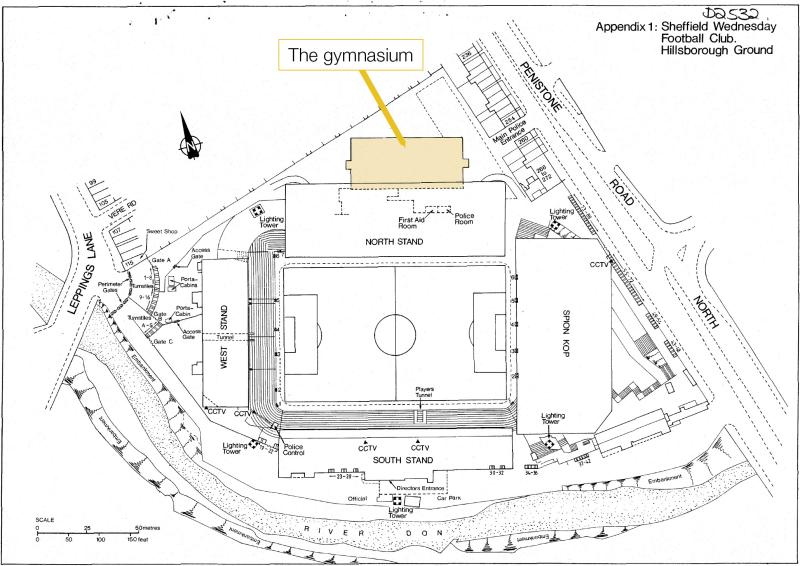
The gymnasium at Hillsborough Stadium was a purpose-built sports hall, situated at the back of the North Stand, as shown in figure 6A.
Image
Figure 6A: Map of Hillsborough Stadium showing the location of the gymnasium (Source: SYP Archive)
After the disaster, the gymnasium almost immediately became a focus of activity. For several reasons, it had been pre-identified as a place to take casualties if needed: it was accessible from the pitch, via the path between the North Stand and the Spion Kop and had some (albeit rudimentary) facilities. It had also been pre-identified as a suitable location for a temporary mortuary if one was needed, and again it fulfilled relevant criteria for this purpose. It had good access from the road and was away from public view. There was also a telephone in the adjoining police room.
On the day of the disaster, many police officers were already in the gymnasium. Some were on standby, others were completing paperwork relating to arrests they had made, and some were having a scheduled refreshment break. Several have said that shortly after 3pm, Ch Insp Beal came in and shouted for the area to be cleared. Some recalled him explaining that it was to receive casualties, while others recalled him saying that it was to be used as a mortuary.
The situation there quickly became chaotic and its use as both a first aid centre and mortuary became untenable as the number of those who had died increased. There was a lack of preparedness and limited control and coordination across agencies. This reflected the fact that although the gymnasium had been selected as a suitable temporary mortuary location during a multi-agency meeting in 1986, no detailed consideration had been given to how this would work in practice. There was minimal medical equipment on site and there was no guidance in the Major Incident Manual, or anywhere else, about the possible layout of a temporary mortuary in the gymnasium. SYP had major incident boxes, which included essential documents setting out clear processes for responding to such an incident and standard forms. These were located at key locations across the force area; however, they did not have one at the stadium, so one had to be brought from a police station.
Numerous practical issues emerged, most obviously the need to separate those who had died from those requiring and receiving treatment. There were also no protocols for attending to bereaved family members who had accompanied or followed loved ones into the gymnasium. Advertising hoardings that had been used as stretchers had been left in the gymnasium so that those who had carried them could quickly return to assist more casualties. However, as the number of hoardings left behind increased, they became obstacles.
There was also a procedural requirement to address body continuity: the process by which police officers and others ensure that, as a body is moved, identified and where necessary examined, all those involved are dealing with the same individual. Normally, the first police officer to attend would stay with the person who has died, but after carrying people to the gymnasium, officers returned to help with the rescue effort.
Once this was recognised, officers were instructed to write their collar number on the hand of the person who had died, before returning to the pitch.
Shortly after 4pm, D Ch Supt Addis arrived, having received instructions from ACC Jackson to ensure the temporary mortuary was functioning. He took charge of the situation there, putting in place processes for documenting details of each of those who had died. He also ensured that Dr Popper had been contacted and directed that officers be placed at the entrance to restrict access to the gymnasium. These actions brought some order to the situation.
D Ch Supt Addis has stated that his main priority was to maintain continuity of the identification and movements of those who had died. However, because identification was the responsibility of the Coroner, D Ch Supt Addis was unable to start a formal process. In the interim, he could have focused on other tasks to make the response more coordinated and effective and to consider the needs of families and friends.
Dr Popper was told about the disaster by 4.15pm; he was at home at the time. Having been given enough information to understand that a large number of people had died, he telephoned key colleagues, then went to the MLC, where he arrived at about 5.40pm. He met with a group of pathologists and coroner’s officers to discuss options for the coronial response to an incident of this scale. With a smaller group of colleagues, he then went to the stadium to assess the situation. He had no direct contact with D Ch Supt Addis or anyone else in the gymnasium before he arrived at the ground.
Concerns about the way family members and friends of those who died were treated were first raised publicly within days of the disaster. They have been acknowledged in different arenas since, from media coverage to formal reports, and a range of issues related to the treatment of families and friends have been identified. These included:
the suitability of the premises SYP used, from the gymnasium at Hillsborough Stadium which served as a temporary mortuary, to the locations used as reception centres
the treatment of family members and friends in the temporary mortuary
the fact that those who died at the hospitals were transferred back to the gymnasium for identification
multiple aspects of the identification process, including the long delay before the process started and the fact that it then took a very long time and was poorly managed and insensitive, in particular through the use of distressing photographs as a first step
the inconsistent and insensitive care and handling of those who died, including that in some cases, their faces were washed before they were photographed and the fact that police officers’ collar numbers were written on some of the bodies
the insistence on adhering to the formal identification process for all of those who died, even when some had already been identified by a friend or family member earlier on, and the fact that personal property and distinguishing features were not used to help in the identification process
the fact that some of those involved in identifying a loved one were under the age of 18 and did not receive appropriate support
the manner in which police officers questioned family members and friends after they had identified a loved one—in particular, that they asked about alcohol consumption and the possession of match tickets, neither of which was relevant to the identification
the overall lack of information provided to families and friends both in Sheffield and remotely, and the quality, accuracy and timeliness of the information that was provided
that family members were prevented from touching, holding or kissing a loved one
several families specifically recalled being told that those who had died were “the property of the Coroner”: this issue—which was brought to widespread public attention in the 1996 docudrama ‘Hillsborough’ and covered further in the HIP Report—was the source of a number of complaints investigated by Operation Resolve
The concerns about the identification process applied to identifications made in the gymnasium and at the MLC. Other issues were broader and applied to the entire experience.
Once they were rescued from the crush on the West Terrace, injured supporters were taken to a range of locations including the gymnasium at the stadium, which was designated as both the place for medical treatment and the temporary mortuary on site, and to Sheffield’s two major hospitals, the Northern General and the Royal Hallamshire.
Within minutes, it was apparent that some of those being carried to the gymnasium had died. From about 3.15pm, the gymnasium became both a casualty clearing point and the temporary mortuary, with the injured being treated in a separate area of the main hall. Those who were pronounced dead by medical professionals on the pitch were also taken to the gymnasium. They remained there until they were identified.
At about 6.45pm, Dr Popper attended the gymnasium and agreed a formal identification process with Detective Chief Superintendent Terence Addis (D Ch Supt Addis), the head of CID at SYP. As part of this process, Dr Popper instructed that all those who had died in hospital must be transferred back to the gymnasium for identification.
By about 9.15pm, 93 of those who had died were at the gymnasium ready for the formal identifications to begin. This commenced about 9.30pm. Just after 10pm, the 94th of those who died on the day was brought to the gymnasium from the Northern General.
Under the agreed process, a photograph was taken of the face of each of those who had died. These photographs were taken using Polaroid cameras so that they could be printed instantly. They were then displayed on boards. In small groups, the family members and friends completing the identification were brought into the gymnasium to look at the boards and asked if they could see their loved one. When they recognised them, the photograph was removed from the board, and the corresponding body was brought by police officers into a small, curtained area for viewing; the family members and friends had to then confirm the identity of their loved one.
The family members and friends were then taken to a different area of the gymnasium where they gave police officers a formal identification statement. It was during this point that some have said they were asked about their or their loved one’s alcohol consumption.
Once a friend or family member had formally identified their loved one, the body was taken by ambulance to the MLC, which was the city mortuary in Sheffield, for a post-mortem examination. By early next morning, the majority of those who died had been identified and transferred to the MLC. A decision was made that anyone who had yet to be identified would also be taken to the MLC and identified there.
A police officer was assigned to stay with each of those who had died for the whole time, in line with a process known as ‘body continuity’. The officer could then confirm that it was the same individual the family had identified, and that there had been no unauthorised contact with them. At the MLC, the officer formally handed responsibility for that individual to the officers on duty there.
By 6.30am on 16 April 1989 the operation inside the gymnasium was closed down. Later that day, post-mortem examinations began at the MLC in line with Dr Popper’s instructions. They were concluded by 2pm on 17 April 1989.
Throughout this period, the situation was both distressing and extremely confusing for friends and family members. Some groups who had travelled to the match together did not have tickets for the same section of the ground, while many of those who did have tickets for the same area had become separated, whether during the crush at the turnstiles on entering the ground, during the crush on the West Terrace, or following their escape from the pens. While some were later reunited on the pitch or on their return to their pre-arranged meeting points, others were frantically searching for their companions and trying to obtain information. Mobile phones were not widely available at the time, so friends and family members had to rely on snippets of information they could get from others—including police officers on duty at the stadium—about where casualties may have been taken.
When this failed, the next course of action was to head to the nearest police station, Hammerton Road, to report their loved ones missing. Some then went to the hospitals, going from one to the other in the hope of finding information.
Many of those who had not been at the match attempted to contact SYP and Merseyside Police by phone, using dedicated Casualty Bureau numbers that were broadcast on TV and radio. However, the sheer number of calls meant that it was difficult to get through and speak to anyone; when calls were answered, the call handlers had little information to give. Many families then made the decision to travel to Sheffield, again trying hospitals but in many cases ending up anxiously waiting for information in various locations around the city that had been hurriedly transformed into reception centres. Those who had been at the game also gravitated to these same locations, typically deeply traumatised by their experiences that day. A large number of social workers, members of the church and other volunteers accompanied and supported the families and friends at those locations.
The main reception centre was at Hillsborough Boys’ Club, a youth club close to Hammerton Road Police Station, which had limited facilities and offered little or no privacy. While there was some support available for the families and friends, the thing they wanted most—information on their loved ones—was in short supply. In some cases, when information did come through, it proved to be inaccurate.
Once the identification process had been determined, families were taken by bus to the gymnasium to identify their loved ones. For many, this involved a long wait outside the gymnasium before they were even allowed in, as the numbers of those inside were carefully controlled. Others simply had to wait in a state of increasing apprehension at the reception centres for the next bus.
This chapter includes witness accounts, images and descriptions of scenes that may be distressing.
What was investigated?
Under the terms of reference for the managed investigation, Operation Resolve investigated:
f) the actions of police officers in the gymnasium, in particular whether the treatment and questioning of relatives was appropriate. The actions of police officers at the Hillsborough Boys’ Club, and any other complaints about the treatment of friends or relatives on the day. The time parameters will be from 3.06pm on 15 April 1989 to the time when the last of the facilities shown below closed down—this will cover events between the match being stopped and the completion of arrangements to assist families at the following locations:
The gymnasium, Northern General Hospital, Royal Hallamshire Hospital, Ecclesfield Casualty Bureau, Merseyside Casualty Bureau, Hammerton Road Police Station, Hillsborough Boys’ Club, Forbes Road Church Hall, Meade House, Kelvin Centre, Burngreave Vestry, and the Medico-Legal Centre
What was found?
• Despite the efforts of many volunteers, medical professionals and individual police officers, the treatment of families and friends of those who died in the disaster lacked compassion. Procedure was adhered to in an unnecessarily rigid way, particularly in relation to the identification process, which added to the distress of families and friends.
• Families and friends repeatedly encountered a lack of information and coordination between sites. This resulted in situations such as parents being taken to see their son who had died in hospital, only to discover that he had been transported back to the gymnasium for the identification process.
• The identification process was largely determined by Dr Popper, the Coroner. He decided that all of those who died must be formally identified at the gymnasium. He also decided that as a first stage in the identification process, those coming to identify a loved one would look at photographs of each of those who had died rather than having to view multiple bodies. This process was adhered even when property found on someone who had died could potentially have spared friends and family that step of the process.
• Police officers had the right to suggest alternative approaches to Dr Popper, but there is no evidence that they did. Instead, they largely followed any directions from him to the letter, regardless of the impact this may have on families and friends.
• Viewing the photographs was a harrowing experience and little consideration was given to the way the photographs were presented to families and friends. For example, the photographs were not separated into age, gender or any other descriptive categories.
• Some families have said that officers they dealt with refused to allow them to touch their loved ones and on occasion told them they were the “property of the Coroner”. While this was not the experience for all families, there was no reason from a policing or coronial perspective why family members could not hold their loved ones.
• Many of those who gave an identification statement have said police officers asked them about their and their loved one’s consumption of alcohol and possession of match tickets. Such information was not needed for any procedural purpose. However, only a small number of the identification statements recorded included references to either issue. There is no record of any senior officer instructing colleagues to ask such questions.
• The Casualty Bureau set up by SYP should have been the single point of contact to help families and friends seeking their loved ones, and to help the police contact relatives, but it was overwhelmed by the volume of calls. It was only the second time SYP had set a Casualty Bureau up and it had never been properly tested; numerous practical issues occurred, limiting its effectiveness.
• One of these issues was that the telephone numbers supposed to be used for contact between the Casualty Bureau and hospitals and police sites were given to the public—meaning there were no dedicated lines. This disrupted information flow.
• The facilities made available for families and friends to wait in were chosen because they were convenient rather than because they were suited to the purpose. Though police officers were present, support for families and friends was largely organised by social services and volunteers.
• Throughout, there was no overarching coordination of the different activities underway. No police officer was in overall control. None of the SYP senior leadership team took any role or even showed any apparent interest in what was happening. This meant that support for families was disjointed, and the effectiveness of the efforts of the many volunteers, social care and medical professionals and individual police officers was limited.
Significant new evidence
The main sources of new evidence around the treatment of families and friends were additional statements, or testimony to the Goldring Inquests, from those involved. Some statements, such as those made as part of the investigation into a complaint about the way individuals were treated, specifically focused on the person’s experiences in the hours after the disaster.
Operation Resolve made further use of the Racal recordings of conversations with the Force Control Room. It also examined two SYP books known as ‘property other than found property registers’ that were used at the gymnasium and MLC to record the personal possessions of a number of those who died.
In the years since the Hillsborough disaster, many family members and friends of those who died have provided harrowing accounts of their experiences in the hours that followed. Within these deeply personal stories, there have been common themes: the difficulty in getting information about their loved ones, the chaotic scenes at the various locations to which they were directed, the traumatising nature of the process used for identifying those who died and the repeated unfeeling bureaucracy of some officials. Many have also recounted how they were questioned by police officers either about their own alcohol consumption, or that of their loved one.
Together, these accounts have painted a striking picture of an ongoing response to the disaster that failed on both a procedural and personal level; that added to the anguish of those first hours and caused enduring distress and trauma.
This chapter examines the way that the families and friends of those who died were treated by the police in the immediate aftermath of the disaster. It covers the period from just after the match was stopped to the point when the last of the facilities made available to the families and friends was closed. It includes extracts from some of the accounts provided by family members and friends but does not seek to represent the experiences of the families or to speak for them. Instead, its focus, in line with the terms of reference for Operation Resolve’s managed investigation, is on how SYP interacted with families and friends of those who died, and whether this followed the expected standards of the day.
Operation Resolve also investigated a number of complaints from families and friends about the way they were treated by the police. The complainants have been informed of the outcomes.
A further, more personal insight into the experiences of the families of those who died in the disaster can be found in Chapter 1 of the 2017 report by Bishop James Jones, the former Bishop of Liverpool and Chair of the HIP, ‘The Patronising Disposition of Unaccountable Power: A Report to Ensure the Pain and Suffering of the Hillsborough Families is not Repeated’.
Operation Resolve investigated a number of complaints and conduct matters relating to the emergency response and provided reports to the IOPC. Having reviewed the evidence detailed in these individual reports, the IOPC opinion was that ACC Jackson, Ch Supt Duckenfield and Supt Murray would have all had a case to answer for gross misconduct, if they had still been serving with the police. Supt Greenwood would also have had a case to answer for misconduct.
ACC Jackson would have had a case to answer for neglect of duty because he failed to take control of the situation. As the senior officer on call, he should have declared a major incident, rather than calling for Operation Support. Once he realised that Ch Supt Duckenfield was faltering, he should have assumed command of the rescue operation. While he did undertake some important actions, such as initiating the Casualty Bureau, he failed to provide overall coordination of the emergency services response, as according to the SYP Major Incident Manual the police should have done. Further, by taking Ch Supt Duckenfield from the PCB to meet SWFC officials, he left a more junior officer (Supt Murray) in sole command for a 12-minute period without guidance or instructions.
Ch Supt Duckenfield would have had a case to answer for neglect of duty on a number of grounds. Despite having an excellent viewpoint from the PCB, he failed to act when it became obvious that Pen 3 and Pen 4 were overfull and that people were in distress. He then was slow to coordinate a rescue operation and did not organise and direct the officers under his command to help save lives. He too could have declared a major incident, but did not, and then failed to take control of the police response as set out in the SYP Major Incident Manual—for example, by failing to communicate effectively with the other emergency services and to coordinate their efforts.
Several of these same issues applied to Supt Murray, who would also have had a case to answer for neglect of duty for failing to respond to the situation, being slow to coordinate a rescue operation and not organising and directing the officers under his command to help save lives. Despite going onto the pitch at a key time, he failed to identify the seriousness of the situation in Pens 3 and 4 and failed to respond to it quickly enough. He did not effectively advise Ch Supt Duckenfield regarding the dangerousness of the situation. He also did not liaise effectively with others to coordinate a response to the disaster.
Supt Greenwood would have had a case to answer for misconduct for a range of allegations about his organisation of the rescue effort. While he did take a number of actions in response to the unfolding disaster, there were other steps he could have taken to better coordinate the police response. He focused his efforts on Pen 3 and was highly involved in the rescue effort: however, as the senior officer in that location, he could have directed others to do this and taken an overview of the situation, coordinated medical triaging and deployed police resources more effectively.
Yet even while both were in the PCB, the police control of the incident remained poor. Though the PCB was in ongoing communication with the Force Control Room, at no point did it provide a clear explanation of what had happened. The Force Control Room operators therefore had to make assumptions in their communication with SYMAS and SYCFS counterparts.
Requests were made for Operation Support and for all officers at the stadium to head to the Leppings Lane end, but with no explanation given. Those responding did not know what they were responding to. As was the case earlier in the afternoon, those outside the stadium did not know what was happening inside and vice versa. When SYMAS and SYCFS teams turned up, the police officers at the entrances did not know why they were there and could provide no useful direction.
Throughout, radio communications were problematic, but there were other means of communication available. Despite the proximity of the PCB to the unfolding situation, Ch Supt Duckenfield did not at any point go on the pitch to make his own assessment. He has subsequently acknowledged that he froze. Supt Murray did go on the pitch but appears to have done little to assist; he did not provide any instructions beyond the reported words to PS Morgan to do whatever they could.
In short, though the senior officers in the PCB had the means to coordinate a response, and a view of the situation unfolding, they failed to manage the police resources and the other emergency services effectively.
Even by the time they left the PCB, they had still not provided the Force Control Room or other locations with clear information about what had actually happened. This inevitably hampered the efforts of those involved with attempting to assist traumatised supporters and the families and friends of those who were injured, missing or who had already died. This is the focus of chapter 6.
Operation Resolve identified a series of recurring issues that restricted the effectiveness of the emergency response. The first of these was a lack of coordination, command and control. This was mentioned in many of the accounts of SYCFS officers who came to the stadium, but also by SYMAS and a significant number of SYP officers. The most visible police leadership came from Ch Supt Nesbit, in organising officers at the gates. Others—from each emergency service and some of the off-duty medical professionals—also took the initiative to provide some coordination, albeit of small groups, which made the response more effective.
Throughout, the processes that formed part of the Major Incident Plan and Manual were not followed. Key omissions included the failure to declare a major incident, and the failure to have a visible site commander in overall control of the emergency response.
Both Ch Supt Duckenfield as match commander and ACC Jackson as the on-call chief officer could have performed this role. Even after both have given evidence on multiple occasions, it is still not clear which of them was the site commander or who was in charge of the emergency response.
At the Taylor Inquiry, ACC Jackson told Counsel to the Inquiry that he did not at any point tell Ch Supt Duckenfield that he was no longer in charge. ACC Jackson said that as the senior officer there, he was at Ch Supt Duckenfield's side, assisting and making sure that everything was done that possibly could have been done. However, ACC Jackson agreed with Lord Justice Taylor that, by the time Ch Supt Mole arrived at the PCB, he had taken over control from Ch Supt Duckenfield.
At other times, ACC Jackson has insisted that Ch Supt Duckenfield had remained in control and assumed the role of site commander in the major incident response. Then at the Goldring Inquests, he said he couldn’t remember whether Ch Supt Duckenfield had performed that role.
At the Goldring Inquests on 18 March 2015, Ch Supt Duckenfield told his own Counsel that ACC Jackson had not offered to take over command, had not overruled any of his decisions and had not given him advice. Two independent expert witnesses—both highly experienced match commanders—said they would have expected ACC Jackson, as the more senior officer, to have assumed command in this situation.
Aside from this lack of clarity about command, from 3.35pm to 3.48pm, both ACC Jackson and Ch Supt Duckenfield were away from the PCB in the boardroom, updating FA and SWFC officials about what had happened and their proposed approach. In the boardroom, Ch Supt Duckenfield repeated the lie that the disaster had been caused by supporters forcing their way into the stadium.
During this period, Supt Murray was left in charge, having recently returned to the PCB from the pitch. Operation Resolve found no evidence to suggest that Supt Murray was given any formal handover of control before ACC Jackson and Ch Supt Duckenfield left the PCB to go to the meeting in the boardroom. It was during this time that SO Fletcher visited the PCB to speak to the senior police officer but received no useful information.
Ch Supt Duckenfield told the Goldring Inquests that he was annoyed at being taken away from the PCB to brief the officials and suggested ACC Jackson should have done this alone.
The efforts of those involved at the front of the pens and in taking casualties away had an impact. By 3.30pm, the front of Pen 3 had been cleared of casualties. This was 25 minutes after Supt Greenwood had caused the match to be stopped.
Tragically, this was already too late for many. At 3.29pm, an entry on the Force Control Room extended incident log recorded that the PCB requested that the Sheffield city mortuary, located at the Medico-Legal Centre (MLC), should be warned “to expect several bodies.”
There was still a major medical effort, including at the back of the West Stand, to try to resuscitate some and treat others.
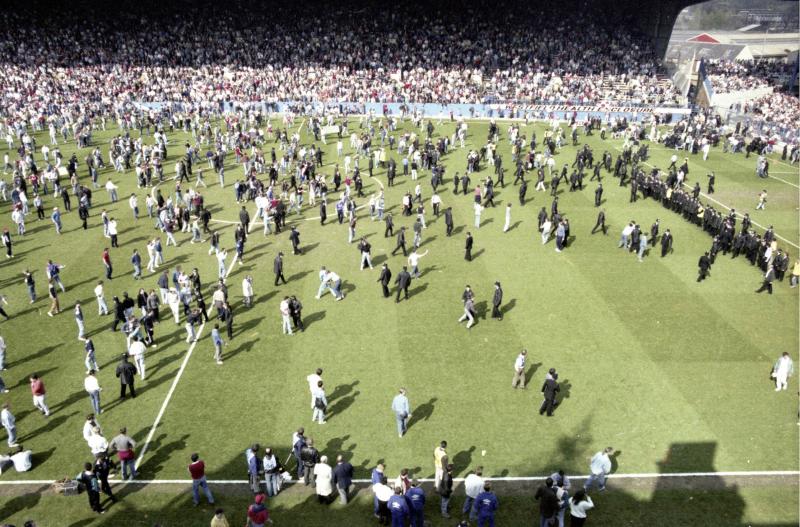
There were also still large numbers of supporters on the pitch, and some police officers were concerned that there was a risk of confrontation between opposing supporters, with some Nottingham Forest supporters in the Spion Kop area chanting and whistling. This led to the police forming further cordons, to prevent Liverpool supporters on the pitch from reaching the areas allocated to Nottingham Forest. By 15:38:30, police officers had formed a cordon in front of the Spion Kop, near the edge of the penalty box.
Image
Figure 5N: A police cordon in front of the Spion Kop, 15:38:30 (Source: SYP)
The cordon then moved up the pitch guiding supporters back towards the Leppings Lane end. There were no confrontations between rival supporters.
Shortly before the cordon was formed, at 3.37pm, two police officers on the pitch close to the Spion Kop had their truncheons drawn. This took place at a time when some Liverpool supporters were making their way towards the Nottingham Forest end of the ground. The footage shows that the truncheons were not used to strike anyone and were put away within moments of them being drawn.
Operation Resolve conducted a comprehensive review of all available video footage, in response to allegations that police officers used truncheons, sticks, canes or batons to prevent supporters seeking to escape from the West Terrace. This was the only instance found of police officers drawing their truncheons during the whole day. Operation Resolve did not identify any footage that supports the allegations. It should be noted that the footage, though extensive, is not continuous.
Further, Operation Resolve did not identify anyone who said they were struck by a police officer with a truncheon or something similar while climbing on or over the perimeter fence of the West Terrace.
SWFC CCTV footage shows that supporters and police officers continued to carry casualties through Gate C to ambulances that were still arriving. In total, SWFC CCTV filmed the arrival of 20 ambulances. The last casualty was carried out of the ground by supporters and police officers at 3.51pm.
At 3.56pm, Liverpool manager Kenny Dalglish gave a message over the stadium PA to ask supporters to remain calm and cooperate with the police. At 4.17pm, a further message was broadcast to inform supporters that the match had been abandoned. By around 4.40pm, Ch Supt Mole arrived at the stadium and went to the PCB, where he assumed command of the remaining operations, allowing Ch Supt Duckenfield and ACC Jackson to return to SYP HQ to brief the Chief Constable.
The focus shifted from the situation on the pitch to the gymnasium and the hospitals, which are examined in chapter 6.