On 28 April 1989, Lord Justice Taylor held a preliminary hearing for the Inquiry at Sheffield Town Hall. The hearing set out his expectations for the Inquiry. Lord Justice Taylor stated: “I emphasise that during the first phase of the Inquiry what is required is factual evidence as opposed to mere comment or non-expert opinion.”
The following day, ACC Jones, who was leading WMP’s work for the Taylor Inquiry, wrote to CC Wright that he had “been directed by Lord Justice Taylor to invite senior police officers who were involved at Hillsborough on Saturday 15 April 1989 to submit, in writing their recollection of the events prior to and during the match.” He listed six officers from whom recollections were sought. He did not specify that comment or opinion was not required.
SYP swiftly conveyed this request to its lawyers. A handwritten file note from Hammond Suddards indicated that Ch Supt Wain phoned the same day and explained the development. After further conversations between DCC Hayes and Mr Metcalf, on 2 May, Mr Metcalf met with some of the senior officers to review their accounts. In a short note of the meeting, Mr Metcalf recorded: “I made various suggestions for alterations to their statements, the principal change being that in respect of ACC Jackson, who had not included any of the details of the planning of the match.”
In what appears to be a direct consequence, ACC Jackson submitted a ten-page account, plus an appendix. This was shared with WMP, who recorded it as his statement.
On 7 May, ACC Jones wrote to CC Wright again, advising him that the Taylor Inquiry had now requested written recollections from a large number of SYP officers, to be drafted in line with “the same criteria as for the senior officers before.” The following day, Detective Chief Inspector Malcolm Ross of WMP (DCI Ross) sent Ch Supt Denton a list of 122 SYP officers from whom recollections were required.
According to a Hammond Suddards attendance note, Ch Supt Wain and Ch Supt Denton jointly telephoned Hammond Suddards and spoke to Miss Norcliffe about WMP’s request. She noted they were “concerned” as some of the accounts they already had from officers on the list “go beyond mere fact.” According to the note, Ms Norcliffe advised them that “as the statements already taken were provided for Legal Advisors, this would not necessarily be a problem, that all the statements would have te [sic] be vetted before release and consents from all Officers would be required.”
Having confirmed this with Mr Metcalf, she then telephoned Ch Supt Wain back to advise him that the best course of action would be “for us to read through every single statement requested that we already had, to ok the ones that should be released and to suggest alterations possibly to others.”
This was therefore the third point at which the legal team suggested that officers’ accounts might need to be amended. Again, there was no recorded response from SYP.
On 9 May, Ch Supt Denton sent Mr Metcalf a bundle of accounts, with the specific acknowledgement: “You agreed to vet the initial batch of those statements.” The decision to send accounts to Hammond Suddards for vetting was communicated promptly within the SYP teams involved in the collection of evidence. On 10 May, Ch Supt Wain instructed the SYP MIR that “nothing currently in our possession will be released to W/Mids until it has been vetted by our legal representatives.”
It is important to acknowledge that WMP’s request meant that officer accounts would now be used for a very different purpose: whereas SYP had asked for them to inform its production of a proof of evidence for the Taylor Inquiry, they were now being treated as primary evidence by another police force.
As detailed at paragraph 9.42, in a CID briefing on 16 April, D Supt McKay told the officers present not to make pocket notebook entries about the disaster. The HIP Report highlighted D Supt McKay’s instruction as the point when “SYP began to shape the investigation that followed.” Others, before and since the HIP Report was published, have suggested that this was a deliberate attempt from SYP to control the evidence that officers gave. The IOPC investigated this issue.
D Supt McKay has stated that “the decision not to make pocket book entries was mine and the subsequent decision taken by the Force stemmed solely from me and this briefing.”
However, his initial instruction was given only to CID officers. On the main SYP F Division Operational Order for the game, there were fewer than 40 CID officers among the 812 officers on duty on the day, and it is not certain that all of these same CID officers were at the briefing led by D Supt McKay.
In a joint statement to Operation Resolve and the IOPC, D Supt McKay recalled that during the meeting with CC Wright on 17 April, he saw ACC Jackson prepare “a telex that was sent out to all stations within the Force area and this highlighted that no delayed entries were to be made in pocket books and notes were to be made.”
In a statement to Operation Resolve in May 2015, Police Sergeant Philip Whitlam (PS Whitlam) recalled that a “fax” was circulated on 17 April 1989, instructing officers to prepare an aide-memoire. He subsequently sent a copy of this document to Operation Resolve. It is in fact a telex, marked from the Chief Constable for the “Information of Chief Superintendents.”
The telex was recorded as being sent at 1.24pm on 17 April, which indicates it was produced after the meeting with CC Wright that morning, in which D Supt McKay made the suggestion to obtain recollections. It therefore seems highly credible that this was the document D Supt McKay was referring to.
The telex advised that all members of the force who had been involved in any way with “the events at Sheffield Wednesday on Saturday 15th April” would probably be interviewed and required to make a statement. It instructed: “In order that there [sic] recollections are as accurate as possible these officers should be seen by a supervisory officer and asked to prepare a note in the form of an aide-memoire – not a statement – of their recollections of what occurred.”
The guidance continued: “This could usefully include not only information about what these officers did but also what they saw, including crowd behaviour.” Subsequently, officers received further instructions about what to include in their recollections.
The instruction in the telex clearly differentiated between an aide-memoire and a statement. However, it did not mention pocket notebooks.
A number of officers have said they received instructions not to make pocket notebook entries. However, they have referred to getting these instructions in many different locations and at different times. For example, some said they were told not to make a pocket notebook entry on Saturday 15 April—so before D Supt McKay’s first instruction. Yet other officers who attended the same debrief meetings did not recall being given any instruction to this effect.
Some officers recalled being specifically instructed to write recollections on plain paper but did not remember being told anything about their pocket notebook. Others stated that they were given no instructions whatsoever about their pocket notebook and completed an entry as normal.
The IOPC asked SYP and its former officers for their help in recovering pocket notebooks. This was the first time SYP had been directly asked for pocket notebooks related to the disaster. In a search of its archives, SYP found a large number of notebooks that had been stored with no marking or labelling to indicate they were relevant to the Hillsborough disaster.
A significant number of officers—or their families—also responded and provided the IOPC with notebooks from the relevant time, which they had kept. Some officers who handed pocket notebooks to investigators did this when first interviewed; others looked for notebooks or other relevant documentation at home after being interviewed by the IOPC and contacted investigators when they found relevant material in lofts, cupboards or other spaces.
In total, 8,407 pocket notebooks were retrieved and reviewed during the IOPC investigation. Of these, 2,338 related to two crucial periods:
March – April 1988, which covered the previous year’s FA Cup Semi-Final between Liverpool and Nottingham Forest, including planning and preparation
March 1989 – April 1991, which covered the planning and preparation for the 1989 Semi-Final, the day itself, the immediate aftermath and subsequent investigations up to the end of the Popper Inquests
Across all of these, 359 notebooks included entries related to the day. This is not as many as would be expected if all 1,100+ officers on duty had made pocket notebook entries in line with normal practice and if all pocket notebooks that covered the day had been retrieved. However, it is far more than were previously believed to exist.
The overwhelming majority of the pocket notebook entries that related to the day itself were factual—simply stating when officers came on duty, where they were deployed and when they came off duty. They provided few details of the events of the day, though some referred to various debriefs that took place. For example, 20 notebooks specifically mentioned a debrief taking place in the North Stand at the stadium. However, there was no relevant information in the notebooks about what these debriefs covered.
D Supt McKay has provided the explanation that pocket notebooks were simply not a suitable tool for officers to record recollections of such a huge event. However, the HIP Report identified a possible alternative reason. It referred to the fact that in a meeting on 26 April 1989, Mr Metcalf from Hammond Suddards commented that “pocket notebook entries can be called for and must be produced.” This meant that if the Taylor Inquiry asked to see any pocket notebooks, SYP would have had to submit them.
However, this comment was made
nine days after the date on the fax produced by PS Whitlam
ten days after D Supt McKay formally instructed CID officers not to make pocket notebook entries
eleven days after the disaster—on the evening of which several officers have stated that they were told not to make pocket notebook entries
Any instruction not to use pocket notebooks to record evidence therefore appears to have predated this advice from Hammond Suddards.
While the evidence around pocket notebooks is unclear, the picture is clearer about what instructions officers were given about their accounts.
The first instructions were those in the telex on 17 April 1989. The next set of instructions to officers was issued on 26 April, by Ch Supt Wain. He briefed a team of seven detectives to obtain accounts from officers who were deployed in the vicinity of the Leppings Lane end and gave them a document listing five questions that the officers should answer. After basic administrative details, the main two questions were: “What did you see that is in any way relevant to the incident?” and “What did you do?”
The background to Ch Supt Wain issuing these instructions was that on 24 April he had been given the responsibility for producing SYP’s written response to the Taylor Inquiry. The need for such a response—known as a ‘proof of evidence’—had been identified by Mr Metcalf at the first meeting SYP had with Hammond Suddards after the disaster, on 19 April. At the request of DCC Hayes, Mr Metcalf had then sent written guidance on what this should cover, setting out six broad topics. In the same letter, Mr Metcalf had also advised DCC Hayes that: “In our view, it will be necessary to have statements from as many as possible of the Officers who were deployed at the ground on that day”. He suggested that these statements should cover “when they came on duty, to whom they were responsible, where they were, what they observed and what they did.”
Notably, he also wrote: “As the statements concerned are not required for the purposes of any criminal investigation, there is no reason for them to be prepared on CJA forms and indeed many can, in our view, be 'self-taken’, in the sense of simply forming a record of the recollections of the Officer concerned on the points raised above.”
When Ch Supt Wain took on the task of producing the proof of evidence, he asked what statements Hammond Suddards wanted from officers. DCC Hayes initially told him that this was no longer necessary, as WMP would be taking statements. However, after the meeting DCC Hayes followed the matter up with Hammond Suddards.
Mr Metcalf was on holiday, so DCC Hayes spoke to a junior solicitor, Belinda Norcliffe, who advised him that the Taylor Inquiry would want statements from all officers who had been on duty in the Leppings Lane area, as well as from all officers of inspector rank or above who had been on duty anywhere. This would be in addition to any official CJA statements taken by WMP.
Following this conversation, Hammond Suddards researched whether SYP officers could produce “self-taken statements”. Miss Norcliffe called DCC Hayes later that day to advise him that this would be fine. The Hammond Suddards note of this second call also mentioned that DCC Hayes asked whether it was acceptable for four senior officers—Ch Supt Duckenfield, Supt Murray, Supt Greenwood and Supt Murray—all to refer in their accounts to the same timeline of events that SYP had produced by using photos and video footage.
According to the note, Miss Norcliffe replied that this was fine because it was SYP footage, and it was not in conflict with the evidence that was likely to come out at the Taylor Inquiry. She added that if Counsel advised otherwise at the meeting on 26 April, then the officers’ accounts could be amended. This was the first point at which the possibility of amending accounts was raised. No evidence has been found to suggest that DCC Hayes questioned or challenged it.
The instructions Ch Supt Wain issued on 26 April reflected the guidance from Hammond Suddards to that point. However, at a meeting later that day, William Woodward QC, the barrister appointed to represent SYP at the Taylor Inquiry, suggested that officer accounts could be broader in scope: “You also ought to be aware that the information you give us is privileged so you should encourage anybody giving evidence to put in his feelings, his worries etc.”
In statements to the IOPC, both DCC Hayes and Mr Metcalf identified this as a significant change.
Following this meeting, the instructions to officers were revised and further questions were added. Several variations of the revised instructions have been found but the essence is the same: in the versions dated after this meeting, officers were asked to comment on issues such as crowd behaviour and the mood of the supporters, and to include their fears, feelings and observations.
In addition, on 27 April, DCC Hayes issued a telex, informing all divisions that he had instructed a team of officers, under the command of Ch Supt Wain, to prepare the proof of evidence for the Taylor Inquiry. He asked all officers who had been on duty at the game and had not yet provided an account to produce written accounts. Due to the very short timescales for production of this proof of evidence, he requested the cooperation of all staff in this—noting that, if necessary, officers should be released from normal duties to complete their accounts as soon as possible.
Towards the end of the meeting on 26 April, DCC Hayes asked Mr Woodward: “The main players in this are doing their own accounts. Is that O.K. or would you rather someone take their statement?” Mr Woodward responded: “It couldn’t be better. They can put all the things in that they want and we will sort them out.”
According to the meeting notes, Mr Woodward did not elaborate on what he meant by “sort them out”. However, in the context, it would appear to suggest the possibility of revising the accounts the officers submitted in some way, to address any potential issues the legal team foresaw. This then seems to be the second time that the legal team raised the possibility of changing officers’ accounts. Like the first, it went unchallenged by SYP.
Based on the available evidence, including witness statements taken from several officers involved in the process, the IOPC has built up a broad picture of how SYP collected the accounts and what they did with them.
Officer accounts were formally received into the MIR and registered on the HOLMES database as reports rather than statements, with an identifying number.
The handwritten versions were typed up and again stored on HOLMES.
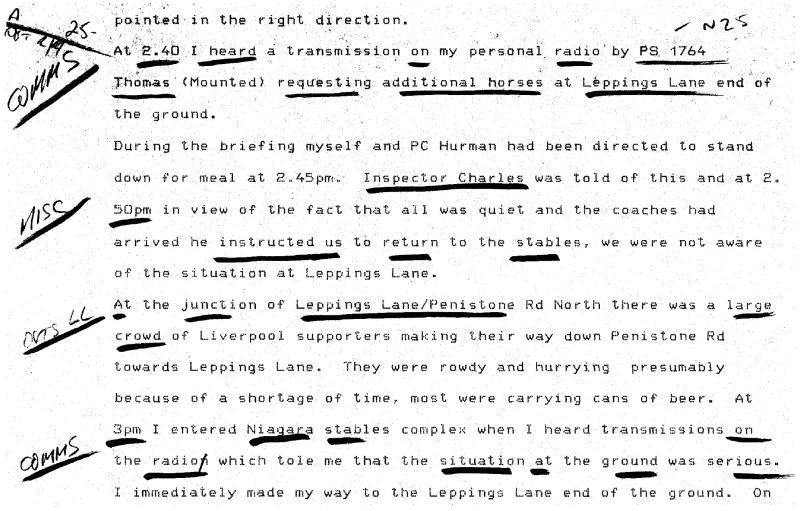
The typed versions were reviewed and marked up for indexing. This is a standard process in an MIR, where the readers mark points in the document that relate to key investigative themes or topics. The indexers then update the document record on HOLMES to show that it contains information relating to these themes. The database can then be searched thematically.
Image
Figure 9C: Indexing marks on an officer’s account (Source: SYP Archive)
A detective sergeant who was a member of the team under Ch Supt Wain stated to the IOPC that “Ch Supt Wain always read the documents first and then passed them to whoever the matter related to, depending on which area of concern the item related to. He read everything without exception.”
The detective sergeant also noted that from an early stage, the topics highlighted by the team in officer accounts typically related to “criticisms of senior management, loss of control, lack of communication and lack of leadership.”
While there is no documentary evidence of the briefing described by Insp Davis, there are detailed notes of several meetings of SYP officers in the days after the disaster.
At 9am on 16 April, around 20 officers who had a key role in the policing of the match and/or the immediate police response attended a meeting led by CC Wright.
CC Wright opened the meeting by setting out his aim: to get a clear understanding of the sequence of events. Building on the discussions he had the previous evening, including a debrief with Ch Supt Duckenfield and ACC Jackson, he stated: “I think I've got a good idea of it now”, but added that he wanted to confirm the details.
According to the notes, his first question was: “Did anything happen before 2.30pm that anybody sees as significant?” The meeting notes then show a consistent pattern throughout, of CC Wright setting out his understanding of the situation then asking others to confirm it.
For example, at one point CC Wright asked: “Have we got any evidence that there was a delay in traffic that resulted in the Liverpool fans' arrival at the ground being as late as it was?” The assumption here was that a majority of Liverpool supporters arrived late; evidence does not support this, as examined in chapter 4, with some supporters in the ground from an early stage and significant numbers around the Leppings Lane entrance by 2.15pm. Ch Supt Nesbit responded to CC Wright’s question to say that by 2.30pm, three major roads near the stadium—Penistone Road, Halifax Road and Langsett Road—”were completely sterile of football traffic.”
Although these were not necessarily the routes that Liverpool supporters would have taken, CC Wright concluded: “there is no evidence whatsoever of the delay in transit of the fans. The fans arrived at the ground vicinity early enough to go in the ground but instead went drinking.”
Some commentators have seen this meeting as a pivotal point in shaping SYP’s response to the disaster. However, on closer examination it seems that several of the issues discussed—and the provisional understanding that was reached—had little impact on SYP’s subsequent evidence gathering.
Similarly, the first CID briefing at 12 noon on 16 April ended up having little impact. D Supt McKay instructed his CID colleagues to prepare for “an enquiry the like of which we have never contemplated before.” He listed some key groups of witnesses that they would need to take statements from, including all the officers who had been at the ground. However, he stated clearly that this would not start that day.
Shortly after the briefing, a HOLMES database was set up for the enquiry and the first action raised on it at 1pm on 16 April. There were 25 actions raised in total on that first day. Most were in line with D Supt McKay’s administrative focus and included:
identifying officers who were on duty, via a forcewide questionnaire
compiling lists of names of stewards and turnstile operators on duty
collecting and preserving video evidence
However, IOPC investigators identified one item that stood out; a policy decision, reportedly made as early as 7.55pm on 15 April, that “All officers statements to be registered as officers reports”. This meant they would be given the HOLMES code R, rather than being coded as statements (S). This was unusual, because a specific decision was taken at this very early stage—before any actions had even been raised to collect evidence—about how to classify the evidence collected from officers.
During the briefing, D Supt McKay also instructed CID colleagues: “I would say to you all, anyone who was involved yesterday, after this briefing take time to sit down and make some notes. Is there anyone in this briefing who has made a pocket book brief? No one. Do not start making pocket book entries. Yesterday was the most traumatic experience of my life and large chunks of it I cannot remember. I am sure it must be the same for many of you.”
This has been taken as central evidence for those who have asserted there was a forcewide instruction to officers not to make pocket notebook entries as normal after the disaster. However, as the next section explores, there is conflicting evidence around this.
D Supt McKay then attended a meeting of senior officers on 17 April led by CC Wright, which appears to have had more of an influence on SYP’s approach.
This took place after WMP had been appointed to carry out—in the words of the press statement read out by ACC Anderson at 5pm on 16 April—”the gathering and assessment of evidence” regarding “The planning and the operational decisions of South Yorkshire Police officers” around the disaster.
This meeting covered similar ground to the one CC Wright had led the previous day, in terms of looking at the events leading up to the disaster and the police response. However, the tone of this meeting was markedly different. Instead of purely confirming a chronology of events as he had done the day before, at this second meeting CC Wright challenged the senior officers present to explain potential discrepancies and prepare for the kind of questions an independent investigator might ask. For example, he asked: “Why is it with the same crowd, the same factors, what happened this year to change it? [...] what is the unknown factor?” At one point, he commented: “There was a problem and what were we doing to address it – we seemed to be adding to it.”
Most notably, in terms of some of the evidence subsequently gathered and presented, there were a series of references to the police closing the central tunnel that led to Pens 3 and 4 of the West Terrace once those pens were full.
The notes show that relatively early in the meeting CC Wright asked those present: “Go back to the control inside the tunnel. Whose responsibility is it there to divert people – anybody?”
Ch Supt Duckenfield replied: “Inspector White with serials 14 and 15. Specific instructions on the Order at phase 2.”
The reference to phase 2 reflects the fact that the SYP F Division Operational Order—the main planning document for the police operation—divided the operation into three broad phases:
before kick-off (phase 1)
during the match (phase 2)
after the match (phase 3)
Ch Supt Duckenfield’s recollection was accurate: the Operational Order instructed that in phase 2 Serial 14 would “be located in the central tunnel to the Leppings Lane terraces to maintain order as required.” However, this meant the officers would only be employed to divert people away from the tunnel once the match had started.
Shortly after Ch Supt Duckenfield’s comment about the duties of Insp White, the meeting notes included the observation: “Top of the tunnel solid with horses – that procedure happened last year.”
CC Wright then asked: “Was there any element of that control put in the Order?” No response was recorded.
Later in the meeting, there was a discussion about how SYP had responded when the decision was made to open the exit gates to relieve the crush outside. Summing up the discussion, CC Wright observed: “the control of movement of people once they were going through gate C, there was no action taken on that. You were well aware there were contingencies to deal with the filled stand, i.e. the shutting off of the tunnel.”
This comment demonstrates CC Wright’s awareness of both a key failing in the police response on the day—that they did not control the crowd coming through Gate C—and of the fact that SYP had at least one established contingency that could have been used. Further, he clearly stated that at least some of the officers present at this meeting would have been “well aware” of such contingencies. There was no direct response or acknowledgement of this recorded in the meeting notes, but no one contradicted him or suggested such contingencies were not available to SYP on the day.
The last section of the meeting was dedicated specifically to the actions that SYP should take next. CC Wright asked how SYP should proceed. D Supt McKay took the lead in responding and proposed that officers who had been at the game should set down their recollections. CC Wright confirmed this action: “Very good point – all officers at the game to make records of their recollections.”
CC Wright concluded the meeting by stating: “The judicial review which is going to be announced today is going to review the evidence that is gathered and if we leave it to West Midlands to provide the evidence we might not get the broad scope of evidence flowing in. We have to be the authors of most of the information fed in. We have to be active and find the areas where the evidence can be found.” These concluding remarks about SYP being “authors” have been viewed by some commentators as an indication of an intent to control the evidence given to WMP.
Within 20 minutes of the match being abandoned, the senior SYP detective on duty at the stadium, D Supt McKay, telephoned the head of the CID, D Ch Supt Addis, to alert him to the situation. D Supt McKay stated that he agreed with D Ch Supt Addis that no police enquiries could commence that evening, and the priority was identifying those who had died in the disaster.
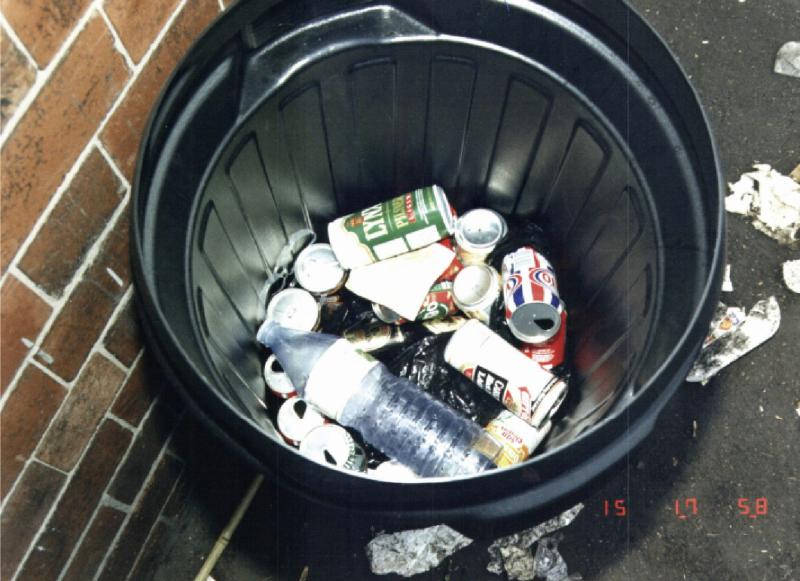
However, after the crowd had left the stadium, SYP Scenes of Crime photographers took pictures of litter at the Leppings Lane end of the stadium. These included pictures of the turnstile area and the contents of bins outside the stadium. Time stamps on the photos indicate that they were taken shortly before 6pm on the day of the disaster.
The most plausible explanation for this action was that SYP wanted to gather evidence of alcohol consumption among Liverpool supporters. However, the photos were of little or no evidential value for this purpose. The litter in the photographs included some empty beer cans, but a similar quantity of empty soft drink cans and other rubbish, so did not support the allegations about alcohol consumption.
Image
Figure 9A: Image of litter outside Hillsborough Stadium, 17.58 on 15 April 1989 (Source: SYP)
SYP secured no comparative evidence of litter from bins at the Nottingham Forest end, or from other games, to help assess whether there was an unusually high quantity of litter at the Leppings Lane end, or an unusually high proportion of alcohol containers within that litter.
The IOPC took statements from the photographer who had taken the pictures. He said that on the day he had been instructed on what to photograph by SYP officers. However, his accounts of who specifically had instructed him varied, and the IOPC has not been able to establish a source of the instruction.
In the first few days after the disaster, there were two other instances of SYP appearing to seek evidence about alcohol consumption.
At 5.17pm on 17 April, an action was raised on SYP’s HOLMES account to “Locate and identify all public houses open and used by fans during morning up to 3pm on date of incident”.
On 21 April, a report was logged on the SYP HOLMES database, which documented that SYP had telephoned pubs near the stadium to establish how many Liverpool supporters had visited, at what times and whether there was any trouble. The report recorded that none of the pubs contacted had experienced any trouble with Liverpool supporters. There was nothing in the report showing who had conducted the enquiries.
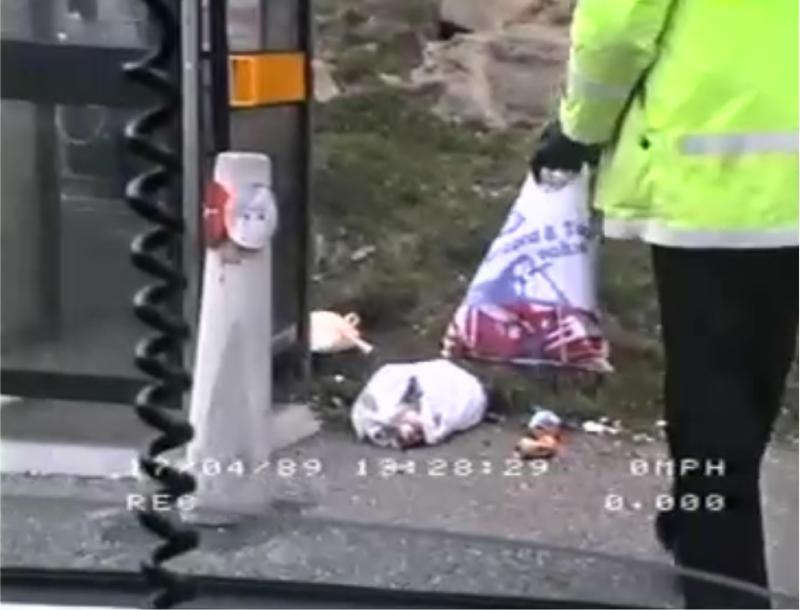
On 17 and 18 April, members of the SYP Traffic Division recorded video footage and took photos on two main routes to Sheffield from the west: the A628 Woodhead Pass and A57 Snake Pass. These were roads that some Liverpool supporters had used on the way to the game.
The IOPC examined three separate videos taken on these trips by the Traffic Division officers. Each shows officers retrieving empty beer cans and wine and spirit bottles from the roadside and then stating on camera that they had been discarded by Liverpool supporters.
Image
Figure 9B: Still image taken from SYP video, 17 April 1989, filmed on roads to Sheffield (Source: SYP)
It is not clear how this could be said with any certainty; there was no footage to show Liverpool supporters discarding litter. Further, there was no comparative evidence of how much litter had been present before the Semi-Final.
Two officers in the Traffic Division produced written accounts of this work on 12 May 1989. Both officers have given statements to the IOPC. One stated that he was instructed to take the footage in a briefing from an inspector on 17 April 1989. He was aware that there were rumours among officers that a large number of supporters had been drunk, and he felt then (and still does) that collecting the cans and video evidence of the litter was a reasonable line of enquiry. He stated he was surprised by the quantity of empty cans they found but acknowledged he had no idea whether this was usual for supporters travelling to a match.
The other officer recalled that they were both keen to get involved in the investigation into the disaster and the video evidence was collected because of a “general consensus at the time that drunken Liverpool fans had turned up in Sheffield and caused the disaster”. He was not certain whose idea it was to collect the video evidence but suggested to IOPC investigators that it may have come from him and his fellow PC; however, he added that he believed their inspector would have agreed to it. He acknowledged that they did not propose a similar process of collecting video evidence on the routes that the Nottingham Forest supporters would have taken; he also had no idea whether this was a normal level of litter for a major game.
The IOPC took a statement from the inspector. He could not recall asking his two officers to do this, nor could he recall the rationale for it or even seeing the output.
Supt Brougham was head of the Traffic Division. He did not recall any instruction being given to film the route and on being shown the footage by IOPC investigators, described it as “a load of rubbish”, adding: “it looks like a set up.” He also stated: “I think it would have been unlikely that the Constables would have filmed the route off their own back.”
The IOPC has found an action registered on the SYP HOLMES database in response to a message from the owner of a snack bar located in a lay-by on the A628 Woodhead Pass, who wished “to make a statement re the behaviour of the fans.”
Detective Sergeant Mick Oughton (DS Oughton) was instructed to speak to the snack bar owner. It was recorded that the snack bar owner had told the officers about “fans leaving beer cans etc in layby 20 miles from SWFC.” However, it does not appear that the officers took a statement from him.
When IOPC investigators took a statement from DS Oughton, they asked him about this action. He remembered the task but couldn’t remember any conversation with the snack bar owner.
This action is striking because it appears so similar to the accounts of Inspector Clive Davis of SYP (Insp Davis), who told the IOPC, the Goldring Inquests and the media that he attended a briefing on 17 April 1989, led by Chief Superintendent Terry Wain (Ch Supt Wain). According to Insp Davis, Ch Supt Wain had opened the meeting by telling the officers present—mostly from CID—that “we are going to put the blame for this disaster where it belongs on the drunken, ticketless Liverpool fans.” Insp Davis said Ch Supt Wain then specifically mentioned that officers were “going to drive down the M62 motorway and we are going to photograph the beer cans which were piled up by the M62.”
The IOPC investigated this and found no documentary evidence of any such meeting. No other officer has said they were there or in any way corroborated Insp Davis’s account of this meeting. Insp Davis named three people as being present. One was on leave that day; the others were Ch Supt Wain and Ch Insp Bettison.
Ch Insp Bettison has strongly rejected Insp Davis’s account and stated he began working as part of Ch Supt Wain’s team on 19 April.
Ch Supt Wain himself told IOPC investigators, and the Goldring Inquests, that he was not involved in any way in the SYP response until 24 April 1989. The IOPC has not found any documentary evidence to suggest he started any earlier than that date.
The IOPC investigated: The actions of police officers and those providing legal advice to police officers in relation to the collection of evidence, in particular:
a) the role of the teams led by Chief Superintendent Terry Wain and Chief Superintendent Donald Denton b) the direction given to officers not to complete notebooks or duty statements c) the process of obtaining handwritten accounts, and the way some of those accounts were subsequently amended, including:
i) the actions of officers who agreed to amend their accounts ii) the actions of any officer involved in asking them to do so
d) whether amended accounts were put forward on behalf of any police officer which they had not agreed and/or signed e) whether the amendments were made in an attempt to deflect blame from the police
What was found?
• Some of the earliest actions by SYP to collect evidence after the disaster involved taking photographs of the stadium and areas around it, including of rubbish bins at the Leppings Lane end on the day of the disaster. In the days that followed, other officers collected rubbish along major routes that Liverpool supporters may have taken to Sheffield. These actions appear to have been an attempt to gather evidence about alcohol consumption.
• After the disaster, SYP officers were asked to produce written accounts of their experiences on the day, on plain paper rather than the more familiar approach of producing statements which met Criminal Justice Act 1967 standards. One of these standards is that statements should be factual and should not include opinions (which are generally deemed inadmissible as evidence). When writing their accounts, officers were invited to include their “fears, feelings and observations” and specifically to comment on “the mood of the fans”.
• There is conflicting evidence about whether officers were instructed not to make entries in their pocket notebooks. While some recalled such an instruction, many more did not, and the IOPC found numerous pocket notebooks with entries related to the day.
• Some 327 officers’ accounts were amended before they were submitted to WMP and the Taylor Inquiry. This figure was more than 100 higher than previous reviews of the evidence had found. While some of the amendments were relatively minor, such as correcting spelling or other typographical errors, many resulted in several paragraphs being removed or rewritten.
• The primary justification given by SYP officers and the force’s supporting legal team for the review and amendment of officers’ accounts was to remove opinion or hearsay. While some of the material that was removed did amount to officers’ opinions, the IOPC’s analysis found that a lot of opinion was left in the accounts.
• The decision to review the accounts was made after SYP was asked to submit them to the Taylor Inquiry. SYP had originally asked its officers to provide their accounts as part of its internal investigation into what had happened, with the expectation that WMP would take statements from the officers. However, at a certain point, it was determined that WMP would not take statements from officers.
• Initially, accounts were reviewed by Mr Metcalf, a solicitor who was acting for SYP in 1989–90, who sent his suggested changes to senior police officers. SYP largely treated these suggestions as instructions and amended the accounts. Accounts received later on were reviewed by a team of SYP officers.
• Accounts were sometimes amended without the officers that had written them being told. Some of those who noticed changes that they were not comfortable with were pressured to accept the amended version. Only one officer has stated that he continually resisted that pressure and did not sign an amended version.
• There was a consistent pattern across all reviewers, including the officers as well as Mr Metcalf, of removing or rewording evidence that appeared to criticise senior officers or suggested there had been chaos or a lack of control. Most strikingly, every reference to SYP officers monitoring the crowd in the pens at previous games or taking action to close the tunnel which led to the centre pens once they were full, was removed from officers’ accounts. These were potentially key points of criticism of SYP’s operation on the day of the disaster.
Significant new evidence
The IOPC obtained a range of new evidence in relation to SYP’s collection of evidence. This included:
• three separate videos recorded by members of the SYP Traffic Division on 17 and 18 April 1989, in which they collected empty cans and bottles on main routes to Sheffield that Liverpool supporters could have taken
• more than 8,000 pocket notebooks from relevant periods, of which 359 were found to include entries related to the disaster
• a telex dated 17 April 1989 and marked from the Chief Constable for the “Information of Chief Superintendents”, which included instructions for officers who had been involved on the day of the disaster to “prepare a note in the form of an aide-memoire – not a statement – of their recollections of what occurred”
• attendance notes and other documentation held by Hammond Suddards, the firm of solicitors that represented SYP at this stage—this information had been disclosed to the HIP, but only at the very end of its work, so had not been assessed in depth
• statements from many of the officers whose accounts were amended, which covered, among other things, their awareness of the amendment process
As the force responsible for policing on the day of the disaster, SYP was also responsible for securing evidence in the immediate aftermath of the disaster. However, the evening after the disaster, SYP announced that the investigation of what happened would be taken over by WMP.
On 17 April 1989, the Government ordered a public inquiry into the disaster, led by Lord Justice Taylor. WMP was appointed to collect evidence for this. On 18 April, senior detectives from SYP—who had been overseeing the evidence collection until that point—met with senior officers from WMP. It was agreed at this meeting that “the limits of the South Yorkshire Police enquiry should be to the preservation of evidence and no further.” Within days, WMP had taken over the investigation and suspended all enquiries by SYP officers.
Despite this, SYP did continue to collect evidence, in part to assist in the compilation of a written submission from the force that was required by the Taylor Inquiry. This submission, known as a ‘proof of evidence’, is examined in more detail in chapter 10.
Evidence was collected in various forms, including through written accounts from SYP officers who had been on duty on 15 April. The HIP Report highlighted that these accounts had been produced in an unusual format—on plain paper, rather than as formal signed statements under Criminal Justice Act rules—and that some of them were amended before they were submitted to WMP and the Taylor Inquiry. While this was not the first time that the amendments had come to light (the issue had been discussed during the Scrutiny of new evidence led by Lord Justice Stuart-Smith in 1997), the HIP Report demonstrated that amendments were more frequent and potentially more significant than Lord Justice Stuart-Smith had identified.
The HIP Report also repeated an allegation that “in contrast to the professional training,” SYP officers were instructed not to write about their actions on the day of the disaster in their pocket notebooks. This referred to the fact that standard practice requires all police officers to make notes of key events in their day, such as when they arrest someone or gather any form of evidence. They can refer to their pocket notebook later to help them complete a statement or, in some cases, when giving evidence in court.
In its referral to the IOPC following the publication of the HIP Report in October 2012, SYP asked the IOPC to investigate the potential criminal offences of:
“pervert[ing] the course of justice by altering accounts/statements”, on the basis that “officers altered their accounts or statements to remove critical or contentious matters”
“pervert[ing] the course of justice by not making pocket book entries”, adding “officers were instructed to make handwritten accounts on blank sheets of paper and not pocket book entries”
The IOPC investigation into SYP’s evidence collection began by conducting an in-depth review of all SYP officers’ accounts, comparing the original accounts, the versions that had amendments marked on them, and the ‘final’ versions submitted to WMP and the Taylor Inquiry. The IOPC also confirmed that the amended versions were used for the Popper Inquests and included by WMP in the file of evidence it prepared for the DPP as part of its criminal investigation. IOPC intelligence analysts then examined the amendments for specific themes and patterns.
Investigators also sought to build a picture of how the SYP evidence-collection process—in particular the amendment process—had developed. This involved reviewing minutes of meetings, including internal meetings involving SYP officers only and meetings between SYP and Hammond Suddards, the firm of solicitors appointed to advise SYP on responding to the claims for damages (rather than SYP using its in-house legal team). Investigators also examined the extensive correspondence between the organisations, and the documentation gathered by the Stuart-Smith Scrutiny in relation to the amendment of accounts.
An initial assessment of the evidence indicated that junior officers had little or no control of the evidence collection or amendment process. Senior IOPC investigators therefore decided to focus the investigative effort on those who devised and managed the process. This included not only senior officers but also SYP’s legal advisers. Though the IOPC’s work is focused on the investigation of police conduct, it is permitted to investigate and evaluate the actions of third parties where these may help to explain the actions of police officers.
During its investigation, the IOPC has obtained three videos which may have been the ones shown to MPs.
In September 2012, staff from the Chief Constable’s office at West Yorkshire Police (WYP) sent the IOPC a video. The Chief Constable of WYP at the time was (former) Ch Insp Bettison. Having learned that the HIP Report had mentioned that he had shown a video to Parliament, he contacted the IOPC and said he would supply a copy of it. This video lasts for 25 minutes and includes a voice-over which is believed to be by Ch Insp Bettison.
In October 2013, an SYP employee at Moss Way Police Station in Sheffield found a video and a set of slides in an envelope addressed to Ch Insp Bettison. SYP alerted the IOPC, and the video was handed over to IOPC investigators a couple of days later. This video turned out to be an identical copy of the first video obtained.
The third video was handed to the IOPC by Ch Insp Bettison during an interview under caution on 11 March 2014. It was in a U-Matic format (a video cassette format used mostly by professional studios and broadcasters in the 1970s and 1980s). This video lasts for 31 minutes and includes a voice-over with a West Midlands accent. A former WMP officer, who worked in the WMP AV unit in 1989, has stated to the IOPC that some of the voice-over was his.
The two different versions of the video have been analysed in detail by the IOPC. The material covered by them both was broadly similar, starting with an overview of football-related disasters resulting in large numbers of deaths and showing some footage of football hooliganism. Both then provided a description of Hillsborough Stadium at the time, highlighting that some of the features of the ground, such as perimeter fences at the front of terraces, were introduced to prevent hooliganism. Both videos then progressed to footage from the day of the disaster, initially outside Leppings Lane, then showing the terraces, then showing the disaster and elements of the rescue effort, including scenes from the temporary mortuary.
While there were numerous similarities between the two videos, there were also some important differences. The video with a West Midlands accent was seven minutes longer. It included an extended section of continuous footage from the 1988 Semi-Final, as well as longer CCTV extracts.
In the video with a voice-over from Ch Insp Bettison, the commentary was far more detailed and included:
a reference to supporters forcing open a gate at around 2.40pm on the day of the disaster
several points of direct comparison of the crowd, and how well the police managed it, in 1988 compared to 1989
a brief reference to the Heysel Stadium disaster, which occurred in 1985
The voice-over by Ch Insp Bettison also emphasised the direct link between hooliganism and the installation of perimeter fences at all major stadia; later, when discussing the rescue effort, this voice-over referred to “narrow perimeter fence gates.” It could be argued that this is a veiled criticism of the stadium design, which was the responsibility of SWFC and, to a lesser extent, its contracted engineers, Eastwood & Partners.
In his evidence to the Goldring Inquests, Ch Insp Bettison stated that he had used three sources of material to compile the video:
material that had been shown to the Taylor Inquiry
some SYP footage from the 1988 Semi-Final
a police training video called ‘Planning for Disaster’
The IOPC has identified that this latter source was a 1986 Metropolitan Police video called ‘Plan for Disaster’ and has obtained a copy of it. The material about previous incidents at football grounds, including footage showing hooliganism and the reference to Heysel, is taken from ‘Plan for Disaster’. This footage appears at the start of both videos; in the longer version of the video, the Metropolitan Police voice-over is also retained.
There is no suggestion that at any time either version of the video was intended to be shown to the public.
The IOPC has not been able to confirm from any of those present which of the videos was shown to MPs, or which was shown at the meeting with Mr Shersby on 3 October 1989.
In the interview under caution on 11 March 2014, Ch Insp Bettison gave a prepared statement, in which he said the third video was the one he presented at the meeting with Mr Shersby and to MPs. In a later prepared statement to the IOPC, he further explained: “I can be sure of that because I recall that Mr. Shersby had to rent a U-Matic player from an AV company in Uxbridge because my tape had been recorded on such an unusual format.”
He also added in this later statement: “My own commentary was added to a later, edited, version of the original tape. This was requested of me by SYP Training School.”
Ch Insp Bettison was asked about the videos when giving evidence to the Goldring Inquests. There, he stated that he had shown the same version of the video at the meeting with Mr Shersby and in Parliament, and that “the video had no narration”. He reiterated under cross-examination that “there was no commentary from me at all”, then again said, more generally “there was no commentary.”
When asked by the barrister representing the Police Federation if that meant the video was silent, Ch Insp Bettison replied: “Please forgive me. There were elements of the video material that had been given to Lord Justice Taylor's inquiry that had a West Midlands Police officer's narrative over it. The first iteration of the video that was shown both to the Police Federation and to Members of Parliament had no additional commentary from me.”
Asked when he put his own commentary on, Ch Insp Bettison stated it was in late 1989 or early 1990, to create a training video for SYP match commanders, in line with a recommendation made by Lord Justice Taylor.
While neither the Taylor Interim Report nor the Taylor Final Report specifically recommends the production of a training video, both emphasised the need for police training. A video could logically and reasonably have been part of SYP’s approach to this.
The visit of Ch Insp Bettison to Parliament a few weeks later was facilitated by Mr Shersby and agreed through SYP senior officers.
In his first prepared statement to the IOPC, Ch Insp Bettison recalled that after the meeting of the Police Federation on 3 October 1989, Mr Shersby asked DCC Hayes “if the video and plans could be shown to an invited audience of fellow MPs in an informal setting he intended to host.” According to Ch Insp Bettison, DCC Hayes subsequently discussed this with CC Wright and then confirmed the visit should go ahead. Ch Insp Bettison stated that DCC Hayes “told me that he wanted me to reprise the presentation and to play it exactly as I had done at the in force meeting.”
He also stated that prior to the initial meeting with Mr Shersby, he had been asked by DCC Hayes “to produce a compilation video to try to convey the breadth and the complexity of the events of the day”. He added: “I did produce a video which included a factual account of the aspects of evidence that were presented to Lord Justice Taylor.”
When he gave evidence to the Goldring Inquests, DCC Hayes confirmed he was aware that Ch Insp Bettison had said he had produced the video on DCC Hayes’s instruction. DCC Hayes stated that he didn’t dispute it but had no clear recollection of it.
Around 40 MPs were invited, of whom 12 attended. Ch Insp Bettison showed the video and answered questions. In a memorandum to CC Wright after the presentation, Ch Insp Bettison commented that while the MPs had welcomed the input, he did not think any opinions had been changed.
The IOPC sought to contact the MPs for their recollections. Three had died and four had no specific recollection of the visit or the video; one was in ill health and gave a confused account. The other four all commented in different ways that they felt it was an attempt by the police to put across their side of the story; they also indicated they were not convinced by the video or the police stance.
If, as may be assumed from Ch Insp Bettison’s memo to CC Wright, this was indeed SYP’s intention, the evidence indicates that it failed.
Given the clear evidence of both the memo, and the fact that he authorised Ch Insp Bettison’s visit to Parliament, it seems implausible that CC Wright would not have been aware of the content of the video and the fact that its overall angle was an attempt to articulate the police side of the story. In assessing CC Wright’s actions in relation to the media and MPs, the IOPC was of the view that his agreement to the video being shown to MPs indicated he approved of its content and tone and amounted to his participation in efforts to minimise SYP’s culpability and to deflect blame. This was among the reasons for the IOPC reaching the opinion that CC Wright would have a case to answer for gross misconduct, as stated in paragraphs 7.120–7.124.
By contrast, there was considerable detail of the meeting with Mr Shersby, on 3 October 1989. Minutes show it was organised by the Police Federation and that, along with Federation representatives including PC Middup, several senior officers were there, including DCC Hayes.
From the start, it was made clear to attendees that the purpose of the meeting was “to draw out information that would be helpful to Michael Shersby when Parliament came to debate the Hillsborough disaster.”
Two months earlier, the Taylor Interim Report had been published. The report clearly rejected the views of police witnesses to the Taylor Inquiry that the behaviour of supporters—particularly in relation to allegations of large-scale drunkenness—was a contributory factor. Lord Justice Taylor wrote: “I am satisfied on the evidence, however, that the great majority were not drunk nor even the worse for drink.”
In early September 1989, Mr Shersby met Mr Hurd to discuss various policing matters. Notes of that meeting recorded that Mr Shersby “had heard that morale in South Yorkshire had taken a great knock as a result of Lord Justice Taylor's interim report”, and that he had been invited to visit SYP.
On 3 October, the Police Federation meeting began with a video presentation to Mr Shersby, led by Ch Insp Bettison. This was intended to provide some context about the disaster. According to meeting notes, the video lasted 29 minutes and included, among other things, a history of football disasters, the layout of the stadium and a comparison of the crowd in 1988 and 1989.
While it was being played, DCC Hayes and Ch Insp Bettison, among others, added further comments relating to previous games and pinpointed specific points in the footage. There were also discussions about the impact the disaster had had on officers and an acknowledgement that supporters had helped in the rescue effort.
However, the notes show that about halfway through the morning session, the tone of the discussions changed from concerns for officers to condemnation of supporters. For example, Ch Supt Mole said the behaviour of supporters in 1989 “was the worst seen”. As Ch Supt Mole had only arrived at the ground once the rescue effort was almost complete, this comment could not have been based on his own experience. Other officers strongly stated that the Taylor Interim Report had overlooked key aspects of police evidence about supporters’ behaviour.
Tony Judge was Publicity Director of the Police Federation nationally and Editor of Police, the Federation journal. He was also present at the meeting. At the end of the morning session, he was recorded as saying “evidence that was not given in the Taylor Report should come out”, and then that “we should plan with Michael Shersby the counter attack.”
In the afternoon, individual officers were invited to give their account of the disaster. These officers were, for the most part, not named in the meeting notes; instead, they were referred to as “Officer A”, etc. The majority of their accounts included references to supporters being drunk and aggressive or abusive. Officers identified in the notes as A and B reported extreme drunkenness; Officers C and E differentiated between what they called genuine supporters and “yobbos”. Officer G suggested that when supporters arrived at Sheffield train stations “at 10 or 11 am all you could smell was beer.”
Officers repeatedly stated that they could not understand why the Taylor Inquiry had rejected evidence about alcohol when they themselves had seen so much being consumed. Several officers specifically mentioned that they hoped Mr Shersby would use their account in parliamentary debates around the disaster.
This discussion was facilitated by Ch Insp Bettison, who began by drawing officers’ attention to some positive comments from the Taylor Report: “If you thought Lord Justice Taylor's Report was unfair – paragraph 253 of the Report: ‘Most Officers did all they could. Many supporters paid tribute’, paragraph 278 ‘Over many years the South Yorkshire Police have given excellent service to the public’, paragraph 279 ‘Aggravated by hostility to rescue victims’.”
He then added: “you have the opportunity to present more balance to the Report: fit those paragraphs much more in context.”
Through close comparison of what was said at the meeting with officers’ written accounts and transcripts of evidence, the IOPC was able to identify six of the officers who spoke at the meeting and asked them what they recalled of it. One was medically unfit to be interviewed, and two told the IOPC they had no recollection of the meeting. Two did recall it and said that they were invited to speak openly, so they did.
At the meeting, one of these officers said: “Before the crush I took a wheelchair through because there was no other way in. As we turned round to get out, the crush was so bad we could not move. We asked for horses to come across to stop them pushing. The horses were kicking people back to stop them pushing. Liverpool have been exonerated from this Inquiry because it would be the death of Liverpool Football Club.”
The IOPC has not found evidence of witnesses referring to being kicked by police horses, though one supporter complained to Operation Resolve that a particular police horse was not being adequately controlled. No mounted officer has stated that their horse kicked fans.
In his comments to the meeting, the other officer identified by the IOPC contrasted the behaviour of the supporters who had travelled to Sheffield by special train—who he described as “decent – no yobbos”—with the scene he saw at “the coach park where Liverpool supporters were being disgorged.” He said: “It was crowded outside supermarkets, urinating in streets. There were so many of them, it was ridiculous. The amount that came in the last 15 minutes was like a human tide. The camera was situated looking down Leppings Lane. But they came over the bridge too – no shots of them over bridge but there were just as many people coming over the bridge. They were carrying 4 packs, 6 packs, anything they could get hold of. There was a genuine reluctance to go into the ground.”
The IOPC compared the comments this officer made in the meeting with his initial written account made after the disaster and with his initial statement to the IOPC, where he described his experiences on the day. In neither of these did he refer to supporters urinating in the streets or carrying “4 packs, 6 packs, anything they could get hold of.” While he did say, in both his written account and his first statement to the IOPC, that supporters were drinking before the game and that some seemed reluctant to head into the ground, on both occasions he described the supporters he met as “good-humoured” and, in his written account, he said they were “well-behaved”.
The tone of his comments in the meeting with Mr Shersby—with terms like “a human tide”—therefore appears quite different to his initial account and to the statement he gave to the IOPC.
Three significant actions followed this meeting. The first was that, when Mr Shersby spoke during a debate in Parliament on the Football Supporters Bill on 30 October 1989, he said that “at the match at which the disaster occurred 3,500 individuals were determined to get into the ground at short notice. Unfortunately some of them had been drinking too much.”
The second was that on 8 November 1989, Ch Insp Bettison visited Parliament at the invitation of Mr Shersby, where he showed a group of MPs a video.
The third, also in November 1989, was the publication of an article in the Police Federation magazine that reported on the meeting. The article included several quotes from the meeting about drunken behaviour, though it did not include the names of the officers. It ended with the lines: “if the police version is indeed the unpalatable truth, the Hillsborough Inquiry's interim report has ignored a major cause for concern. If mass drunkenness is to be dismissed as a potential creator of future disaster, how can Taylor be said to have done his job?”
By the end of November 1989, the Sheffield Star and at least five national newspapers had published versions of the story.
Overall, the evidence examined does suggest that the meeting was set up to encourage Mr Shersby to speak up for the view of the police officers and particularly the Federation members, and that the prevailing view of the officers present was that the consumption of alcohol by supporters, and supporter behaviour, had contributed to the disaster. This view was not supported by other evidence.
Officers were entitled to share their views, and the Police Federation was entitled to arrange such a meeting. Nonetheless, the evidence indicates that some officers at the meeting exaggerated aspects of their accounts, in a bid to redress what they perceived as an imbalance in the Taylor Interim Report.
Mrs Thatcher travelled to Sheffield by helicopter on the morning of 6 April. The agenda for her visit included a briefing from SYP, then visits to the stadium and the hospitals to thank staff and speak to the injured and their families. She arrived in Sheffield at around 11.45am, accompanied by the then Home Secretary, Douglas Hurd, and left at around 4.45pm.
The HIP Report contains a suggestion that when briefing the Home Secretary and Prime Minister, SYP attempted to blame supporters for the tragedy. This suggestion appears to be based on two factors:
the HIP’s review of an early draft of the Home Secretary's statement to Parliament about the disaster
comments made by Sir Bernard Ingham, the Prime Minister’s Press Secretary, in the aftermath of the disaster
Any information given by senior SYP officers would be expected to form an important part of the Home Secretary and Prime Minister’s understanding of the disaster. The IOPC sought to investigate whether the briefing given by SYP to the Home Secretary and Prime Minister on the day after the tragedy contained any inaccurate or inappropriate information.
The early draft of the Home Secretary’s statement included the words: “The Chief Constable of South Yorkshire told us that shortly after the start of the match there was a surge of spectators on the Leppings Lane terrace which crushed many at the front against the safety barrier.” It also referred to the behaviour of Liverpool supporters outside the stadium, saying that police officers had needed to use “loudhailers to urge the crowd to be patient”; as the crowd increased, “some supporters started to climb the walls and turnstiles.” While the draft statement indicated that they did so to escape the crowd pressure outside the stadium, this could be read as a criticism of supporter behaviour.
In the final version of the Home Secretary’s statement, the reference to being given information by the Chief Constable was removed, and the description of a surge crushing spectators against the barrier was phrased as a factual explanation of what occurred. The comments about the use of loudhailers and supporters climbing walls were retained.
The IOPC has identified that there are strong similarities between the Home Office Statement and a written update sent from CC Wright’s office to the Home Office at 9.30am on 16 April 1989—before Mrs Thatcher’s arrival in Sheffield. This appears to have been an initial briefing to duty officials at the Home Office.
It is understandable that SYP provided an update to officials and that the Home Office used this as the basis for drafting a statement. The Home Office, in both its early and final versions, added more information; it also expressed sympathy for those affected and thanked those who helped in the rescue attempt. These details were not in SYP’s written update.
As Press Secretary to Mrs Thatcher, Sir Bernard accompanied her when she visited Sheffield the day after the disaster. On multiple occasions, he has stated that while there, the police told them that the disaster had been caused by the actions of “tanked-up” supporters. For example, in a letter sent in 1996 to a man whose friend had died in the disaster, Sir Bernard wrote: “I believe that there would have been no Hillsborough disaster if tanked-up yobs had not turned up in very large numbers to try to force their way into the ground. I visited Hillsborough the day after the disaster and I know what I learned then.”
In a 2014 statement to the IOPC, he said: “We were told that a huge crowd had assembled there late, some of whom I was told were ‘tanked up’.” He did not specify who told him this.
There are no minutes available of the briefing Mrs Thatcher received from officers. Several of those involved in the meeting with Mrs Thatcher had died before the IOPC investigation began, including CC Wright and Mrs Thatcher herself.
However, the evidence from others present offers a very different perspective to Sir Bernard’s. Mr Hurd stated to the IOPC: “There was no hint at the time of what became The Sun story ‘it was all the fault of the Liverpool fans.’ I didn’t know about it until I saw the story – I had never heard that story.” He added: “On the day of our visit I don’t think that I heard anything about how the fans behaved from anyone on the day of the disaster.”
Dominic Morris was the Private Secretary for Home Affairs at the time and also accompanied Mrs Thatcher throughout the visit. He told the IOPC he had no recollection of officers making any reference to alcohol or the behaviour of supporters.
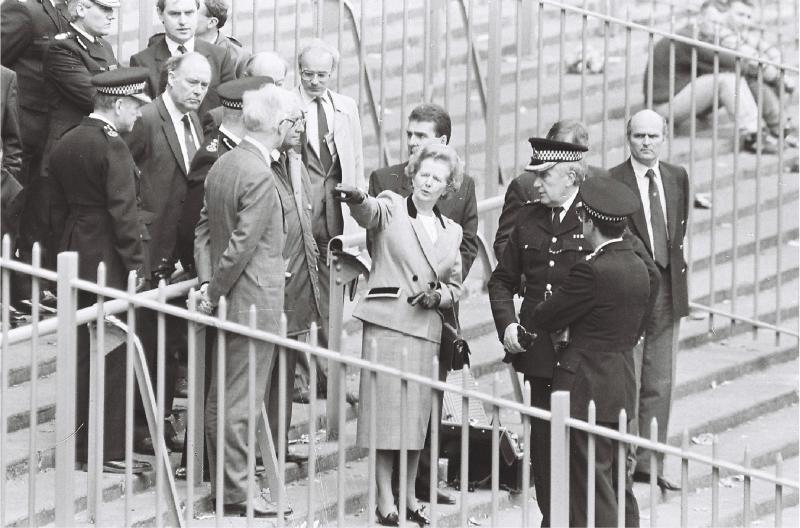
Photographs show Mrs Thatcher visiting the Leppings Lane terraces. Three uniformed senior officers can be seen with her, including Ch Supt Duckenfield (with back to camera) and Ch Supt Mole (next to Mrs Thatcher). CC Wright was known to be present and may be the obscured officer, standing to Mrs Thatcher's right.
Image
Figure 8A: Mrs Thatcher’s visit to the terraces, Sunday 16 April 1989 (Source: NewsCorp/The Times Group)
A number of journalists were also present during Mrs Thatcher’s visit, and some toured the ground with her. Investigators asked them for their recollections; none remembered any comments from the police about supporters. The IOPC also asked officers who were, or may have been, present if they could recall what had been said; none could.
All available AV footage has been scrutinised. IOPC investigators also examined a range of papers and diaries related to the period. These included:
Mrs Thatcher’s diaries
Lord Hurd’s diary, which he handed to investigators when interviewed
Sir Bernard Ingham’s papers, which are held by the Churchill Archive Centre in Cambridge as part of its Thatcher Archive
Despite these wide-ranging efforts, it has not been possible to confirm the details of the discussions between SYP and Mrs Thatcher and her advisers on the day after the disaster.
Under the term of reference covering SYP’s engagement with the media and MPs in the aftermath of the disaster, the IOPC investigated: The interactions of police officers with the press and politicians, in particular:
a) whether any police officer was involved in the passing of inappropriate or inaccurate information to a journalist, including whether any police officer was involved in passing written accounts to the press b) whether any police officers passed inappropriate or inaccurate information to any Member of Parliament—whether individually or at meetings. This will include investigation of the actions of Chief Inspector Norman Bettison in visiting Parliament and the evidence he presented, its content and subsequent use by others c) whether the briefing which was given to the Home Secretary and Prime Minister on the day after the disaster contained any inaccurate or inappropriate information d) whether the evidence demonstrates that such interactions were directed or encouraged by SYP
This chapter focuses on parts b and c. Some interactions with MPs, in relation to what they then said to the media were covered in chapter 7, along with issues under part a.
What was found?
• Despite wide-ranging enquiries, it has not been possible to establish what SYP officers told the then Prime Minister, Margaret Thatcher, when she visited Hillsborough Stadium the day after the disaster. Key witnesses have provided very different accounts of what was said.
• At a meeting with Michael Shersby MP, the then parliamentary advisor to the Police Federation, in October 1989, some officers described the behaviour of supporters in more critical terms than they had done in their original accounts. This was in the context of an attempt to address a perceived imbalance in the Taylor Interim Report, which some officers described as a whitewash.
• MPs who attended an SYP video presentation in Parliament about the disaster felt that the force was trying to present its side of the story. None felt it changed their understanding of events.
Significant new evidence
The IOPC obtained three versions of a similar video, all of which fulfil the description of the video shown at both the meeting with Mr Shersby and the presentation in Parliament. The videos were provided by different sources. The IOPC has analysed these; two are identical and the third is a few minutes longer and has a different voiceover. The IOPC has not been able to confirm which was shown on either occasion.
In addition, the IOPC has taken statements from several MPs and former civil servants who attended one or more of the meetings under investigation for this term of reference.
After the IOPC announced its investigation into the aftermath of the Hillsborough disaster, it received a number of complaints relating to police interaction with MPs. These came from supporters who had been at the game and survived the disaster, and from family members of those who died, and focused on three events.
The visit of the then Prime Minister, Mrs Thatcher, to Sheffield the day after the disaster, and what information officers gave her and her advisers during it.
A South Yorkshire Police Federation meeting on 3 October 1989, where numerous police officers told Mr Shersby that they had been prevented from giving evidence about supporter behaviour to the Taylor Inquiry. At the time, Mr Shersby was the parliamentary advisor to the Police Federation for England and Wales. At the meeting, these officers (who were not named in the meeting notes) recounted their experiences on the day of the disaster. Several expressly stated that they hoped Mr Shersby could use their accounts in parliamentary debates relating to the disaster.
A visit to Parliament by Chief Inspector Norman Bettison (Ch Insp Bettison) of SYP on 8 November 1989, where he gave a video presentation to 12 MPs about the disaster. Complaints referred to both the act of going to Parliament in this way, and the content of the video.
The three incidents above were all referred to in the HIP Report. The central allegation around them was that on each occasion, SYP officers were seeking to influence MPs’ understanding of the disaster and to draw attention to the behaviour of supporters.
The IOPC investigated each incident further, interviewing as many of those who were present as possible—including the police officers involved—to gather their recollections. In each case, investigators sought first to establish what information officers gave to MPs, as a step to assessing whether this was inappropriate or inaccurate.
Ten current or former MPs provided statements; a further four responded to the IOPC by email or telephone to state they had no recollection of the specific incident. In addition, the IOPC contacted and, where appropriate, took statements from civil servants and MPs’ staff who were identified as potentially having relevant information regarding this strand of the investigation. These included press officers and advisers to Mrs Thatcher.