Exit gates, as the name suggests, are primarily used as a means of exit from the stadium at the end of the game or in the event of an emergency. They are wide gates designed to allow people to go through unimpeded (in contrast to turnstiles at the entrance, which control access to the ground). They are not normally used to allow people into the ground.
As shown in figure 4A, there were three exit gates at the Leppings Lane end.
Gate A was closest to the turnstiles allocated to supporters with tickets to the North Stand.
Gate B was the middle gate of three exit gates at the Leppings Lane end of the ground. It was to the left of the area that gave access to turnstiles A to G. This exit gate was used to allow supporters from the West Terrace and the West Stand to exit the stadium.
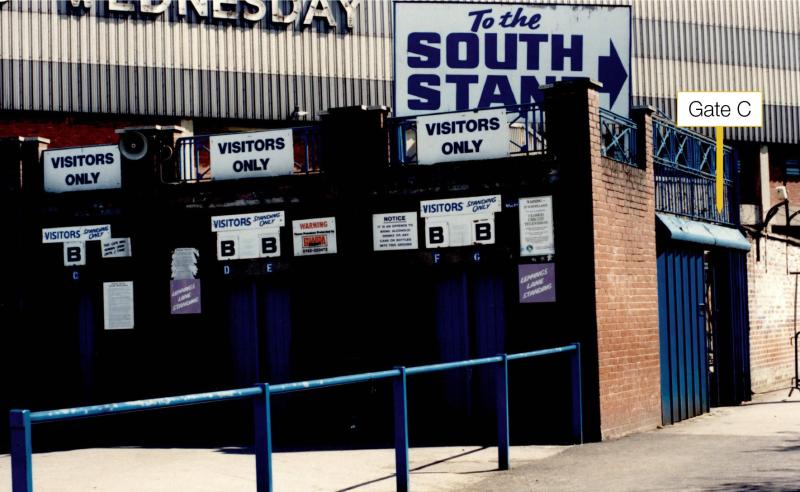
Gate C was at the far southern end, close to the river. It opened onto the service road at the side of the stadium and was slightly hidden from view behind the turnstiles allocated for supporters with standing tickets (see figure 4I).
Image
Figure 4I: Photo of Gate C and surrounding area at the Leppings Lane end (Source: Provided by Yorkshire Ambulance Service, Sheffield Archives)
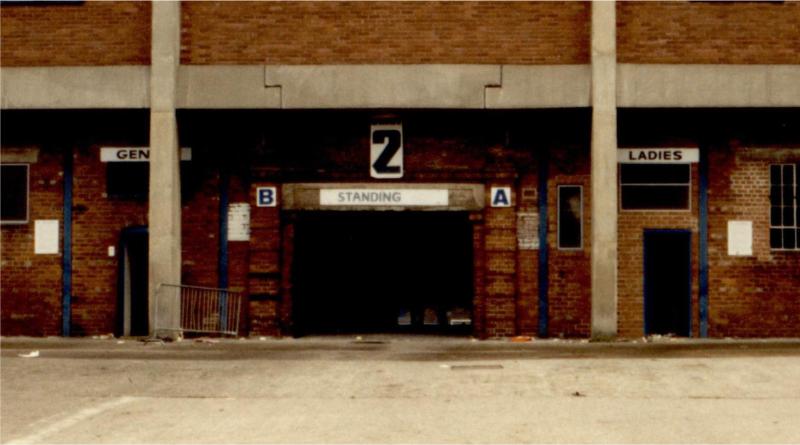
From the earliest stages after the disaster, the opening of Gate C was identified as a pivotal moment. When it was opened, large numbers of supporters came through it at the same time, in an uncontrolled flow. Evidence shows that the majority headed towards the central tunnel, which was the most obvious route to the terraces. The word above it reads “STANDING”. The only other sign to an alternative route to the terraces was not readily visible.
Image
Figure 4J: Photo of the inner concourse of the Leppings Lane end, as viewed from Gate C, in 1989 (Source: WMP)
The central tunnel led directly into Pens 3 and 4 of the West Terrace, which is where the fatal crushing occurred, following the arrival of a large number of people into those pens at the same time. These pens were already full, or near full, but no action was taken to stop more supporters going into them. In the Taylor Interim Report, the fact that no action was taken to cut off access to the centre pens following the opening of Gate C was described as “a blunder of the first magnitude”.
Since the disaster, it has been established that there were three different openings of Gate C which led to supporters coming into the ground. Gates A and B were also opened to allow supporters in. Each of these openings is considered in the following sections.
Having decided not to delay the kick-off, Ch Supt Duckenfield did not then consider whether there were other tactics that could be used to alleviate the situation at the turnstiles. Evidence from supporters and police officers suggests that in the period immediately after 2.30pm, the crowd outside the Leppings Lane entrance began to increase rapidly.
Supporters’ accounts of this period describe being unable to move freely and being crushed against walls and turnstiles. Many have stated it was the worst crowd situation they had ever experienced, with some feeling faint or unable to breathe, and others recalling people screaming in pain. They also commented on police officers in the crowd, including mounted police officers, becoming overwhelmed.
Officers closed the outer perimeter gates, to reduce some of the pressure on the bottleneck at the turnstiles. However, the pressure outside was so intense that one of the gates sprung back open a couple of minutes later. It was later established that the bottom bolt holding it closed had buckled. Several mounted officers have described how their horses were being lifted off the ground by the sheer pressure of the crowd.
Chief Inspector Robert Creaser (Ch Insp Creaser) was one of the most experienced officers on duty outside the stadium at the Leppings Lane end. In his original account, he recalled that at about 2.30pm he could see that difficulties were being experienced at the turnstiles and commented that the build-up of supporters was later and larger than was usually the case.
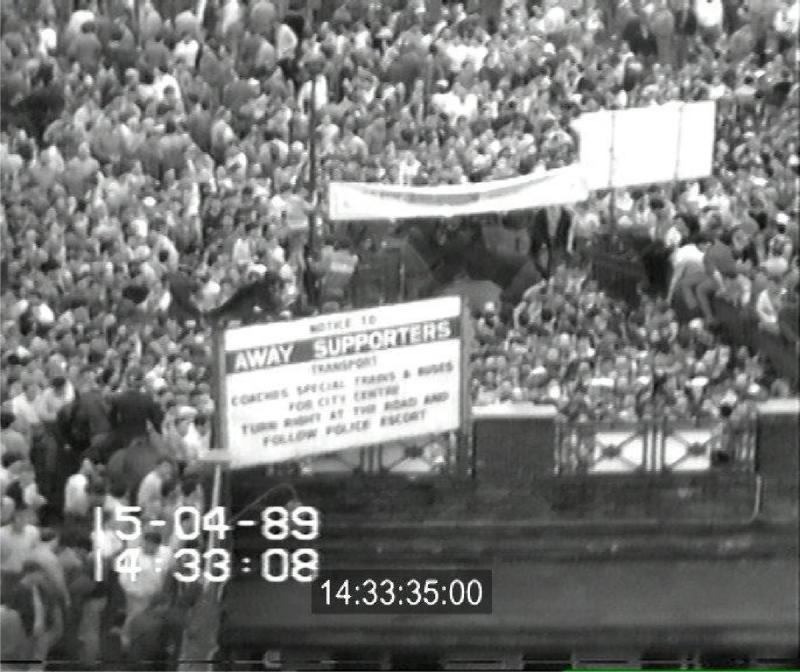
Figure 4F, taken from CCTV footage at 14:33:35, demonstrates the density of the crowd outside the Leppings Lane turnstiles at this time.
Image
Figure 4F: View of the crowd build-up outside the Leppings Lane entrance, 14:33:35 (Source: SYP CCTV)
With increased pressure on the turnstiles, some supporters climbed onto the walls and over the turnstiles to escape the crush. Turnstile operators recalled the state of supporters as they finally entered the ground, with many distressed, red-faced and out of breath. Another turnstile operator said that after 2.30pm, the crush was so intense that “some supporters were unable to take tickets from their pockets.”
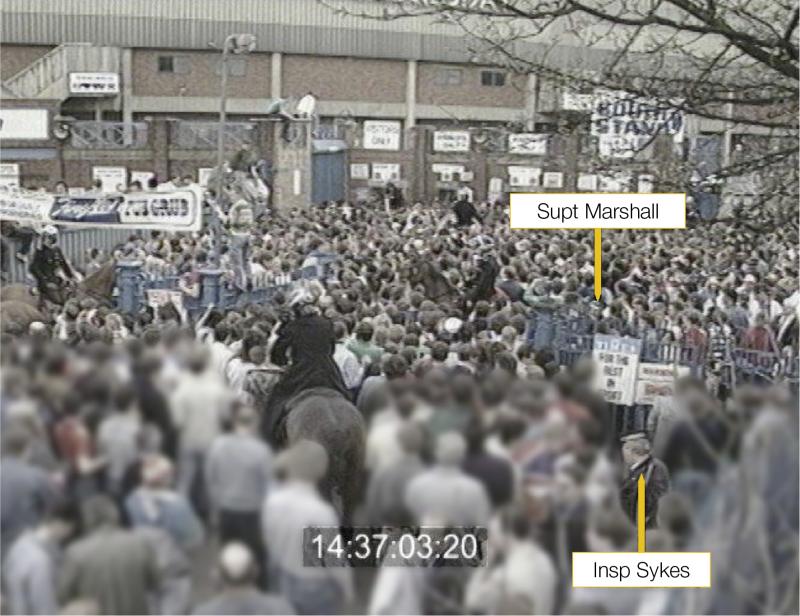
Figure 4G shows the situation at 14:37:03 from the opposite angle, looking towards the stadium from Leppings Lane. Supt Marshall has been identified between the turnstiles and the outer perimeter gates, surrounded by supporters. Police horses can be seen between the outer perimeter gates and the turnstiles, also surrounded by the crowd. Some supporters can be seen on the walls above the turnstiles.
Image
Figure 4G: The crowd outside the Leppings Lane turnstiles at 14:37:03 (Source: BBC)
Inspector Robert Purdy (Insp Purdy) was part of sector 1, officially under Supt Greenwood. He was on duty on the outer concourse, by the turnstiles. In evidence to the Taylor Inquiry, he explained that around this time he felt the officers outside the turnstiles were no longer effective because they themselves were in danger, so he decided to redeploy them.
Other officers described their efforts to try to help particular individuals out of the crush, unable to control the crowd as a whole. Many mentioned supporters pleading with them to do something to relieve the crush.
Supt Marshall told the Taylor Inquiry that the situation was worsening by the minute with more supporters arriving. He had attempted to get a better vantage point away from the crush, by heading to a bridge outside the stadium, but from there he saw what he described as “A vast and progressively more unruly crowd” that officers were struggling to control.
Insp Purdy was also seeking a better vantage point by standing on the funnel bar, a railing that separated the turnstiles from the service road. He had initially attempted to direct supporters from there, but at 14:39:41 was handed an injured child from the crowd.
In a statement to Operation Resolve, he recalled: “I thought at first he was dead. He was limp in my hands.” However, the child was taken by another officer to a first aid point and recovered.
By the point at which the injured child had to be lifted out of the crowd, it should have been apparent to officers outside the ground that this was now a very serious crush, and that urgent action was required.
At around this time, Insp Purdy had a conversation with D Supt McKay, who was close by; D Supt McKay suggested that the gates would have to be opened.
Officers on the inner concourse were equally concerned. In a statement made in 2013, Inspector John Bennett (Insp Bennett) recalled sending a radio request for more officers to be deployed to the Leppings Lane end of the ground, based on both his own observations and the comments of supporters entering through turnstiles A–G that someone could be killed. He did not recall receiving an acknowledgement.
The PCB had received an earlier request for additional officers to be sent to the Leppings Lane end. In response, PS Goddard had radioed a Mounted Section sergeant to deploy all available mounted officers to the area, and Supt Murray also deployed reserve Serial 20 from the gymnasium. Insp Bennett said this serial arrived close to him at Gate A shortly after his request. Gate A was an exit gate closest to the North Stand. A few minutes later, another serial joined them there.
At about this time, Supt Marshall attempted to contact the PCB by radio to request that an announcement be made over the Tannoy system to urge supporters to queue in an orderly fashion. He also asked for Police Constable Michael Buxton (PC Buxton), who was driving a Land Rover equipped with a public address system, to make his way to Leppings Lane.
Though there was no reply from the PCB, PC Buxton himself confirmed by radio that he was on his way. He arrived a few minutes later. However, he could not be heard over the noise of the crowd. Believing that his messages were not getting through to the PCB, Supt Marshall radioed the Force Control Room at SYP HQ, to ask officers there to contact the PCB regarding a Tannoy announcement. This was one of several examples Operation Resolve has identified where problems with radio communications appear to have hampered the police response. More generally, officers have commented on the fact that radio communications were inaudible, or unclear; many simply did not have access to a radio.
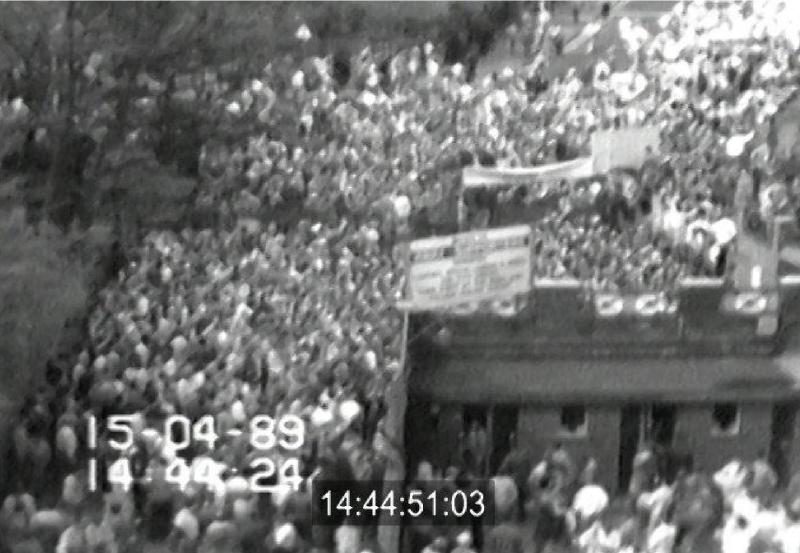
By this stage, the crowds on Leppings Lane had extended beyond the funnel bar and were between the outer perimeter gates and Gate C. Figure 4H, taken from SYP CCTV footage, shows the situation at 14:44:51.
Image
Figure 4H: The crowd outside the Leppings Lane entrance, 14:44:51 (Source: SYP CCTV)
At 2.47pm, Supt Marshall radioed the PCB again. This time, he requested that the exit gates at the Leppings Lane end should be opened, to allow supporters to escape the crush outside.
He did this after speaking to Insp Purdy near the outer perimeter gates. Insp Purdy commented that because he was unable to contact Supt Marshall, he had to force his way through the crowd to speak to him. Though this was a distance of only approximately 30 yards, Insp Purdy said it took minutes, rather than seconds to reach him.
In his 1989 account, Supt Marshall said that once he arrived at the outer perimeter gates, “Inspector Purdy told me that people at the front of the crowd by turnstiles A-G were being crushed and asked me to open gates.” Supt Marshall further explained: “He was not specific as to which gates he thought should be opened but his anxiety was apparent.”
Supt Marshall said he was reluctant to do so, as it would result in uncontrolled access to the stadium. However, because an officer with the experience of Insp Purdy seemed extremely concerned about the situation, he agreed to ask the PCB to authorise the opening of the gates.
Again, there was no acknowledgement, so he borrowed a radio of a different type from another officer and tried to send the message a second time. Still there was no acknowledgement. He made a third attempt, suggesting that if the gates weren’t opened, people would be killed.
Supt Marshall has repeatedly stated that he requested the PCB’s authority before opening the gates, and various officers have said that they heard his increasingly frantic radio requests.
However, Insp Purdy has consistently recalled that Supt Marshall gave him the authority to open the gates when they spoke. Specifically, he believed he had authority to open Gate C.
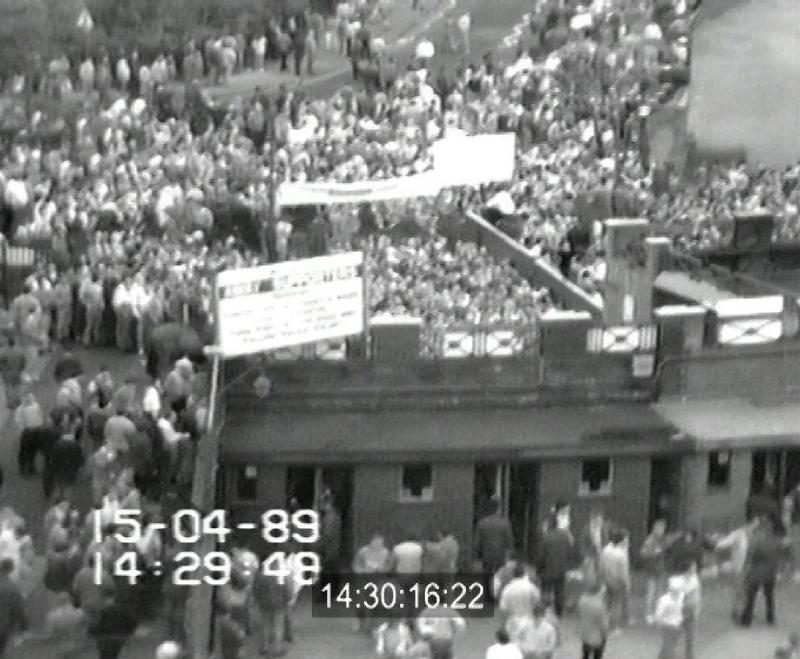
By 2.30pm, the contrast in fullness between the Spion Kop and Leppings Lane ends was increasingly pronounced. The screens in the PCB showed a large crowd outside the Leppings Lane entrance, with supporters tightly packed in front of the turnstile block.
Police Constable Trevor Bichard (PC Bichard), the officer responsible for monitoring the CCTV cameras in the PCB, estimated that there were over 3,000 supporters waiting to get in. Police Sergeant Michael Goddard (PS Goddard), who operated the personal radio network in the PCB, recalled PC Bichard making a comment about the size of the crowd, and so he looked at the screens. He told Operation Resolve he estimated that there were about 3,000 to 4,000 supporters there and commented: “Only once before have I seen such numbers and that was when Sheffield Wednesday played Coventry City in an FA Cup 6th Round match in 1987 when the Coventry fans came to Sheffield in their thousands.”
Operation Resolve has established that some supporters at that game experienced severe crushing.
Image
Figure 4E: View of the Leppings Lane entrance from the West Stand, 14:30:16 (Source: SYP CCTV)
At around 2.30pm, Ch Supt Duckenfield and Supt Murray discussed whether to delay the kick-off, so supporters could get in safely. In advance, they had agreed on a very small set of reasons which would necessitate delaying the kick-off. These essentially amounted to the late arrival of a large number of supporters due to circumstances beyond their control, such as poor weather or a major traffic problem en route.
They had received no information about any such delays, and Supt Murray assured Ch Supt Duckenfield that there should be sufficient time to get the waiting supporters into the ground by the scheduled kick-off time. They agreed that the kick-off should not be delayed.
In agreeing this, neither suggested consulting with other officers, such as Supt Greenwood inside the stadium or Supt Marshall outside, nor did they check the turnstile count data, which could have given them more information about how many supporters were still to arrive. Instead, they relied on their own visual assessment of how full the Leppings Lane end was.
Yet even this basic visual assessment should have been a cause for concern. Officers in the PCB have indicated that at 2.30pm they thought the North Stand was only about half full. Given its official safe capacity was 9,702, this would indicate that just under 5,000 supporters were still to enter. There were ten turnstiles available for the North Stand, so to fill it by 3pm, each of those turnstiles would have to admit more than 450 supporters over the next half hour. As detailed in chapter 2, the Green Guide advised that the maximum number of supporters that could enter through a single turnstile each hour was unlikely to exceed 750—so 375 per half hour. Later analysis by the HSE concluded that, based on the number of people in the stadium at 2.30pm, it would have taken until around 3.40pm for all supporters to have entered safely through the turnstiles.
Subsequently, it was also established that there had been various traffic problems affecting several of the routes Liverpool supporters would have used if travelling from Merseyside. This information was not shared with officers in the PCB.
The D Division Operational Order contained an instruction that the Force Control Room at SYP HQ was to be informed of any traffic issues. However, Operation Resolve’s review of the Operational Orders showed that there was no instruction in any of them for officers engaged on the road traffic operation or in the Force Control Room to inform the PCB of problems with the routes into Sheffield.
There were also no plans in place to liaise with neighbouring forces, to understand if there were issues in their areas that could affect the arrival of supporters into Sheffield. Major delays were reported in Greater Manchester and Derbyshire; it appears the SYP Force Control Room was not made aware of these, nor did it check. Certainly, no information about these was passed to the PCB, but neither did anyone in the PCB ask whether there were any problems on the roads.
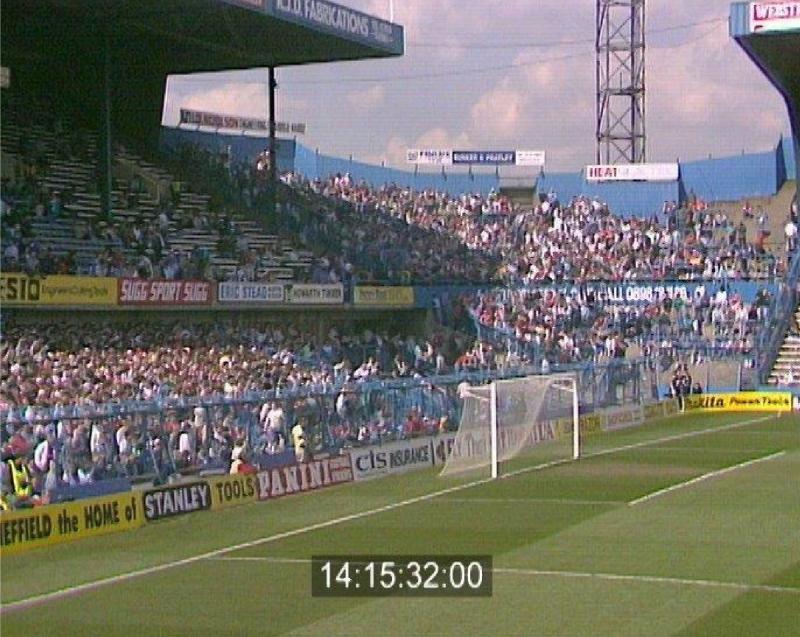
By about 2.15pm, officers in the PCB were discussing the disparity between how full the areas allocated to Nottingham Forest supporters were, and the comparative emptiness of the areas allocated to Liverpool supporters. This can be seen in figure 4C, which offered a similar view to that which would have been available through the PCB window.
Image
Figure 4C: View of the West Stand, West Terrace and North West Terrace, 14:15:32 (Source: BBC)
While the centre pens of the West Terrace (shown in the foreground) appear quite full, the pen beyond the goal is comparatively empty, as is the West Stand above. A lot of space is also visible in the North West Terrace in the corner of the stadium.
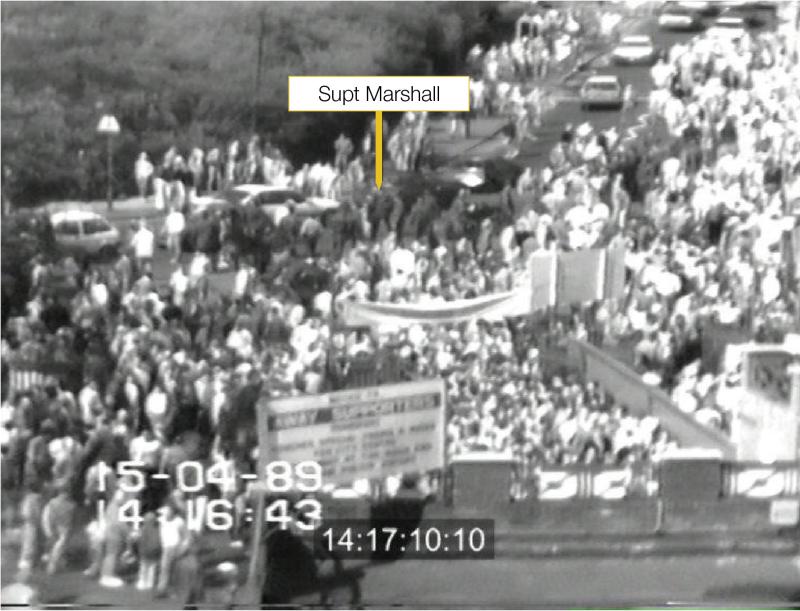
By this time, the crowd outside was building, as can be clearly seen in the CCTV image at figure 4D, from 14:17:10.
Image
Figure 4D: View of the area outside the outer perimeter gates, as seen from the West Stand, 14:17:10 (Source: SYP CCTV)
Various factors had contributed to this build-up, including the arrival of a special train at Wadsley Bridge station just after 2pm, from which mounted police escorted between 350 and 500 supporters to the stadium. Photographs of the supporters being escorted from the train show them walking calmly and there are no signs of supporters with alcohol.
In addition, at 2.10pm, PS Miller decided to close the Horse and Jockey pub and direct supporters towards the stadium. He suggested there were about 400 supporters there and alerted the PCB to his actions. As with the supporters on the special train, there were no reports of anyone causing problems.
Together with supporters arriving from other locations, this meant that up to 1,000 more people converged on the entrance area at around the same time.
Accounts vary as to what the situation was like at the turnstiles around this time. Some officers and spectators have said that up to 2.15pm, there were neat queues, with supporters laughing and joking. Others recall that from 2pm there was some pushing and shoving at the turnstiles; one supporter said that when he arrived at 2.10pm “There was just a sea of people at the turnstiles” and another commented that by 2.15pm there were no distinct queues and police officers could no longer organise the crowd.
In his 1989 account, Detective Superintendent Graham McKay (D Supt McKay), who was the senior detective on duty at the stadium at that stage, recalled that at about 2.15pm, he went to the service road to the side of the Leppings Lane turnstiles. He saw that officers were having great difficulty controlling the crowd and it was apparent that the turnstiles were not coping efficiently with the increasing number of supporters.
Supt Marshall was outside the stadium, on Leppings Lane. In an account from 1989, he said that by 2.15pm, Leppings Lane was full of supporters moving in both directions. He estimated there were between 6,000 and 8,000 supporters in the area. He said they were spilling off the footpaths onto the road and disrupting traffic flow. At 2.17pm, he radioed the PCB asking for Leppings Lane to be closed to traffic. A serial of officers was deployed to do this at one end, but the PCB was unable to contact the serial at the other end of the street. The road was not closed immediately and at about 2.22pm, Supt Marshall sent a further message reporting that there was still traffic coming along the road and asking again for it to be closed.
Both Ch Supt Duckenfield and Supt Murray commented in their 1989 accounts that, having seen the CCTV footage, they did not think closing the road looked necessary.
In describing the situation at around 2.20pm, the accounts of supporters are largely consistent. With just a few exceptions, they paint a picture of no discernible queues and a mass of people at the entrance. Those closer to the turnstiles referred to pressure building from behind and being unable to turn around or get out of the crowd. This pressure then increased further.
In their original statements, and again in statements to Operation Resolve, some supporters compared the situation at the 1989 Semi-Final with their experiences the previous year, where they recalled that the police operation seemed more organised, with officers checking whether supporters had tickets before they got close to the entrance area. There had been no such crowd pressure at that game.
Up to at least 1pm, the number of supporters in the vicinity of the stadium was quite small, despite advance efforts by SYP to encourage people to enter the ground early. These included messages in match programmes at preceding home games of both teams and a promise of pre-match entertainment in the stadium (which did not take place).
The first cars and minibuses carrying Liverpool supporters began to arrive shortly after 11am, and the first coaches arrived in designated coach parks at around 11.45am.
After the disaster, a persistent theme in police officers’ accounts was that supporters travelled to Sheffield early and then went to pubs or bought alcohol from shops. Evidence from a range of sources strongly indicates that there was nothing out of the ordinary about this. The licensee of a pub a short distance from the stadium—The Horse and Jockey—confirmed he was expecting to be busy with football supporters.
The likelihood of supporters drinking featured in numerous police briefings and instructions. For example, Serial 48 under Police Sergeant Derek Miller (PS Miller) had instructions to pay particular attention to licensed premises in the Wadsley and Middlewood areas. In a statement to Operation Resolve, PS Miller confirmed that they started patrol at 11.30am and visited several pubs which were busy with Liverpool supporters. He described them as being in “high spirits” but presenting no problems.
Though there were instructions to “pay attention”, there was no direction within the Operational Order about how to deal with supporters drinking: a clear oversight given its likelihood.
Some 52 coaches of Liverpool supporters arrived between 12.30pm and 1.45pm. Some of those who travelled by coach went directly to the stadium; others felt it was too early, so chose to go for a drink. As the available pubs were mostly full, some bought drinks from shops instead.
Image
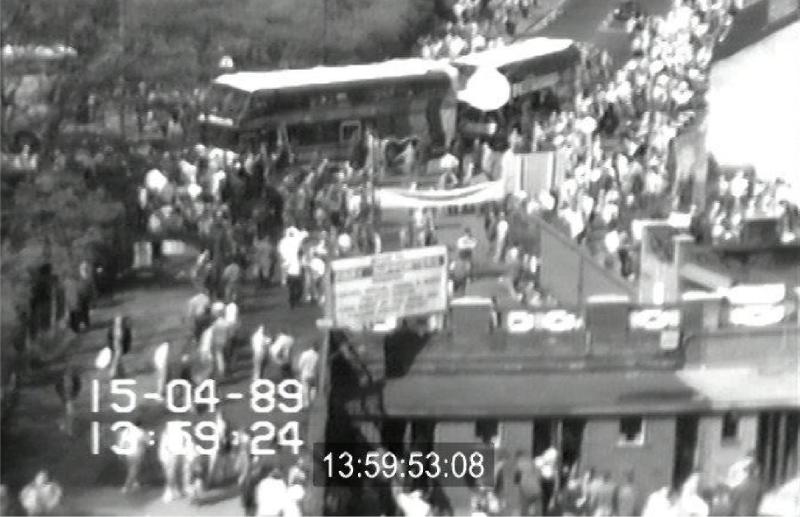
Figure 4B: View of Leppings Lane and the entrance at 13:59:53 (Source: SYP CCTV)
From around 1pm, the numbers of supporters at the ground steadily increased. Figure 4B shows the scene at the Leppings Lane entrance at 13:59:53. It is taken from SYP CCTV footage, which would have been visible to those in the PCB.
While the situation at the entrance presented no issues, various witnesses have commented on how empty some of the areas of the stadium allocated to Liverpool supporters were at this time. Inspector Peter Darling (Insp Darling), on duty in the South Stand, visited the SWFC control room around this time. He told the Taylor Inquiry that someone in the control room had noted there were only 12,000 people inside the ground at that stage, compared to 20,000 at the same time at the previous year’s Semi-Final. This information would have been based on turnstile count data, which was displayed on a screen in the control room. However, Insp Darling did not mention this to the PCB and there is no evidence to indicate that anyone in the PCB actively requested this potentially invaluable data.
Some officers have since acknowledged that, if they had known how few supporters were in the stadium at 2pm, they would have been concerned.
The turnstiles were scheduled to open at midday ahead of the 3pm kick-off. Officers on duty at or around the stadium attended a 10am briefing in the North Stand, led by Ch Supt Duckenfield. He used exactly the same briefing notes as he had for his briefing of senior officers the previous day.
The evidence of officers present suggests there was nothing particularly remarkable about Ch Supt Duckenfield’s briefing. Following it, there was a series of sector and serial briefings, with more detailed instructions about the duties of individual officers. The majority of these were as officers expected, but a small number of discussions appear to have been significant.
Supt Greenwood, as ground commander inside the stadium, briefed officers on duty at the Spion Kop (the terrace allocated to Nottingham Forest supporters) about how they should deal with any Liverpool supporters that had bought tickets for that area. He instructed officers that any Liverpool supporters there should remain in a segregated area on the Spion Kop and not be transferred to the Leppings Lane end of the ground. This instruction was different from what was set out in the F Division Operational Order, in which officers were told to transfer Liverpool supporters found in the wrong area to their own designated area. Supt Greenwood did not want to do this, because he was concerned that it could result in overcrowding on the West Terrace, as had occurred at the 1981 Semi-Final.
Despite this concern and other instances of overcrowding on the West Terrace, no officer appears to have given, or received, a direct instruction during a briefing to monitor capacity in the pens there. As no instructions to this effect were included in the F Division Operational Order either, no officers anywhere in the stadium were told that they had a responsibility for monitoring the pens. Ch Supt Duckenfield and other senior officers have all stated in evidence that they understood officers in certain areas of the ground had that responsibility.
There were separate briefings for D Division, who had commenced duty earlier in the city centre, and for the Dog and Mounted Sections, both of which were briefed at the Niagara Sports and Social Club, where they were based, a short distance from the stadium.
Ch Supt Duckenfield arrived at the Niagara Club before the Mounted Section had left, at around 11.30am. He spoke briefly to the mounted officers to wish them well.
This is one of few clear details about how Ch Supt Duckenfield spent the time between the end of the 10am briefing and his arrival in the PCB at around 1.50pm. Ch Supt Duckenfield’s own accounts are vague on what he did in this period. Operation Resolve has used multiple sources of information to re-examine this issue, drawing together the accounts of different officers, witnesses at different venues and locations, and some AV material.
Some evidence indicates that Ch Supt Duckenfield toured the area in a police car with Insp Sewell and then went around the stadium—though there are few witnesses to this latter part. It appears they then went for lunch in the gymnasium at around 1.30pm.
Partly because his accounts are so vague, questions have been asked about what Ch Supt Duckenfield did during this period, and it has been alleged that he could have drunk alcohol during this time. Operation Resolve has found no evidence to indicate he (or any other officer on duty at the match) did so.
Nonetheless, the evidence gathered by Operation Resolve demonstrates that Ch Supt Duckenfield’s activities and movements in this period lacked the focus and purpose that would be expected of a match commander. He did not use the time after the pre-match briefing to familiarise himself with the important areas of the stadium, to talk to officers on duty in different areas about their knowledge of previous issues and risks, or to gather their observations on the arrival of supporters.
Ch Supt Duckenfield subsequently acknowledged that he was not sufficiently aware of the structures of the stadium or the facilities available to him to be able to understand how to manage any foreseeable events.
This chapter includes witness accounts, images and descriptions of scenes that may be distressing.
What was investigated?
Under the terms of reference for the managed investigation, Operation Resolve investigated: Actions of the police on 15 April 1989 prior to the disaster, including:
a) actions of police officers outside the football ground—including the alleged failure by the police to prevent supporters entering the Leppings Lane end, failure to prevent build-up of supporters outside the Leppings Lane turnstiles and filter supporters away from those turnstiles b) the decision not to postpone the kick-off of the match c) the monitoring of crowd numbers in the pens—both the alleged failure to prevent the pens from becoming overcrowded and the alleged failure to act once the pens became overcrowded d) the opening of Gate C e) the actions (or lack of) to direct supporters once Gate C was opened
What was found?
• The briefings to officers on the day did not cover the gaps identified in the police planning for the match. In sector and serial briefings, some officers then issued instructions that contradicted the F Division Operational Order.
• After addressing all officers on duty at the stadium in a 10am briefing, Ch Supt Duckenfield then toured the area around the stadium for over two hours before going to the PCB where he intended to base himself for the match. Though his activities in this period lacked focus and did not amount to adequate preparation for the match, there is no evidence to support the allegation that Ch Supt Duckenfield drank alcohol in this time.
• From about 2.15pm, there were clear signs of crowd build-up outside the stadium. Supporters arriving at the Leppings Lane entrance around this time have described their surprise at the size of the crowds they encountered, and some have described there already being a crush towards the turnstiles. Several have commented that there was a lack of control, especially compared to the previous year’s Semi-Final.
• Officers inside the stadium—including some in the PCB—observed that the areas allocated to Nottingham Forest supporters were much fuller than those allocated to Liverpool supporters. However, Operation Resolve did not find evidence that any concerns were communicated to the match commander, Ch Supt Duckenfield. Further, no efforts were made to check this by reference to turnstile count data, which was readily available in the SWFC control room.
• From the PCB, it was possible to see the situation both on the West Terrace—directly in front of the PCB window—and outside the stadium, on the CCTV monitors. At around 2.30pm, with the crowd increasingly built up outside, Ch Supt Duckenfield consulted Supt Murray on whether to delay the kick-off to ensure spectators could safely enter the stadium. Referring to a very limited set of pre-determined criteria to inform the decision, he chose to allow the game to kick off as planned. He did not consult other officers or consider turnstile count data as part of his decision making.
• Over the next short period, the situation at the Leppings Lane entrance deteriorated rapidly as supporters arrived more quickly than they could enter through the turnstiles. Supporter accounts describe intense crushing; officers on duty outside feared for their wellbeing and police horses were lifted off their feet by the crowd. Many of the supporters who made it through the turnstiles appeared to be in discomfort.
• By around 2.45pm, officers outside the Leppings Lane entrance had become increasingly concerned about the pressure of the crowd outside the stadium. At 2.47pm, radio requests were made to open the wide exit gates next to the turnstiles, to allow supporters into the stadium at a greater rate and reduce the pressure outside.
• Over the next ten minutes, all three exit gates (A, B and C) were opened. The most significant of these was a prolonged, uncontrolled opening of Gate C, which resulted in a large number of supporters entering the ground. By contrast, the opening of Gate A was tightly controlled and caused no issues.
• It has previously been largely accepted that Gate C was opened at the instruction of Ch Supt Duckenfield. However, Operation Resolve’s investigation casts doubt on this. While Ch Supt Duckenfield did issue an instruction to open the gates, evidence indicates that no officers acted on this.
• One reason was that Gate C had already been opened, with a view to allowing small numbers of supporters into the stadium in a controlled way. However, the police lost control, and this became an uncontrolled flow.
• Those involved in this intentional opening of Gate C did not inform Ch Supt Duckenfield about what they were doing or why.
• While opening Gate C did help to relieve the pressure outside, a lack of communication had catastrophic consequences. No one inside the stadium was informed that officers were opening the gates and so they could not—and did not—prepare for supporters arriving at a far greater rate than through the turnstiles. Officers near the gates had no awareness of the situation inside the stadium, where the centre pens of the West Terrace had become quite full while other areas were still comparatively empty. There was no attempt from the police to control or guide the supporters coming in, who headed in large numbers towards what appeared the most direct route to the terraces: the tunnel that led to the centre pens.
• Though Ch Supt Duckenfield ordered the opening of the gates, he gave no instructions to anyone to manage the inflow of supporters.
Significant new evidence
In examining the events of the day, Operation Resolve was able to draw on a substantial volume of existing evidence gathered by previous investigations. This included documents, photographs and video footage.
Using today’s technology, investigators were able to synchronise the footage from different sources, including SYP and SWFC CCTV cameras and from broadcasters that had been filming the match. Many images shown in this chapter are presented with the synchronised time in the 24-hour clock format by hour, minute, second and video frame, for example, 14:55:29:13 (meaning 2.55pm and 29 seconds, frame 13).
Once the material was synchronised, specialist equipment and software enabled investigators to view moving footage at 25 frames per second, and to stop and start at any point and move the footage backwards and forwards frame by frame. This approach was used to follow the movements of those who died in the disaster, then combined with documentary evidence and photographs to provide individual timelines for the Goldring Inquests. It was also used to follow the movements of certain officers at key times, such as those involved in the opening of each of the exit gates.
Operation Resolve also examined in detail recordings and transcripts of police radio communications and telephone conversations, including those between the PCB and SYP’s Force Control Room at Police HQ, some of which had not previously been open to scrutiny.
This strand of the Operation Resolve investigation examined the events of the day of the disaster, up to the critical point when the exit gates (Gates A, B and C) at the Leppings Lane end were opened. Using a broadly chronological approach, it brought together evidence from supporters, police officers, SWFC officials and other witnesses, as well as video material and photographs, covering the arrival of supporters at the stadium, the build-up of supporters outside the Leppings Lane entrance and how the police responded.
In particular, Operation Resolve undertook an extensive investigation into the sequence of events around the openings of Gate C. This involved frame-by-frame analysis of CCTV footage, radio transmissions, witness accounts and minutes of meetings after the disaster.
This chapter refers to numerous specific features of the Leppings Lane entrance area. These are shown in the diagram below.
Image
Figure 4A: Plan of Leppings Lane entrance area and turnstile locations (Source: Operation Resolve, based on Mr Cutlack’s diagram)
SYP asserted that its planning for the 1989 Semi-Final was largely the same as for the 1988 one. However, there were several differences that may have been significant, including the replacement of the match commander, and the lack of a joint planning meeting between SYP and SWFC meant that potentially significant information, such as the change in turnstile arrangements, may not have been communicated sufficiently to SYP. Taken as a whole, it suggests a laissez-faire and inadequate approach to planning, the disastrous consequences of which became apparent.
The crushing incidents at previous semi-finals amply demonstrated the dangers of overcrowding. The Operational Order should have not only described this risk but also set out clear responsibilities and guidance on contingencies to prevent overcrowding. This was not the case. This was one of several key issues that was not addressed within police planning, which was also poorly coordinated.
The failures of police planning were considered in complaint and conduct reports produced by Operation Resolve. The IOPC was of the view that both ACC Jackson and Supt Murray would have had a case to answer for gross misconduct, if they had still been serving, on the grounds that they failed to plan adequately for the match.
For ACC Jackson, the IOPC noted a series of failings, categorised as neglect of duty. These include that as the senior officer with overall responsibility for the planning process, he failed to ensure that learning from previous matches was properly gathered and used to inform future plans. He also failed to ensure that the Operational Order contained instructions about key issues, including how the queues to the turnstiles were to be properly supervised and how the capacity of the pens would be monitored—both of which were set out as key responsibilities in the Green Guide and other key guidance.
For Supt Murray, the IOPC identified that he would have had a case to answer for neglect of duty, for instructing officers that supporters should find their own level rather than giving explicit instructions that officers were responsible for ensuring that supporters were evenly and safely distributed across their allocated areas.
In total, there were 93 turnstiles at Hillsborough Stadium. Well over half of these were at the Spion Kop/Penistone Road end of the ground, which was where SWFC home fans would normally arrive for league games. The highest number of turnstiles provided access to the Spion Kop (the largest of the stands), but there were also turnstiles at this end that gave access to some areas of the South Stand and North Stand.
SYP had insisted that the segregation arrangements for the 1989 FA Cup Semi-Final had to replicate those used in 1988. To maintain the segregation between opposing supporters, 12 turnstiles, which would have allowed access to the North Stand from Penistone Road, were closed. Instead, all Liverpool supporters with tickets for the North Stand had to use the turnstiles at the Leppings Lane end, as did the Liverpool supporters with tickets for the West Terrace, North West Terrace and West Stand. This meant that in total, there were only 23 turnstiles available for almost 24,000 Liverpool supporters to enter the stadium. In both years, there were fewer turnstiles available at the Leppings Lane end than, according to Green Guide standards, there should have been for a crowd of that size.
However, for the 1989 game, there was a further change in the arrangements which meant that there was an additional change in the way the 23 turnstiles at the Leppings Lane end were allocated.
In 1988, 13 of the 23 turnstiles had been used to grant access to the West Stand (permitted capacity 4,465), the West Terrace (permitted capacity 7,200) and the North West Terrace (permitted capacity 2,900). So 14,565 supporters had to enter through 13 turnstiles.
For the 1989 game, 6 of these 13 turnstiles were used solely to grant access to the West Stand, with the remainder then dedicated to the West Terrace and North West Terrace. This change meant there were just seven turnstiles available to the 10,100 supporters with tickets for these areas. This equated to 1,443 supporters per turnstile. With a turnstile able to allow between 700 and 800 supporters in per hour, it would have required every turnstile to work continuously at full speed for almost two hours to let all the spectators in.
In contrast, at the Spion Kop, 21,000 supporters had 42 turnstiles through which to enter the ground, equating to 500 supporters per turnstile.
The decision to change the turnstile allocation was made by Mr Mackrell. It is not clear on what basis. Ch Supt Duckenfield did not know about the change. Supt Murray suggested he was aware of it, and understood its significance, but was uncertain when he had been told. At the Popper Inquests, he said that he had not questioned whether that was sufficient for the 10,100 supporters who needed to pass through them and that the turnstile arrangements were down to SWFC and nothing to do with him. Ch Supt Mole similarly told the Taylor Inquiry that “The arrangement for turnstiles is a matter of the Club's responsibility”.
What is certain is that SYP did not adapt its plans in 1989 to reflect the change in allocation, for example, by considering whether to permit the use of some or all of the turnstiles at the Penistone Road end that would grant access to the North Stand.
In his 1989 account for the Taylor Inquiry, Ch Insp Beal confirmed that the possibility of Liverpool supporters accessing the North Stand via turnstiles 77 to 88 on Penistone Road was considered, but it was believed that this would have presented potential public order problems.
There was no mention of the change in turnstile allocation in the Operational Order. This also meant that the supervisory officers at the Leppings Lane end were not aware of the change in advance. Many of these officers had considerable experience policing matches there and may have been better placed to identify the risk of this change.
The change to the turnstile allocation was at the heart of the prosecution of Mr Mackrell under the HSWA 1974.
Sir Peter Openshaw, the judge in the case, explained the offence as follows: “…[Mr Mackrell] failed to take reasonable care, as the Safety Officer, in respect of the arrangements for admission to the Hillsborough Stadium and particularly in respect of turnstiles being of such numbers as to admit at a rate whereby no unduly large crowds would be waiting for admission.”
Specifically, the judge stated that the charge against Mr Mackrell related to the changes he authorised between the 1988 and 1989 Semi-Finals to the allocation of the 23 turnstiles at the Leppings Lane end. The judge commented: “If the defendant had properly considered the consequences of this change of turnstile allocation which he made in 1989, he should have realised that there was an obvious risk that the so many spectators simply could not pass through just seven turnstiles in time before the kick-off; that being so, he should have realised that would cause a crowd to build up outside the turnstiles and he should have realised that that might present a risk of harm to those spectators waiting outside the grounds to pass through the turnstiles. ...that is exactly what happened.”
On 3 April 2019, the jury found Mr Mackrell guilty of failing to discharge a duty under the HSWA 1974. He was sentenced to a fine of £6,500 and ordered to pay costs of £5,000.