SYP was the primary driving force behind SWFC's initial application for a Safety Certificate under the SSGA 1975. It was then involved, as part of the OWP (and later the SSGAG), in discussions around the requirements of the Safety Certificate before it was issued.
The evidence shows that SYP officers continued to be involved in discussions around safety and stadium design. Following a crushing incident at the 1981 FA Cup Semi-Final, SYP expressed to SWFC the view that the capacity at the Leppings Lane end was too high. It also proposed the introduction of radial fences to divide the terrace into separate pens to assist with crowd control. The fences were introduced, but the capacity was not reviewed.
SYP was also instrumental in the installation of further fences in 1985 and the removal of parts of barrier 144, in 1986.
While these changes were proposed by SYP, they were then planned by SWFC and particularly Eastwood & Partners. The plans were considered by the OWP—of which SYP was a member—and agreed. The involvement of SYP within this process appears to have been appropriate and in keeping with expectations of the time.
Mr Cutlack observed that the removal of barrier 144 had a detrimental effect on safety. However, he commented that this should have been raised by the engineers and did not criticise SYP for suggesting it.
Both Eastwood & Partners and the SYCC principal surveyor have said that SYP offered to monitor the entrance to the pens from the central tunnel, as part of securing agreement for the changes to barrier 144. SYP officers have said they did not agree to any such duties, and police planning documents make no reference to any officers being allocated to this task.
SYP was also closely involved in a further proposal to redesign the Leppings Lane turnstile area. Mr Cutlack identified that the resulting plans, if implemented, could have averted the disaster or at least reduced its severity. However, the plans were deemed too expensive, and a less extensive change was made, which did not increase turnstile numbers and resulted in fewer turnstiles being available for entrance to the West Terrace.
Considered as a whole, the evidence gives the impression that SYP had an interest in the stadium layout, insofar as it affected the force’s ability to police matches effectively.
This also appears to have been the primary factor in SYP’s insistence that it would only agree to Hillsborough Stadium hosting the 1989 FA Cup Semi-Final if the same arrangements were used as in the previous year—despite the request from Liverpool Football Club to change the allocation of ends.
Questions about the safety of the stadium are crucial not only to understanding the causes of the disaster, but also to investigating the actions of the police and other organisations. In simple terms, if the stadium was not safe, this could indicate other parties—notably SWFC—were also at fault. Set against that, the police were responsible for managing the safety of spectators attending football matches at a stadium. This meant that if officers felt any aspect of the ground was unsafe, the police had a responsibility to raise concerns to the club and other partners, and to mitigate any perceived risks to supporters.
Evidence shows that the licensing authorities—first SYCC, then SCC—did not insist on a review of the Safety Certificate in response to changes to the stadium layout or incidents of crushing.
However, the core responsibility for ensuring the Safety Certificate was up to date rested with SWFC. Over the decade after the Certificate was issued, SWFC authorised a series of significant changes to the design and layout of the stadium and in July 1986, asked Eastwood & Partners to review the current Safety Certificate and advise the club of any alterations to the terms and conditions it considered appropriate. Despite this, the Safety Certificate was not updated, and the capacities of the different areas were not reviewed, except in the case of the Spion Kop, where capacity was increased after an application from Eastwood & Partners and SWFC.
Operation Resolve investigated both SWFC and Eastwood & Partners in relation to their responsibilities under the HSWA 1974 and the SSGA 1975. However, because neither organisation exists as the same legal entity it was at the time of the disaster, it was not possible to launch meaningful legal proceedings against either. In the case of SWFC, the company was still in existence but had no registered directors; Operation Resolve ensured it was kept active for sufficient time to explore these issues.
Although proceedings could not be considered in respect of any organisation, they could in respect of individuals. Over the course of its investigation, Operation Resolve identified a range of evidence that indicated Mr Mackrell may have failed to fulfil his duties as SWFC’s ‘responsible officer’ under the SSGA 1975 and as safety officer as defined in the Green Guide.
Following the investigation by Operation Resolve, and consideration by the CPS, Mr Mackrell was charged with two offences under the SSGA 1975. These charges related to breaches of the Safety Certificate for Hillsborough Stadium alleged to have been committed by SWFC while he was the responsible officer. These charges were in addition to a separate charge against him under the HSWA 1974, which is examined in chapter 3.
During the trial of Ch Supt Duckenfield and Mr Mackrell, jurors were directed by the judge that it was not appropriate to proceed with the charges under the SSGA 1975 due to insufficient evidence.
The evidence clearly indicates that the choice of the stadium to host the 1989 Semi-Final was made by the FA. The choice was based on geographical location and the perceived suitability of the stadium. Hillsborough Stadium had been used to host an FA Cup Semi-Final in both the previous two years, and these were viewed as having been successful by the FA, SWFC and SYP.
When the FA selected Hillsborough Stadium as the venue for the 1989 FA Cup Semi-Final, none of the authorities raised any objections or concerns.
SYP did have some input into the decision. When Hillsborough Stadium was proposed by the FA as a possible venue for a Semi-Final between Liverpool and Nottingham Forest, Mr Mackrell contacted Ch Supt Mole to ask if SYP would be willing to police the match. Ch Supt Mole made it clear that SYP would only agree if the same fundamental arrangements for the allocation of areas of the stadium were applied as had been used at the 1988 Semi-Final between the same teams. This was to facilitate the segregation of opposing supporters.
This meant that the Liverpool supporters would be allocated the West Terrace, North West Terrace, West Stand and North Stand, reflecting their likely routes to the ground. However, it also meant that Liverpool would receive fewer tickets overall than Nottingham Forest, despite having higher average crowds, and that all Liverpool supporters would be required to enter the ground through the turnstiles at the Leppings Lane end.
The then Secretary of Liverpool Football Club, Peter Robinson, asked the FA if it could change this allocation of ends so that more tickets would be available to Liverpool supporters. SYP refused and would not agree to policing the game if the arrangement was changed. This was accepted by the FA. Nottingham Forest supporters were allocated 27,754 tickets for the match, including 21,000 for the Spion Kop terrace. Liverpool supporters were allocated 23,542 tickets, including 10,100 for standing areas (7,200 on the West Terrace and 2,900 on the North West Terrace).
The number of standing tickets allocated to Liverpool supporters matched that on the Safety Certificate, but as has been made clear, the permitted capacity of the West Terrace was based on flawed calculations. It should have been reassessed and potentially reduced once the additional fences were installed.
Although Hillsborough Stadium possessed a Safety Certificate, it was identified as early as the Taylor Inquiry, and has since been confirmed in Mr Cutlack's reports, that there were various ways in which the ground in 1989 did not adhere to the recommended standards of the Green Guide 1986. For example:
there were not enough turnstiles at the Leppings Lane end for the number of spectators
the fact that Pens 3 and 4 had a shared entrance and exit
there were some areas of Pens 3 and 4 where the distance to the nearest crush barrier was more than recommended
some of the barriers were the wrong height—including one of the barriers higher up the terrace than the barrier that collapsed, which meant during the crush in the pens the collapsed barrier was subjected to a pressure greater than it had been designed to withstand
the emergency exits from Pens 3 and 4 were not suitable—the central tunnel was too steep and the gates in the perimeter fence at the front were too narrow
the permitted capacity for Pens 3 and 4 was far higher than it should have been
Despite these factors, and the fact that there had been previous crushes on the West Terrace, Operation Resolve has found no evidence that any party felt that Hillsborough Stadium was unsafe when it was considered as a venue for the 1989 FA Cup Semi-Final.
The various alterations to Hillsborough Stadium should have resulted in a review of the Safety Certificate and its terms and conditions, but did not. However, from 1986, work began to review the conditions of the Safety Certificate, both by SCC and, separately, Eastwood & Partners on behalf of SWFC.
However, by the time of the 1989 Semi-Final, this had only resulted in revised draft conditions being presented for consideration by the SSGAG. The revised version contained the same capacity figures as the original Safety Certificate, with the exception of the capacity for the Spion Kop, which had been revised upwards to 21,000 following work to extend it. SWFC and Eastwood & Partners had requested this upward revision, which increased the overall capacity of the stadium from 50,174 in the original Safety Certificate, to over 54,000.
In 1987, SWFC specifically asked Eastwood & Partners' advice as to the capacity of the West Terrace in light of all of the alterations that had taken place over the years. Eastwood & Partners advised that there was no need to change the capacity of 10,100.
In June 1986, Insp Calvert sent the newly appointed SYP match commander, Chief Superintendent Brian Mole (Ch Supt Mole) a summary of officers' suggestions for improving policing at Hillsborough Stadium. One issue he raised was that some of the crush barriers on the West Terrace caused congestion as supporters entered the centre pens from the central tunnel. He raised the concern that similar problems could occur with getting into the tunnel if an emergency evacuation was needed.
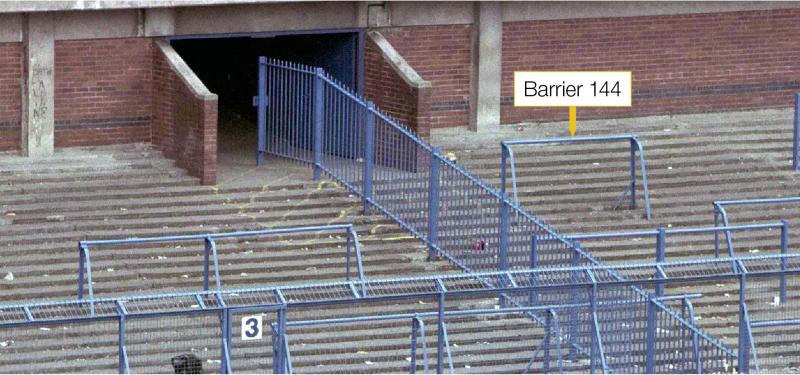
The primary cause of concern was barrier 144, a 7.625m-wide barrier consisting of three parts, located directly in front of the central tunnel. In evidence to the Taylor Inquiry in 1989, Insp Calvert explained that “the barrier was right across the entrance to the tunnel and the fans got to the barrier and stopped and we would have a build-up right back up the tunnel, fans would not move out and we could not control what was happening.”
He and some colleagues felt that the West Terrace would be safer if the crush barrier was removed, or at least partially removed. After discussion with senior officers, it was agreed to propose this at the next OWP meeting, where after initial reservations by some members, it was agreed to remove parts of barrier 144.
In a statement from 1990, the surveyor from South Yorkshire County Council (SYCC), who was part of the OWP, recalled this and said he had agreed with the proposal. However, he noted two key points. Firstly, he understood that the police would be present near the tunnel entrance and would work to keep the area clear of supporters. Secondly, he suggested marking out a ‘sterile area’ in front of the central tunnel mouth that should be kept clear of spectators at all times.
Two parts of the barrier were removed as proposed and yellow markings painted on the floor to mark the sterile area. These markings are just visible either side of the radial fence in figure 2H, which was taken after the disaster. However, no evidence has been found that either SYP or SWFC managed the sterile area at the 1989 FA Cup Semi-Final or took steps to prevent supporters standing there.
Image
Figure 2H: The location of barrier 144 and the central tunnel, April 1989 (Source: Philip Rich, SYP)
In his first report, Mr Cutlack commented: “Clearly, it was intended that the removal of part of barrier 144 was to have a beneficial effect on safety however in my opinion the reverse was true.” He explained that “The removal of this barrier created an un-obstructed path for a crowd surge in the tunnel” and added: “In my opinion EP [Eastwood & Partners] should have resisted this alteration and advised the Club and the Police of the likely implications of removing Barrier 144.”
On the day of the disaster, a crush barrier in Pen 3 collapsed. This has been identified as one of the key moments in the disaster. The evidence does not suggest that the removal of barrier 144 had any direct effect on the barrier that collapsed.
In his report, Mr Cutlack explained that during the crush, barrier 124A was subjected to a pressure greater than it had been designed to withstand, as a result of three factors:
crowd density
the depth of the crowd behind the barrier
the fact that barrier 136 (higher up the terrace) was substantially lower than recommended, resulting in the crowd behind this barrier exerting a greater forward pressure
However, he did not believe that the removal of barrier 144 could have had any impact on barrier 124A, because the additional pressure on barrier 124A came from an area outside of where barrier 144 had been.
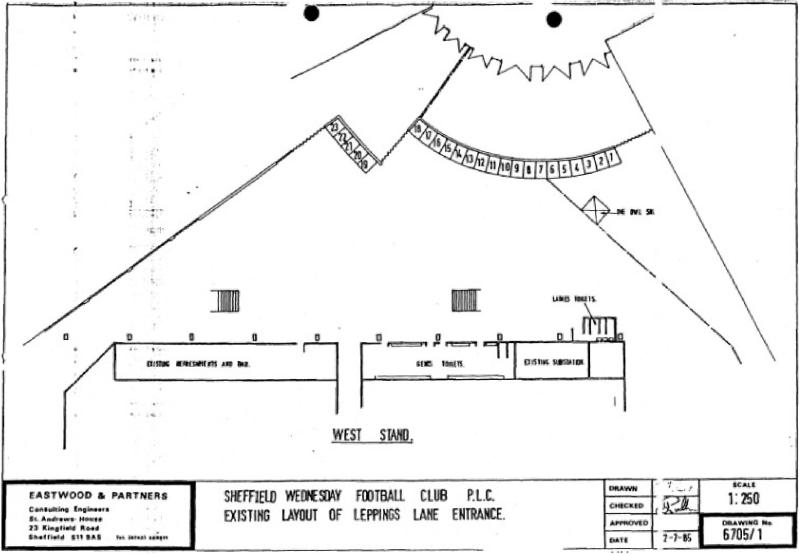
Around this same period, there was also discussion between SYP and SWFC about changing the turnstile configuration at the Leppings Lane end. This occurred after SWFC returned to the top division and had larger numbers of away supporters at its games. SYP found it harder to keep these away supporters segregated from the home supporters accessing the Leppings Lane turnstiles. Figure 2F shows the layout at the time, which required barriers to separate opposing supporters.
Image
Figure 2F: Drawing of Leppings Lane entrance layout as it was in 1985 (Source: Eastwood & Partners)
Inspector Clive Calvert (Insp Calvert), who regularly policed the Leppings Lane end in this period, proposed that the whole of the Leppings Lane turnstiles, which were then in a crescent shape, should be demolished and replaced with new ones parallel to and near the rear of the stand. These new turnstiles would then offer direct access to individual pens and to the stands—meaning opposing supporters could be separated earlier. They would also have separate toilets and food and drink facilities, to avoid potential conflict. Senior officers agreed that this proposal should be discussed with SWFC, and the main match commander at the time wrote to the SWFC Secretary, Richard Chester, setting out SYP’s suggestions.
Mr Chester discussed these with Dr Eastwood, and they agreed an alternative proposal, which would require less work but still offer complete segregation of opposing supporters. It involved adding six new turnstiles but not changing the entire layout.
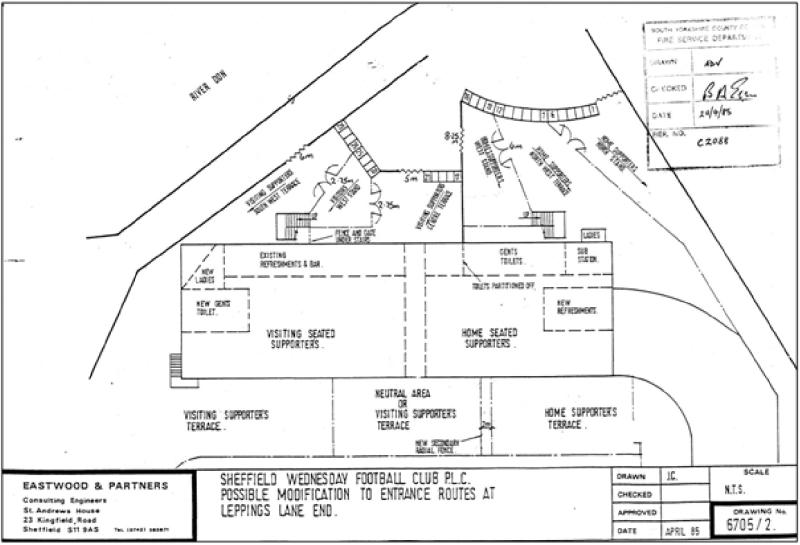
This was discussed further at an OWP meeting, and SYP accepted the proposals, subject to a few additional recommendations. The design was revised and by the end of April a clear plan was in place, as shown in figure 2G. This would have resulted in 30 turnstiles rather than the 23 which existed at the time. Each block of turnstiles was also clearly aligned with a specific area of the stadium; for example, on the far left, turnstiles 28 to 30 would have offered access only to the south pen of the West Terrace.
Image
Figure 2G: Drawing of proposed modification to Leppings Lane entrance (Source: Eastwood & Partners)
In his first report, Mr Cutlack commented that if this plan had been implemented “it is quite possible that the events of 15th April 1989 would not have occurred with the same consequence.” As well as having more turnstiles available, which would have made a crush outside less likely, he noted that the plan would have enabled better use to be made of turnstile count data. Because the banks of turnstiles would have been directly linked to specific areas, the data would have shown the numbers of spectators that had been admitted into each area. When an area reached capacity, the associated turnstiles would simply have been closed.
SWFC asked Dr Eastwood to provide an estimated cost for the work. At a board meeting on 2 May 1985, SWFC directors rejected the proposal as too expensive. A few days later, the Bradford fire occurred (see paragraph 2.8) in a wooden stand. Even before the investigation was complete, football clubs realised that they would need to fund fire safety improvements; SWFC was no exception.
There was further discussion between Eastwood & Partners and SWFC, and in August 1985, a revised plan was implemented. This involved no increase to the number of turnstiles but allocated each bank of turnstiles to a specific area of the stadium, to assist with segregation. Under this plan, there were seven turnstiles allocated to the terraces, eight to the North Stand and six to the West Stand.
Mr Cutlack commented that these alterations “resulted in it being more likely that over-crowding would occur outside the turnstiles because fewer turnstiles were allocated to the West Terrace.” He added: “This was reasonably foreseeable by any competent party.”
Once again, the changes to the turnstile layout should have resulted in a review of the Safety Certificate; they did not.