

2. Overall findings
During 2025/26, there were:
- 15 road traffic fatalities
- 4 fatal police shootings
- 27 deaths in or following police custody
- 67 apparent suicides following police custody
- 63 other deaths following police contact that were independently investigated by the IOPC
Demographic information about people who died is provided in the following chapters, along with details about the circumstances of their death and a summary of trend data. The appendix contains more information, such as the age, gender and ethnicity of those who died, and information about the police force or appropriate authority involved. (The appropriate authority is usually a chief officer or police and crime commissioner.)
Some of the investigations into the deaths recorded in this report are ongoing at the time of publication. Details about the nature and circumstances of these cases are based on information available at the point of analysis.
England and Wales were in lockdown owing to the coronavirus pandemic for a large part of 2020/21. At this stage, it is not possible to say with certainty what impact this had on the number or types of interactions that members of the public had with the police. Caution should be taken when comparing data from 2020/21 with previous and subsequent years.
Investigations
When we are informed about a fatality, we consider the circumstances of the case and decide whether an investigation is necessary. If we decide an investigation is necessary, we then choose the mode of investigation. We can decide to investigate the case independently, direct a police force to investigate the case under IOPC control, or decide that the case should be investigated locally by the police force.
Each police force has a professional standards department (PSD) or equivalent department, which oversees complaint handling and certain conduct matters. In some circumstances, we decide that the PSD is best placed to investigate a case locally.
Since February 2020, supervised and managed investigations were no longer available as a mode of investigation. A new type – ‘directed investigation’ – was created. Directed investigations take place under IOPC direction and control, but use police resources.
Box B below includes a description of each type of investigation.
Table 2.1 shows the type of investigation at the time of analysis for all incidents involving a fatality recorded in 2025/26. The figures show the number of incidents. An incident leading to a single investigation can involve more than one death, so the total number of incidents for some categories may be lower than the total fatalities presented above. In 2025/26, the IOPC independently investigated 103 incidents.
Table 2.1 no longer includes figures for supervised and managed investigations as all the fatalities in this report happened from April 2025 onwards. There were no directed investigations in any of the death categories.
| Type of investigation | Road traffic incident | Fatal shootings | Deaths in or following police custody | Apparent suicides following police custody | Other deaths following police contact* |
|---|---|---|---|---|---|
| Independent | 12 | 3 | 25 | 1 | 62 |
| Directed | 0 | 0 | 0 | 0 | 0 |
| Local | 0 | 0 | 2 | 15 | 0 |
| Back to force | 3 | 0 | 0 | 51 | 0 |
| Total incidents | 15 | 3 | 27 | 67 | 62 |
Note: Investigation type as recorded on the IOPC case system at the time of analysis.
*This category includes only cases subject to an independent investigation.
Trends
The figures in Table 2.2 show the number of fatalities across the different categories since 2015/16. It would not be meaningful to produce trend analysis across all five categories.
This is because of the wide variation in the circumstances and changes to how the category of ‘other deaths following police contact’ is defined.
| Fatalities | |||||||||||
|---|---|---|---|---|---|---|---|---|---|---|---|
| Financial Year | |||||||||||
| Category | 15/16 | 16/17 | 17/18 | 18/19 | 19/20 | 20/21 | 21/22 | 22/23 | 23/24 | 24/25 | 25/26 |
| Road traffic fatalities | 21 | 32 | 29 | 42 | 24 | 25 | 42~ | 28 | 32 | 26 | 15 |
| Fatal shootings | 3 | 6 | 4 | 3 | 3 | 1 | 2 | 3 | 2 | 2 | 4 |
| Deaths in or following police custody | 14 | 14 | 23 | 17 | 18 | 19 | 12~ | 23 | 25 | 18~ | 27 |
| Apparent suicides following custody | 61 | 56 | 57 | 63 | 54 | 55 | 57 | 54 | 68 | 61~ | 67 |
| Other deaths following police contact* | 106** | 131 | 178 | 156 | 107 | 97 | 113 | 92~ | 63~ | 53~ | 63 |
*Change in definition of ‘other deaths following contact’ in 2010/11 to include only cases subject to an independent investigation.
**Expansion of IOPC investigative resource and capacity to carry out more independent investigations into serious and sensitive matters. This has a direct impact on the number of ‘other contact deaths’ that are reported.
~This table presents the most up-to-date set of figures for these categories. Any changes to previously published data are indicated.
Figure 2.1 Incidents by type of death and financial year, 2015/16 to 2025/26
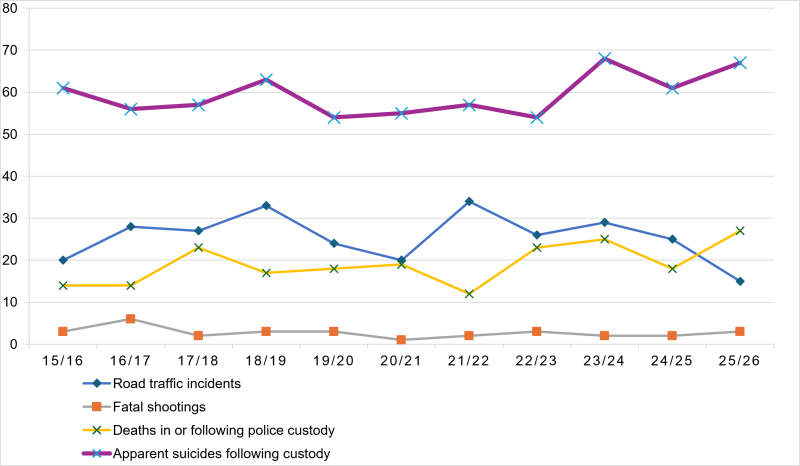
The number of fatal road traffic incidents (RTIs) has decreased this year, with 15 incidents, compared to 25 last year. This is lower than the average of 26 incidents recorded over the 11-year period since 2015/16. These figures are subject to fluctuation and, therefore, year-on-year comparisons should be approached with caution.
This year there were four fatal police shootings, compared to two recorded last year. This is higher than the average of three fatal shootings recorded since 2015/16.
The number of deaths in or following police custody has increased over the last year from 18 to 27. Over time, there have been some fluctuations in this category, with notable increases recorded in 2014/15, 2017/18 and 2022/23. The 2025/26 figure is higher than the average of 19 deaths over the 11-year period.
The number of recorded apparent suicides following custody was 67, higher than the 61 fatalities recorded last year. The number of deaths in this category remain higher than the average number recorded over the years before 2012/13, when there was a notable increase. The number is higher than the average of 59 deaths reported over the 11-year period. Reporting of these deaths relies on police forces making the link between a person’s apparent suicide and them being recently in custody. The overall increase in these deaths over the period since 2014/15, may be influenced by improved identification and referral of such cases.
The category of ‘other deaths following police contact’ is not included in Figure 2.1. The inclusion of a death in this category depends on whether we decide to conduct an independent investigation into the circumstances surrounding it. The criteria for making this decision may vary over time – for example, in response to public and community concerns. In 2015/16 our capacity to carry out independent investigations increased, which had a direct impact on the number of deaths reported in this category. (See our Corporate plan 2015-18 and Strategic plan 2018-22 for more information.) This means trend analysis of deaths recorded in this category would not be meaningful.
Figures on all fatal incidents (as distinct from fatalities) are provided in Table A1 in the appendix. The appendix also includes data on:
- ethnicity
- age
- gender
- police force
- category of death
We have published annual statistics on deaths during or following police contact since 2004/05. Previous reports and time series data are available here.
Box B Types of investigation
Independent investigations are carried out by the IOPC’s own investigators. IOPC investigators have all the powers of the police in an independent investigation.
Directed investigations are IOPC investigations that are carried out using police resources. The IOPC sets the terms of reference for the investigation and directs the course of enquiries. At the end of the investigation, the police investigator submits the investigation report to the IOPC for review.
Local investigations are carried out by the police force. In death and serious injury cases, the force sends the report to the IOPC for review at the end of the investigation.
Referred back to force indicates cases where the IOPC has reviewed the circumstances and returned the matter back to the police force to deal with as it considers appropriate.